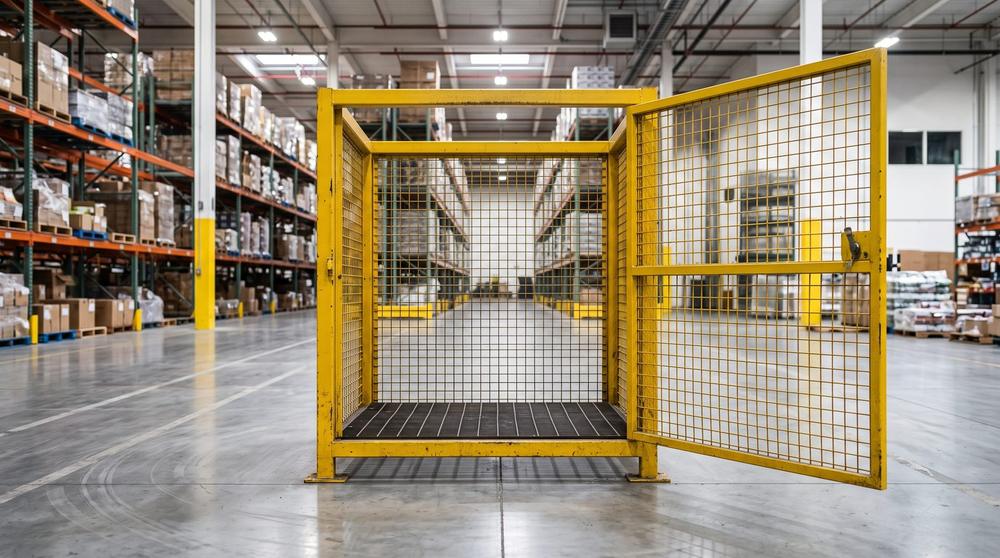
Agility Robotics released Digit 5 today. The headline feature is an absence: the robot no longer needs a fence around it.
Digit 4 ran inside a cage. Digit 5 is built to work alongside people without physical barriers, using added sensors and collision-avoidance software to detect a human nearby and stop moving — or sit down — rather than route around them. The hardware improved too: payload rises from roughly 16kg to about 23kg, with a 90-minute battery that recharges in nine.
The payload number is the one the robotics press will quote. The fence is the one that decides whether this is a business.
Why the cage is the cost
A caged robot is a machine you design a building around. It needs guarded floor space, interlocks, a safety assessment, and a workflow that hands material across a boundary. That integration work is frequently more expensive than the robot, and it is why humanoid pilots have a habit of staying pilots — each new site is a new construction project rather than a copy-paste.
Take the fence away and the unit of sale changes from “a cell” to “a worker.” You drop it into an existing aisle. That is the claim Agility is making, and it is making it with some evidence: Digit is running commercially at customers including Schaeffler, GXO and Toyota Motor Manufacturing Canada, with more than 65,000 hours of operation accumulated across nine customer facilities.
The order book reflects the bet. Agility reports more than $300 million in multi-year orders for Digit 5, subject to contractual milestones, against a pipeline of over 30 customers. The company is going public via a $2.5 billion SPAC merger with Churchill Capital Corp XI, which would make it the first pure-play humanoid robotics company listed in the US.
Our take: Read “subject to the realization of certain contractual milestones” twice. A $300m order book with milestone conditions attached is a pipeline with a press release around it, and the milestones are exactly the thing an unfenced humanoid has not yet proven at scale — uptime, safety record, and cost per hour against a human doing the same tote. Sixty-five thousand hours across nine sites is real operating data and also, spread across nine facilities, roughly one shift-year each. The cage removal is the right product decision. The SPAC is the part that needs the milestones to land on schedule.
What to watch
- Conversion of the $300m. Milestone-conditioned orders become revenue or they do not. The first two quarters as a public company will show which.
- Deployment time per site. If the no-fence claim holds, time-to-first-productive-hour at a new customer should collapse. That metric, not payload, is the moat.
- A safety incident. One serious one at any unfenced humanoid vendor re-regulates the whole category, and the regulator will not distinguish between manufacturers.
- Labour response. Unfenced humanoids in logistics and auto plants land in workplaces that have spent 2026 negotiating hard. This will appear in a contract fight before it appears in a policy paper.
The humanoid sector has spent three years selling motion. The thing that turns it into a business is boring: how fast you can install one, and what it costs when it stops.