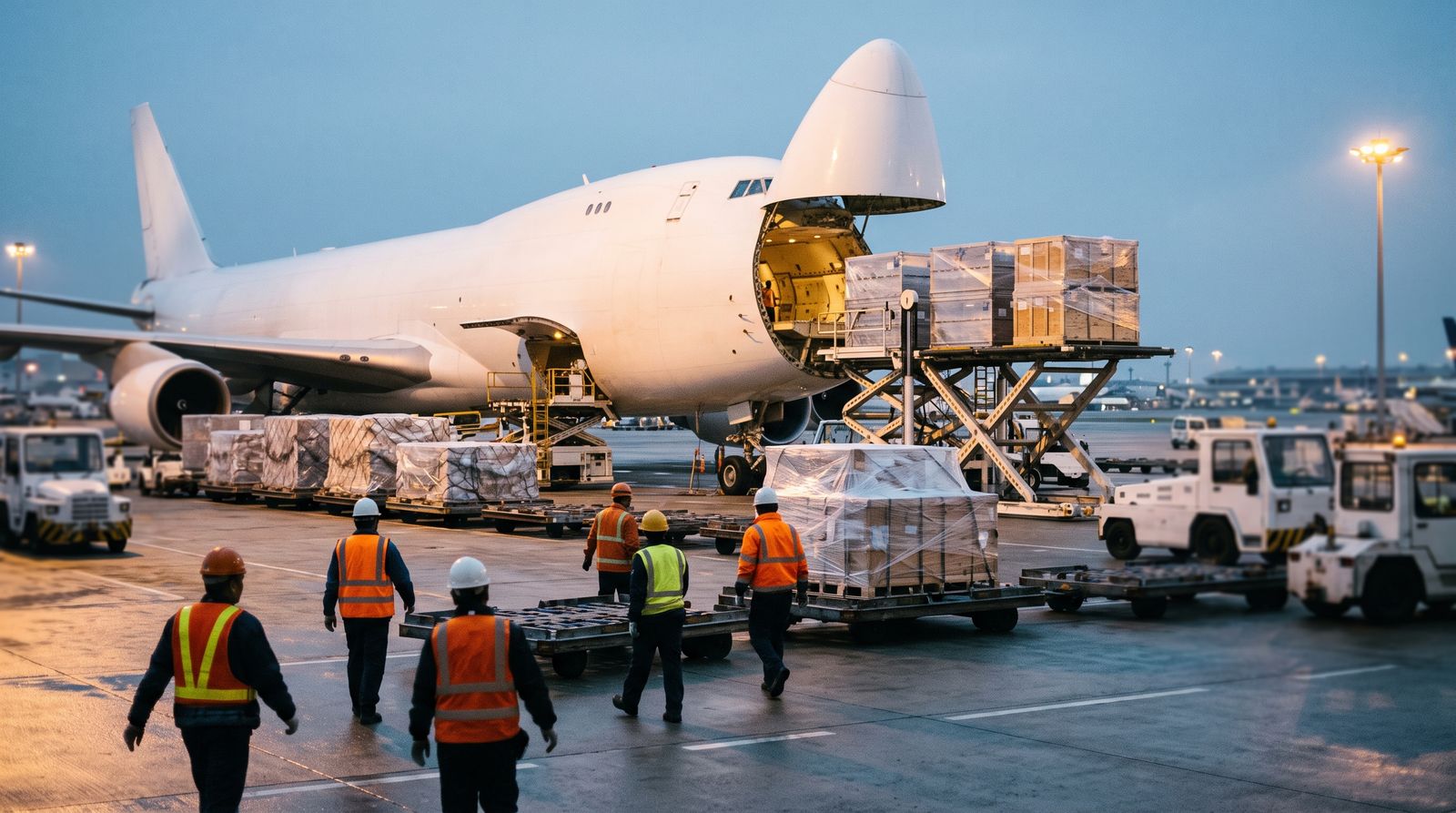
Korean Air’s second quarter had two numbers pointing in opposite directions. Total revenue cleared 5 trillion won for the first time — a record, up roughly 26% — while operating profit fell about 34% to 261.8 billion won as fuel costs bit. The line doing the lifting was cargo: 1.54 trillion won, up about 46% year over year, on semiconductors, server racks and data-centre hardware, plus a healthy assist from Korean beauty exports.
That is not a one-airline anomaly. It is the visible edge of a swap that has been building all year across Asian air freight, and it became the subject of a Reuters analysis published this morning: the AI buildout has displaced cross-border e-commerce as the region’s cargo growth engine. Carriers are redrawing route networks around chip fabs and assembly hubs instead of parcel warehouses.
Niall van de Wouw, chief airfreight officer at the rate benchmarking firm Xeneta, put it plainly: “E-commerce was air freight’s single biggest growth pillar, but that is no longer the case.”
The parcel side has been shrinking on its own schedule. China’s low-value and e-commerce exports fell 7% year over year in May — a sixth consecutive monthly decline. On 1 July the European Union scrapped its 150-euro duty-free threshold for low-value imports, replacing it with a flat 3-euro duty per item, with a further 2-euro handling fee expected in November. The cheap-parcel trade that filled belly space for five years is being taxed and tightened at both ends.
The capacity math
What replaced it is heavier, more valuable and far more fragile. AI shipments move complete server racks, graphics processors and semiconductor manufacturing equipment — freight that needs different handling than a pallet of fast fashion. Taiwan’s Taipei transit hub, the main consolidation point for US-bound high-tech cargo, filled to capacity in July, leaving space tight both transpacific and within Asia. EVA Airways says AI-related shipments now account for as much as half of its cargo revenue.
Rates show the squeeze. Asia-Pacific to US spot pricing sat at $6.68 per kilo in the first full week of July, down just 2% week on week but 37% above the same week a year earlier. Xeneta has now inverted its own outlook: long-term rates it once expected to fall 5–10% across 2026 are forecast to rise 5–15%, with the February escalation in the Middle East as the immediate shock and AI freight holding the floor under it.
Our take: AI capex gets argued about on earnings calls, where backlogs are slides and commitments are letters of intent. Freight rates don’t argue. A parcel boom is a demand story that can evaporate in a quarter; multi-year memory and processor orders feeding committed data-centre construction is a delivery schedule. When an airline rebuilds its network around fabs, it is putting aircraft financing behind the view that the buildout is real for years, not quarters. That is a harder signal to fake than a backlog number — and a more expensive one to be wrong about.
What to watch
- Hyperscaler capex guidance. Microsoft reports fiscal Q4 after today’s close, Amazon on Thursday. Capex commitments set freight demand two to three quarters out, not this week’s tonnage.
- Whether transpacific spot holds above $6 per kilo into peak season, when e-commerce would historically claw capacity back. If it holds, the swap is structural rather than seasonal.
- The EU’s 2-euro handling fee, expected in November — one more squeeze on the parcel volumes carriers are actively replacing.
- Fuel. Korean Air expects cargo demand to persist through the second half. Its profit problem this quarter wasn’t demand, it was the price of jet fuel, and that arithmetic applies to every carrier chasing this freight.