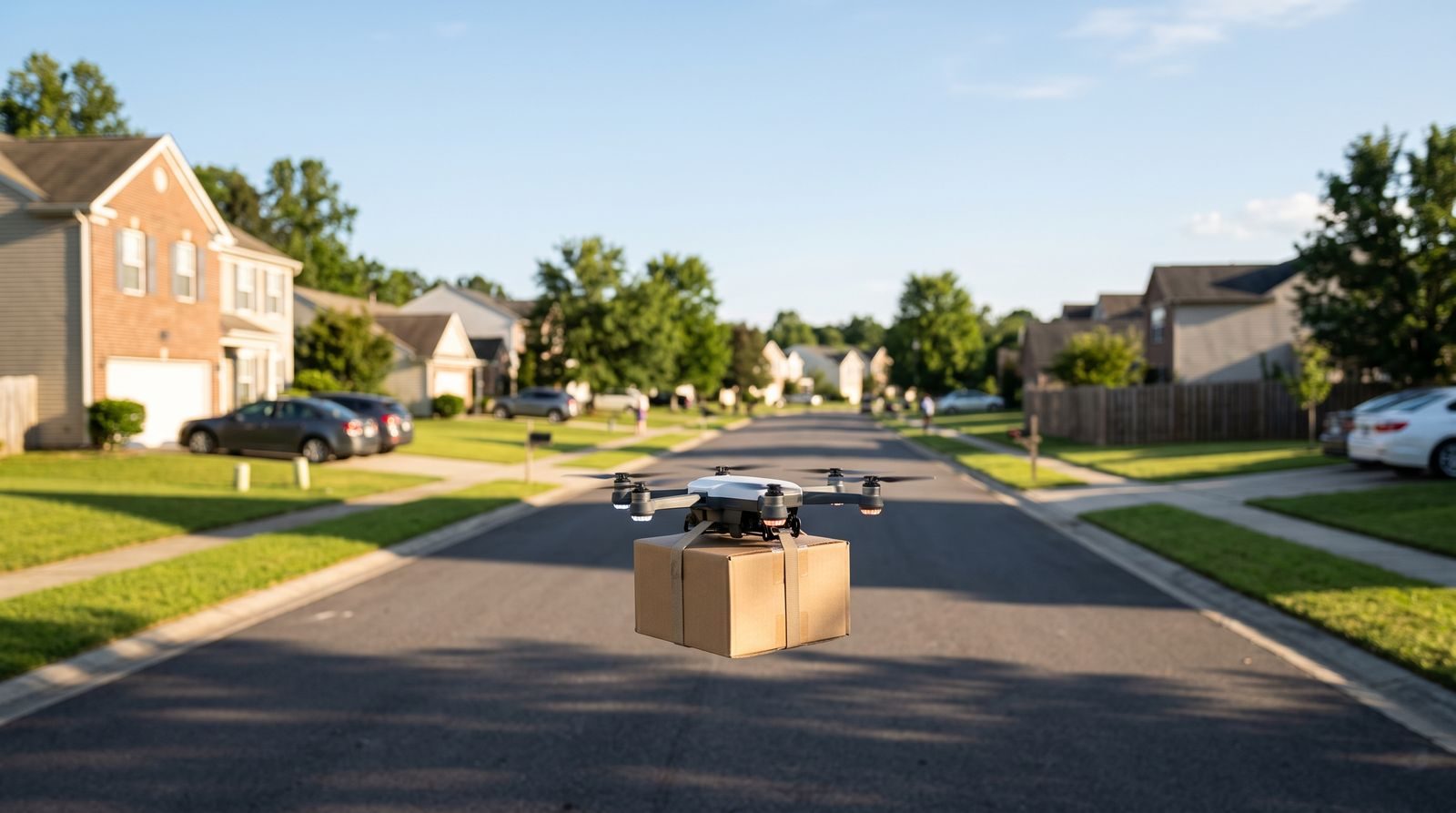
Amazon said on Wednesday it will expand Prime Air drone delivery to nearly 500 US cities and towns by the end of 2026 — roughly a sixfold increase on its current footprint. The service runs today in 11 metro areas across seven states: Arizona, Florida, Kansas, Louisiana, Michigan, Nebraska and Texas. Each site covers about 175 square miles.
The headline number is the map. The number that actually changes something is $2.99.
That is what a Prime member pays for a drone delivery on an order under $50. Over $50, it is free. Non-members pay $4.99. Packages go up to five pounds — which Amazon says covers more than 60% of frequently purchased items — and arrive in as little as 30 minutes.
The threshold is the product
Drone delivery has been a demo for a decade. What Amazon just published is a price list, and price lists are where logistics experiments turn into unit economics. The $50 line is a basket-size lever pointed straight at the category Amazon has always lost: the small, urgent, one-item purchase that people currently walk into a pharmacy or a hardware store to get.
A shopper who wants one $9 item in 30 minutes now has two options at Amazon: pay $2.99, or add $41 of something else. Both outcomes are good for Amazon. That is the whole design.
Scale is arriving fast enough to matter. Amazon has made hundreds of thousands of drone deliveries so far this year and completes thousands daily; a company executive told CNBC that Prime Air is targeting one million deliveries in 2026. Near-term launches include Tolleson, Arizona; Ruskin, Florida; Kansas City, Kansas; Papillion, Nebraska; Baton Rouge, Louisiana; Hazel Park and Pontiac, Michigan; and Richmond, San Antonio, Richardson and Waco, Texas — with the Chicago, Atlanta, Cleveland, Syracuse and Boise metros to follow.
The regulatory moat is the real asset
The reason competitors cannot simply copy the price sheet is paperwork. Prime Air holds FAA Part 135 certification — the same framework used for commercial air carriers, and the highest level of oversight applied to drone delivery. In 2024 the FAA granted Amazon a waiver to fly beyond the visual line of sight of its operators, which is the difference between a pilot per drone and a fleet per operator. That waiver is the cost structure.
Our take: Ignore the drone. Amazon has spent a decade buying two things that are hard to buy: a regulatory position that lets one operator run many aircraft, and a delivery slot no one else can price. The 500-city map is the moment that stops being R&D spend and starts being a line item with a margin attached. Watch whether the $50 threshold moves — if Amazon lowers it, the economics are working; if it rises, they are not.
The expansion is not friction-free. In October 2025 two Amazon drones collided with a crane in Tolleson, Arizona. The FAA opened a separate investigation after a drone struck and severed an internet cable in Waco, Texas. Both are places on the new launch list. A sixfold footprint increase is also a sixfold increase in the surface area for that kind of incident, and drone delivery’s regulatory position is precisely the sort of asset a bad month can dent.
What to watch
- The $50 threshold. Movement in either direction is the clearest public signal of whether the per-delivery cost is beating the per-delivery revenue.
- Whether the one-million-delivery target lands. Thousands a day gets you to roughly 1–1.5 million a year only if the new sites ramp immediately rather than sitting idle through permitting.
- FAA posture after the next incident. The BVLOS waiver is the whole advantage; a suspension is a bigger risk to this business than any competitor.
- Ground-network response. UPS and FedEx have no equivalent price point for a five-pound, 30-minute delivery — and Amazon has already spent two years reducing what it hands them.