Amazon’s third quarter was, on the income statement, the best in the company’s history. Net sales of $201.9 billion, up 12%. Operating income of $28.1 billion against $17.4 billion a year ago. A 13.9% operating margin the company calls its highest ever. AWS revenue of $46.0 billion, up 39% — an acceleration, not a fade — carrying $17.8 billion of operating income on its own.
Then there is the cash flow statement, which tells a different story about the same three months. Free cash flow over the trailing twelve months was an outflow of $42.4 billion, against an inflow of $14.8 billion a year earlier. Purchases of property and equipment in the quarter alone came to $77.3 billion, against $35.1 billion in the same quarter last year. And Amazon raised $48.1 billion of long-term debt in the quarter, against nothing at all in the third quarter of 2025.
Long-term debt on the balance sheet stood at $173.1 billion at the end of September. On the last day of December it was $65.6 billion. Amazon has added roughly $107 billion of long-term borrowing in nine months.
The margin and the borrowing are the same story
It is tempting to read these as two unrelated facts: a great operating quarter, and a separate financing decision. They are one fact. The 13.9% margin is what the existing fleet earns. The $77.3 billion of quarterly capex is what the next fleet costs. Amazon is telling you that the return on installed capacity is high enough to justify building the next tranche faster than operations can fund it.
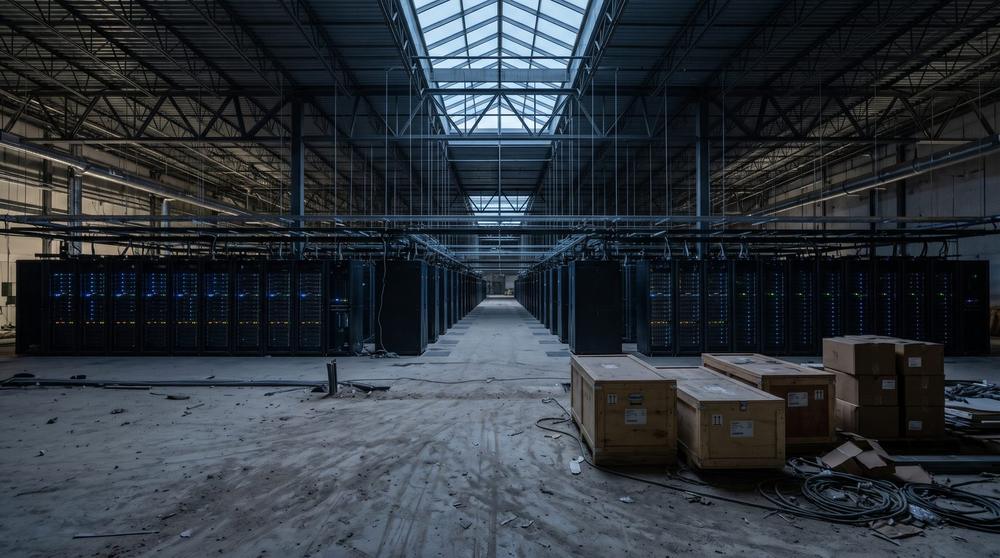
The company reiterated roughly $220 billion of 2026 cash capital expenditure — a figure it has held steady rather than raised. Andy Jassy put a number on what it is buying: AWS growth above 39% now, and “projected revenue growth rates of over 40% both in 2027 and in 2028.” Amazon attributes the free-cash-flow swing directly to a $94.8 billion year-on-year increase in property and equipment purchases, which it says “primarily reflects investments in artificial intelligence.”
Note also that reported net income fell, to $20.7 billion from $21.2 billion, and diluted EPS to $1.89 from $1.95. That is not operational. Last year’s quarter carried $9.5 billion of pre-tax gains from Amazon’s Anthropic stake sitting in non-operating income. Strip the comparison back to operations and the quarter improved by more than 60%.
Our take: The bear case on hyperscaler capex has always been “they are spending into demand that may not show up.” AWS accelerating to 39% with a $184 billion run rate is the strongest counter anyone has offered this cycle. But the financing has changed character. For twenty years Amazon funded its own expansion out of operations. This quarter it funded a third of a year’s capex with a single debt raise. That is a rational choice at these returns — and it is also the first time the AI build has shown up as leverage rather than as retained earnings.
What to watch
- Q4 guidance: net sales of $240.0–247.0 billion, 12% to 16% growth, and operating income of $28.5–33.5 billion against $25.0 billion last year. The low end of that income range is barely above the quarter just reported.
- Whether the $220 billion holds. Amazon has now kept the 2026 figure steady through two prints. A raise in January would say demand is still outrunning the plan; it would also extend the cash-flow gap.
- The debt cadence. $48.1 billion in one quarter, $115.1 billion over nine months. A fourth-quarter raise of similar size would put long-term debt past $200 billion.
- Advertising, guided to grow “in the high teens” in Q4 — the highest-margin line Amazon has, and the one that quietly pays for a lot of concrete.
The number to hold onto is not the margin and not the debt. It is the gap: $28.1 billion of quarterly operating income against $77.3 billion of quarterly capex. Amazon is spending roughly $2.75 of capital for every $1 it earns from operations, and has decided that is the right trade. The next four quarters will say whether it was.