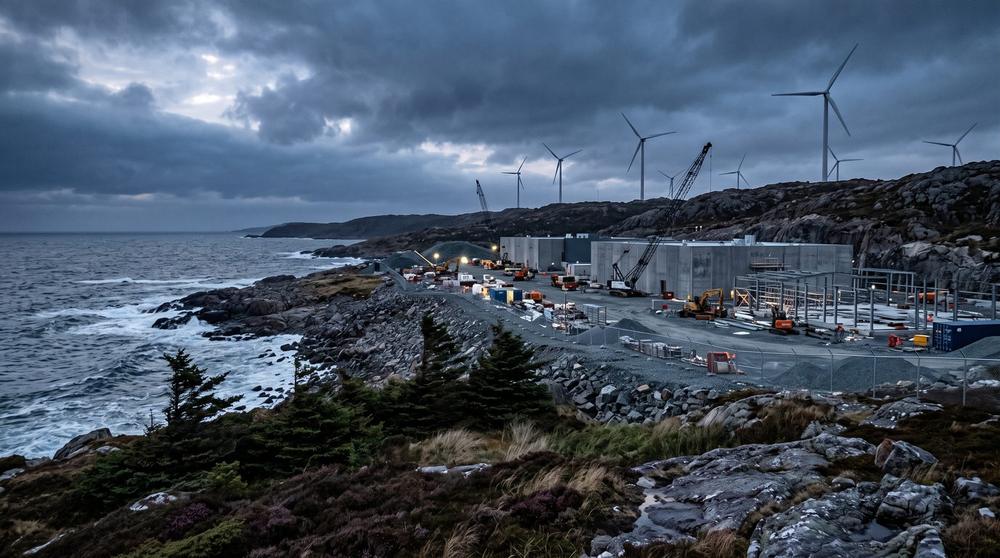
Anthropic has signed a long-term lease for data centre capacity at EverWind Fuels’ Point Tupper site near Port Hawkesbury, Nova Scotia — its first data centre agreement in Canada. EverWind announced the campus on Friday with a “leading AI company” as anchor tenant; Anthropic confirmed it was the tenant on Friday evening.
The numbers EverWind published: about $10 billion of private investment, split roughly $8 billion to develop, build, own and finance the data centre and $2 billion for onshore wind. The first phase is 95 megawatts starting late 2027. An expansion to 325 MW is targeted for 2028 subject to regulatory conditions, for a 420 MW full build, plus several hundred megawatt-hours of battery storage. EverWind says it will fund the electricity infrastructure itself so the cost is not passed to Nova Scotia ratepayers.
Cooling is closed-loop — a sealed water-glycol mixture, with air as the primary method and water-assisted cooling only in the hottest weather. EverWind puts phase-one consumption at about 100,000 litres a day, comparable to a large shopping mall, rising to roughly 500,000 litres a day at full build. The project is forecast to create about 2,000 construction jobs and 215 permanent positions, and more than $400 million in municipal tax revenue across the lives of the data centre and the wind projects. Negotiations are underway with a First Nations consortium led by Membertou Development Corporation over a possible ownership stake.
Our take: Four hundred and twenty megawatts is not a frontier-scale campus — single US AI sites are being permitted at two and three times that. What is notable here is the structure, because it is the structure that gets these things built in a jurisdiction that was saying no eighteen months ago. The developer funds the grid upgrades rather than socialising them. The water figure is published up front and small, because the cooling loop is sealed. The host First Nation is being offered equity, not a consultation. Premier Tim Houston had said in June he would only pursue data centres if the province could fully supply the power; what changed is not the power, it is who is paying for it. Expect every subsequent North American proposal in a power-constrained province or state to copy this term sheet. Note also what Anthropic did: it leased. No capex, no 20-year asset on its own balance sheet, the counterparty carrying the construction risk — which is the same asset-light posture visible in its first public credit rating last week.
Late 2027 is the number that matters
Read this as a 2028 compute story, not a 2027 one. Phase one does not energise until late next year, and the step up to 325 MW is explicitly conditional on regulatory approval. In a market where compute claims are being made a quarter at a time, a megawatt announced today and delivered in fourteen months is a statement about capital commitment, not about capacity.
Nova Scotia’s interest is the mirror image. “Canada doesn’t have enough compute power,” Houston said — a sovereignty argument, and the reason the province is tolerating an industrial load it had previously ruled out. Ottawa announced $100 million on Thursday to advance the Wind West offshore project, which is the same thesis with a different timeline.
What to watch
- The regulatory condition on 325 MW. That clause is where this either becomes a 420 MW campus or stays a 95 MW one. Watch the provincial approval process, not the press release.
- Whether the Membertou consortium takes equity. An ownership stake rather than a benefits agreement is the precedent other developers will be asked to match.
- Ratepayer protection in writing. “EverWind will fund it” needs to survive into a filed interconnection agreement. The NDP’s objection — that a private company will act in its own interest — is answered by the contract, not the quote.
- Lease length and escalators, if they surface. A long-dated power-linked lease is a fixed cost for Anthropic in a market where inference prices keep falling.
- Replication. If a second province or a US state announces a developer-funded-grid deal within two quarters, this was the template.
For the general version of the question — how to read any capacity announcement for the difference between committed and conditional — see our capacity announcement playbook.