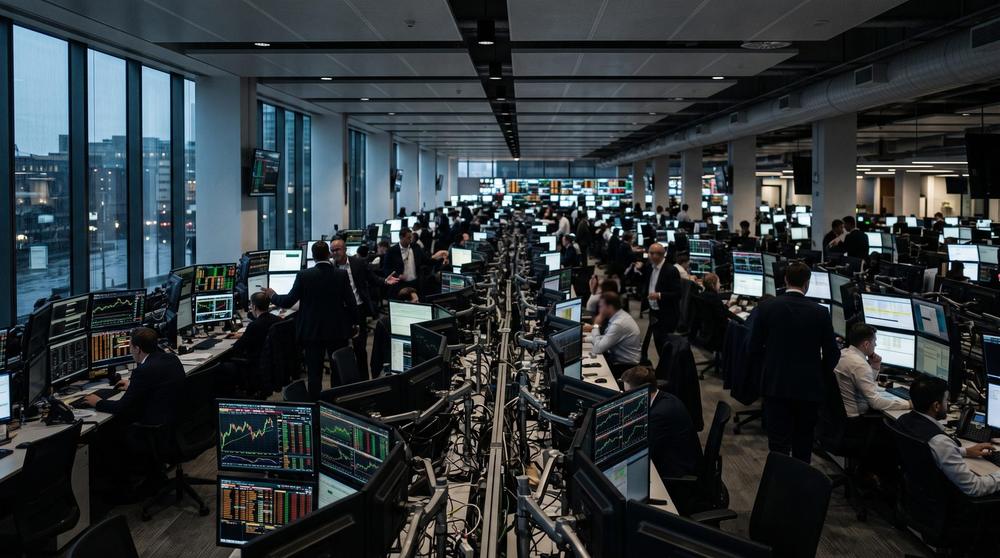
The first morning of bank earnings season landed, and it split cleanly down one line: the trading floors delivered, and almost everything attached to lending did not.
Goldman Sachs reported third-quarter earnings of $17.01 a share against roughly $13 expected, up from $12.25 a year ago, with net profit of $5.29bn versus $4.10bn and an annualised return on common equity of 18.7%. Equities revenue was $6.44bn, up 72% and well clear of the $5.09bn consensus. Fixed income, currencies and commodities came in at $3.47bn, roughly flat year on year and short of the $3.72bn expected. Investment banking fees were $3.22bn, up 21%. The stock ran more than 4% pre-market and held about +1.4% into the early session.
JPMorgan went the other way on the headline. Net revenue of $50.2bn was up 8% from $46.4bn and net income of $15.3bn was up 6%, but earnings per share of $5.57 missed the $5.90 consensus — $5.75 excluding $658m of pretax losses on investment securities. The same pattern as Goldman sat underneath: equities revenue $4.95bn, up 49% and above the $4.47bn expected, against fixed income of $5.37bn, down 4% and more than $600m light. The bank raised its 2026 net interest income outlook to about $106.2bn. Shares were up around 1.2%.
The two that tell you what is actually happening
- Wells Fargo beat on earnings and missed on everything that explains them: EPS of $1.87, up 13% and two cents ahead, on revenue of $21.87bn against $22.31bn expected, with net interest income of $12.52bn against $12.59bn expected. Equities revenue rose 21%; fixed income fell 7%. CEO Charlie Scharf said growth was “partially offset by lower revenue from our venture capital investments.” The stock fell about 1.2% on an EPS beat.
- Citigroup was the clean one: net income $5.2bn, EPS $2.85 against $2.65 expected, revenue $23.8bn against $23.72bn. Fixed income brought in $4.4bn — its best third quarter in at least a decade, and the only FICC desk of the four that beat.
The tape around them was not a bank story at all. The Dow was up about 300 points, or 0.6%, while the S&P 500 slipped 0.1% and the Nasdaq Composite fell 0.4%, because semiconductors were selling off again: Micron down 5.8%, AMD down 3.3%, Nvidia and Broadcom down 1.3% each, after Samsung Electronics fell 7.4% and SK Hynix 10% in Seoul and the Kospi closed down 5.5%. The ten-year Treasury finally reopened and eased to 5.20% from 5.24% late Friday. Brent fell 1.3% to $105.22.
Our take: Strip the names off and this is a quarter of brokerage results wearing bank jackets. Equities trading was up 72% at Goldman and 49% at JPMorgan, and in both cases fixed income missed — so the beat came from volatility in stocks, which is the least repeatable revenue line a bank has. Meanwhile the one number that should benefit from a 5.20% ten-year is the one that disappointed: Wells Fargo missed on net interest income and got sold on an EPS beat, which tells you the market is already marking the lending franchise rather than the quarter. JPMorgan raising its NII outlook to $106.2bn is the genuinely useful disclosure here, and it is the only forward number of the morning. Note too that Dimon paired “strong business investment and ongoing consumer spending” with the observation that client activity “did moderate somewhat during the quarter” — two sentences that do not point the same direction.
What to watch
- Whether any FICC desk other than Citi’s beats as the rest of the group reports. Three misses out of four is a trend, not a quirk.
- Net interest income guidance, not net interest income. JPMorgan moved its 2026 number up; Wells missed its quarter. The spread between those two postures is the real read on deposit costs at these yields.
- Credit provisions, which none of the morning’s releases put front and centre — usually a sign the number is unremarkable, occasionally a sign it is buried.
- The semis, which are now the market. A bank-earnings beat that still leaves the Nasdaq down 0.4% means the index is being priced off Seoul, not off Wall Street.