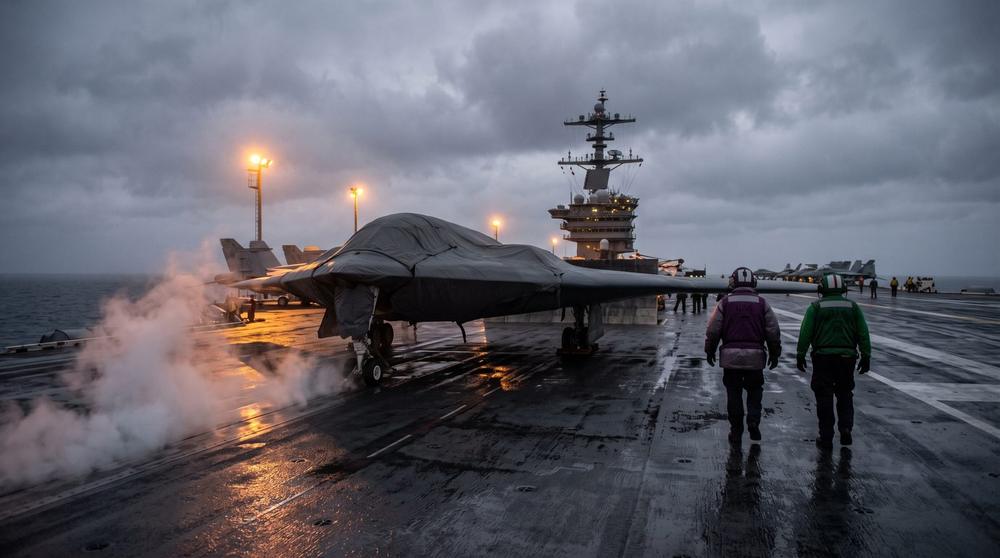
The US Navy awarded Boeing a full-scale development contract worth more than $20 billion on Wednesday to build the F/A-XX, the sixth-generation fighter meant to operate from carrier decks. The award covers systems and weapons integration testing and the procurement of multiple test aircraft for ground and airworthiness work. The jet is intended to augment and eventually replace the F/A-18E/F Super Hornet and EA-18G Growler fleets starting in the 2030s.
Northrop Grumman was the only bidder left standing against it. Northrop pitched a clean-sheet design and made the concentration argument out loud: a company already building one sixth-generation fighter should not be asked to build a second one at the same time. Lockheed Martin was eliminated from the competition back in March 2025. Acting Secretary of the Navy Hung Cao called the aircraft “a generational leap in air superiority.” Boeing’s reply to the parallel-programs question was blunter: “Delivering two advanced fighters in parallel was always our plan, and we invested accordingly.”
Boeing shares rose roughly 3%. Northrop fell around 3.5%.
Congress kept this program alive, not the Pentagon
F/A-XX came close to not existing. The Pentagon wanted to concentrate sixth-generation money on the Air Force’s F-47, and it was Congress that forced the Navy programme back onto the books — $750 million inside the 2025 tax-and-spending law, then a further $1.4 billion appropriated for fiscal 2026. The Navy’s justification has been the spread of advanced air-defence systems out of China and Russia and, increasingly, Iran: range and survivability off a carrier deck are the capability it says it cannot buy any other way.
That history matters for a reason that has nothing to do with aviation. A programme revived by appropriators rather than requested by the department is a programme whose funding line gets re-litigated every single budget cycle. Boeing has just signed up to a decade of development on money that Congress has already had to defend once.
One prime, two sixth-generation fighters
With this award, a single contractor holds both American sixth-generation fighter programmes. Boeing has said its F/A-XX design shares substantial commonality with the F-47, and it has expanded its St. Louis facilities in a way widely understood to serve both. Commonality is a genuine cost argument. It is also the definition of a correlated failure: a supply-chain problem, a design flaw or an engineering-talent shortage now lands on two programmes at once, and there is no second source for a sixth-generation fighter to switch to.
Our take: The number that decides whether this is good news for Boeing is not $20 billion — it is the contract type, and nobody has published it. Boeing’s defence unit spent years absorbing charges on fixed-price development programmes it bid aggressively and then had to finish at its own expense. Cost-plus development puts the overrun risk on the taxpayer; fixed-price puts it on Boeing’s balance sheet. Until the structure is disclosed, the headline tells you about the Navy’s ambition, not about Boeing’s margin. Treat the share move as a vote on revenue, not on profit.
What to watch
- A Northrop protest. None had been reported as of Wednesday. A company that argues the concentration case publicly before an award usually has the paperwork drafted for after it.
- The contract structure in the detailed Pentagon announcement — cost-plus or fixed-price, and where the fee sits. This is the single most informative disclosure still outstanding.
- St. Louis throughput. Two clean-sheet fighter programmes on one campus is an industrial-capacity question before it is an engineering one. Watch hiring and floor-space announcements, not press releases.
- Whether the 2030s delivery window survives the next two budget cycles. Programmes that Congress had to rescue once tend to need rescuing again.
The Navy got the aircraft it fought for. What it also got is a fighter industrial base with one door in it.