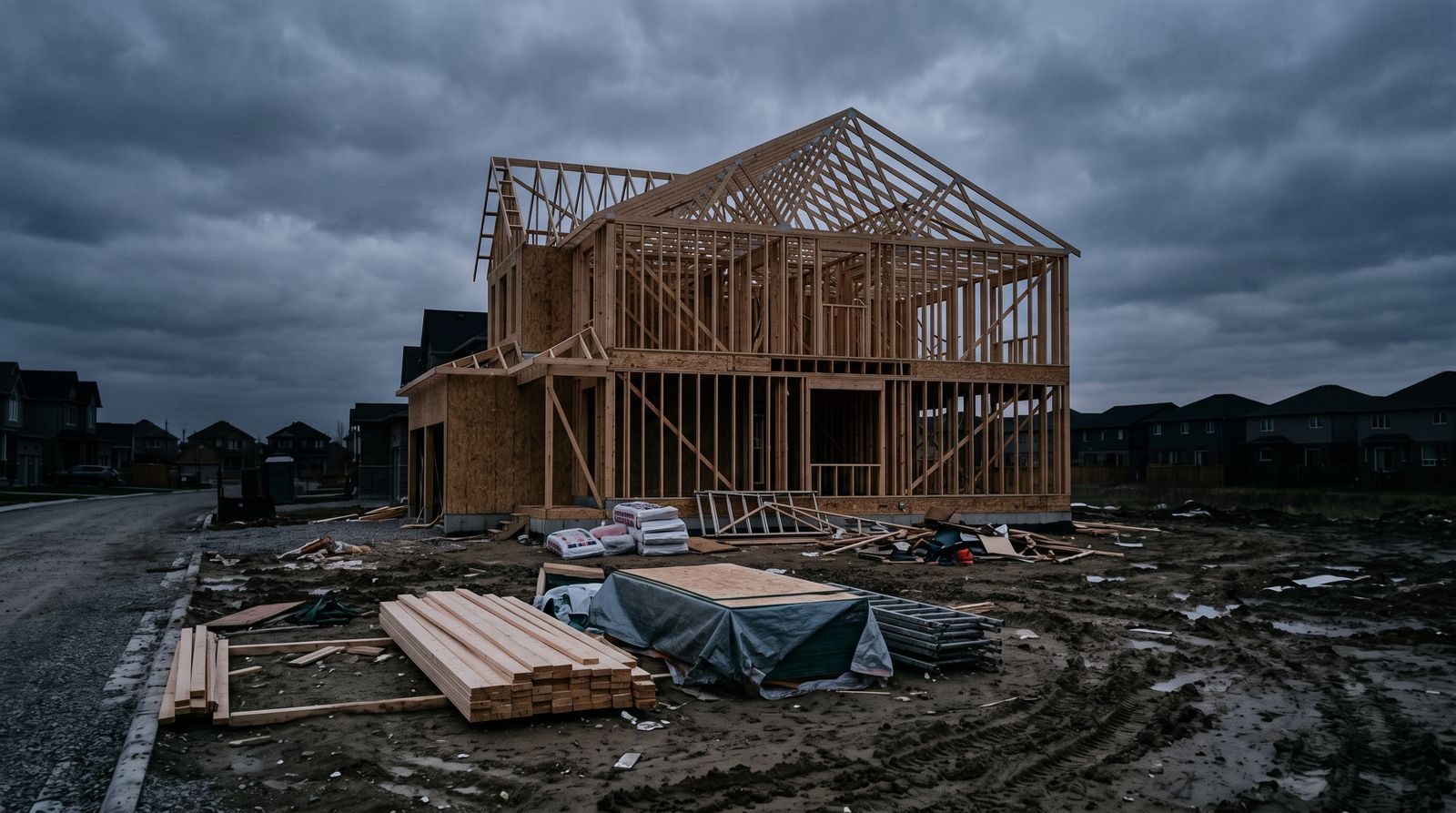
Homebuilder sentiment went up in August, and that counts as the good news. The NAHB/Wells Fargo Housing Market Index rose one point to 35, from 34 in July. Economists had expected it to fall to 33. On the headline, a beat.
Underneath, the survey is a portrait of an industry buying its own demand. August was the 16th consecutive month in which at least 30% of builders reported cutting prices to move product. It was also the 16th consecutive month with the index below 40, and the index has not printed above 50 — the line where more builders call conditions good than poor — since May 2024. Two years of a market that only clears with a discount attached.
The components tell you where the movement came from. Present sales conditions rose two points to 39. Expectations for future sales held flat at 43. Prospective buyer traffic held flat at 23. Builders feel slightly better about the houses they are selling right now and no better at all about the people walking through the door. “Our latest builder survey continues to show signs of weakness in the home building market,” NAHB chief economist Robert Dietz said.
A discount is not a recovery
A price cut is a builder converting margin into volume. One quarter of that is a promotion. Sixteen months of it is the business model. And it is showing up downstream: Zillow cut just over 500 jobs earlier this month — about 7% of staff, its second round this year — with the company pointing to a housing market that is essentially flat. Retail sales fell 0.6% in July, the sharpest monthly pullback in more than a year, against forecasts of a gain.
Within the survey there is also a split worth noticing. Custom builders report better conditions than spec builders. Smaller, less dense markets are outperforming large metros. Smaller builders are doing better than large ones. That is the signature of a market where demand still exists at the top end and in the places where land is cheap, and thins out everywhere the volume actually is.
Our take: Ignore the one-point beat. The durable signal is the price-cut streak, because it is the only line in the survey that costs a builder real money to report. Sentiment indices are opinions; discounts are decisions. Sixteen months of decisions says the industry has stopped waiting for demand to return on its own and started paying to manufacture it — which caps margins across the whole housing chain until affordability, not rates alone, moves.
What to watch
- Home Depot, Tuesday morning. The first big-box read, landing days after a leadership reshuffle. Watch the comp on big-ticket remodel categories rather than headline EPS — that line tracks the renovation cycle, which moves with home turnover.
- Target Wednesday, Walmart Thursday. After July’s retail miss, these are the cleanest reads on whether the pullback was a one-month wobble or the start of a trend.
- The price-cut share next month. If it finally breaks back under 30%, that is the first real evidence in nearly a year and a half that builders can clear inventory at list. If it climbs, margin guidance across the builders gets harder.
- Buyer traffic at 23. It has not moved. Sentiment cannot durably recover while the top of the funnel stays this thin.
The index beat the forecast. It did not beat the problem.