Two numbers from the pre-market tape on Wednesday morning tell you everything about how the midterms landed. Dow futures were up 2.1%, around 1,083 points. Nasdaq-100 futures were up 0.4%.
That is not a market celebrating or panicking. It is a market re-pricing one sector and leaving the rest alone — the same split tape that gave the Nasdaq its worst month since March 2025 while the Dow went up, only sharper and with a cause you can name.
The sequence matters. Democrats took both chambers of Congress on AP projections, with the new majority seated in January. Equity futures initially fell — S&P futures were down as much as 1.4% overnight, and Nasdaq-100 futures printed 27,615.75, their lowest since 30 July — then reversed as the result was accepted and traders settled on divided government. By 9am ET the ETFs showed the split cleanly: DIA +2.10%, SPY +1.08%, QQQ +0.23%.
The gap has a zip code
The reason tech lagged is one state race. In Texas, Democrat Gina Hinojosa beat incumbent Greg Abbott after campaigning on pausing new data-centre construction — described variously as a proposed pause, an immediate pause and a moratorium, which is itself the problem: nobody yet knows which.
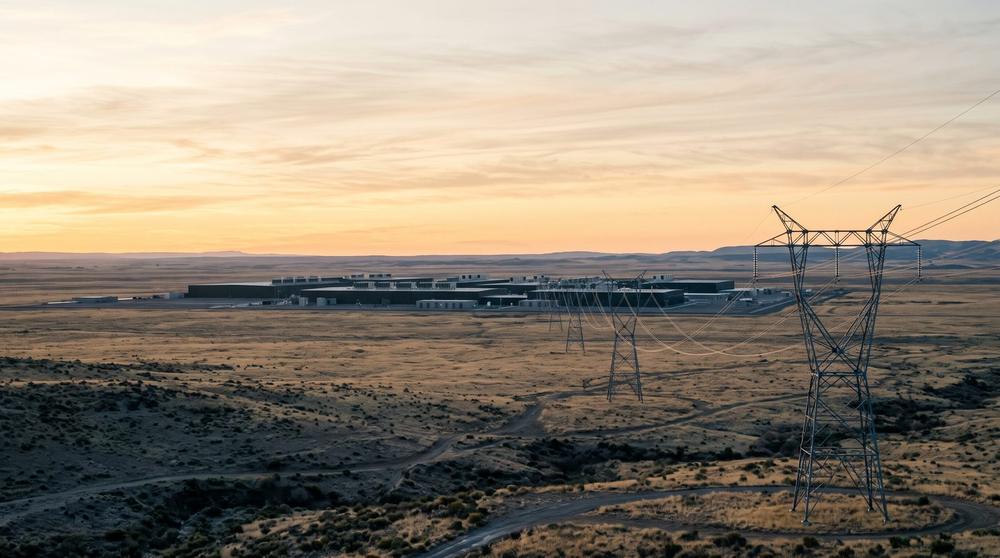
Texas is where the capacity is. Wells Fargo research cited by StockTitan and KASM Capital puts the state at roughly 27% of US data-centre power capacity; Investrade's framing is more than 25% of planned capacity through 2030. Either way, a quarter of the pipeline for American AI buildout now sits under an administration that ran against it.
The names moved accordingly. CoreWeave −6.36%. Tesla −5.52%. Oracle off around 3%. On the other side of the trade, First Solar +7.64%, Centene +4.21% and Molina +6.3% as renewables and managed care caught a bid, while defence primes — RTX, Lockheed Martin, Northrop Grumman — were among the biggest pre-market losers.
Our take: the Dow-versus-Nasdaq spread is the cleanest read on this market's real anxiety, and it is not interest rates. It is siting risk. We wrote last week about OpenAI's Georgia campus and the utility's right to switch off a third of its load; the same question now has a political form. Compute is the only input that can't be offshored on a conference call, and it has to be built somewhere a governor can say no. Every AI capex forecast you read this year assumed permission. That assumption is now a variable.
The rest of the morning
Risk-off hedges held even as futures rallied. The 10-year Treasury yield fell to roughly 4.92–4.94%. Gold was up 2.93% and silver 4.44% by the pre-dawn session. The dollar slipped. VIX came off 12% to 18.25 after holding above 20 overnight. Brent traded around $102.3–102.8 and WTI around $95.3–95.8, both lower.
Tuesday's close, for reference: S&P 500 +0.36% to 7,568.92, ending a three-day losing streak; the Dow −0.38% to 51,786.72, dragged by Apple's post-earnings fall; the Nasdaq Composite +0.83% to 25,372.01.
Earnings did the usual damage underneath. Amdocs −36.4%, FIS −21.7%, Datadog −13.8% and Skyworks −12.9% on soft guidance, against Duolingo +20.3%, Riot Platforms +14.9% and Kyndryl +12.9%. Super Micro reported fiscal Q1 revenue of $19.95bn, up 298%, and was close to flat by the open after giving back its early gain — a useful reminder that in this tape a 298% revenue print buys you about an hour.
What to watch
- ISM services at 10am ET, consensus around 54.8. ADP's October private payrolls came in at 86,000 against expectations near 75,000, per Dow Jones estimates — though consensus and prior figures differ across providers, so treat the beat as directional.
- Friday, 8:30am ET: the October jobs report, the last payrolls print before the December Fed meeting.
- Texas specifics. Pause, moratorium or review — the word choice is worth billions in capex timing, and nobody has published it.
- Qualcomm, Arm, McKesson and AppLovin after the close; Uber and McDonald's already out this morning, with McDonald's +3.17%.