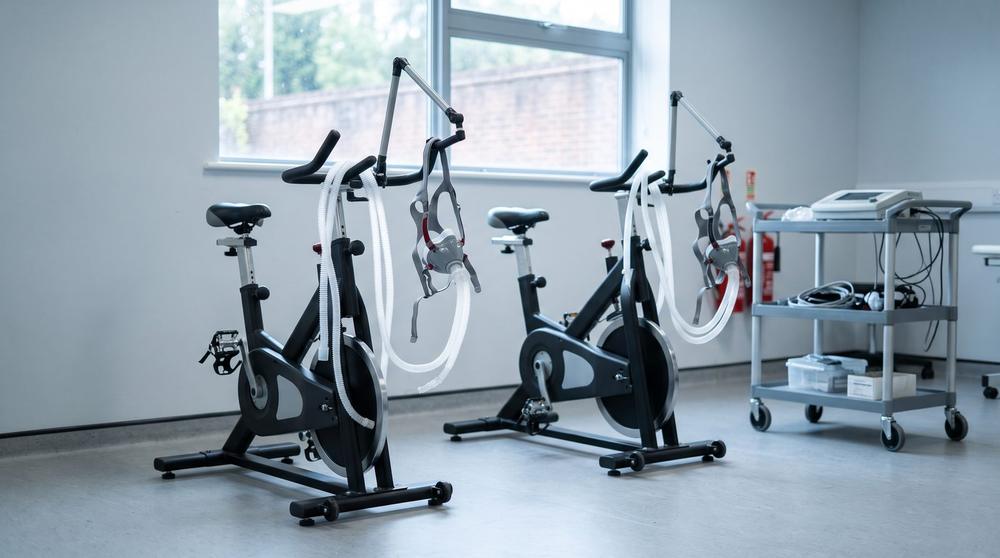
Forty-two untrained middle-aged adults in Norway did the same thing twice. Two near-identical 8-week endurance programmes, separated by 8 weeks of detraining, with intensity prescribed individually and re-set against a fresh maximal test every second week. They completed 23.9 sessions in the first block and 23.8 in the second. The stimulus was, as closely as a supervised trial can manage, repeated.
Their starting points reproduced almost perfectly. The intraclass correlation between the two baselines was 0.98 [0.97, 0.99] for maximal oxygen uptake and 0.96 [0.93, 0.97] for 15-minute maximal mean power — which is also the evidence that the detraining worked.
Their responses did not reproduce at all.
The numbers
Reproducibility of within-individual adaptation, reported as intraclass correlations with 95% confidence intervals, in the Journal of Applied Physiology (volume 141, issue 1):
- Haemoglobin mass: 0.00 [0.00, 0.30]
- Capillaries per fibre: 0.00 [0.00, 0.36]
- Citrate synthase activity: 0.15 [0.00, 0.33]
- Maximal oxygen uptake: 0.19 [0.00, 0.37]
- 15-minute maximal mean power: 0.20 [0.00, 0.37]
Every one of those intervals touches zero at the lower bound. And the blood and muscle measures explained little of the variation in the performance measures, so the paper cannot offer a mechanism for the inconsistency either.
The authors’ conclusion is blunt: physiological adaptability “does not reflect a stable, individual-specific attribute” but emerges from “dynamic and context-dependent biological processes.” Their Noteworthy summary says the result “challenges the notion that physiological training responsiveness is a stable, trait-like characteristic.”
That lands harder than previous attempts because the prior evidence was thin. Earlier repeat-training studies ran 10 to 19 young, moderately trained men. This one is 21 men and 21 women, aged 30 to 65, untrained — 53 enrolled, 42 completing — with individual baselines and individual training loads both documented, which the earlier work mostly did not do.
The counter-argument, in the same volume
Three issues later, a Viewpoint by Pekka Matomäki and Timi Malinen argues the finding may be mostly noise. The case is arithmetic: measuring the reproducibility of a change requires four measurements, and the error at each one compounds.
They derive a closed-form expression for the correlation you would expect if measurement error were the only source of variability — a hypothetical world in which every participant adapts identically. Feeding in the study’s own values (baseline VO2max around 2,800 ± 900 mL/min, a 9% improvement, and the reported test-retest typical error of 2.1%, giving a 3% coefficient of variation), the model predicts a correlation of 0.28. The study reported 0.19.
Their table makes it sharper still. Across the endurance and strength interventions they tabulate, every one with an improvement-to-measurement-error ratio above 5 reported a correlation above 0.60 — and all of those were strength-training outcomes, where the adaptation is large relative to the noise. Resistance-training reproducibility, as they note, may simply not have this problem.
Our take: Both papers accept the same number and disagree about what produced it, and the practical consequence is identical either way. If adaptability is genuinely context-dependent, personalised endurance prescription loses the premise it rests on — that your response to a programme is a durable fact about you. If it is mostly measurement error, the premise survives but nobody can currently measure it well enough to act on, which is operationally the same thing. Either reading kills the same inference: one 8-week block’s result is not a readout of a person’s trainability. Filing yourself as a non-responder on a single cycle’s data is the mistake both camps would agree about.
What to watch
- Whether the study’s authors respond to the Viewpoint, and whether they accept the error estimate it uses — which is their own reported figure.
- A repeat design with several baseline and post-test measurements at each time point, which would separate biology from noise directly rather than by model.
- Whether the strength-training contrast holds, since that would make the problem one of effect size rather than of individuality.
- Any product claim — genetic, wearable or coaching — still selling individual trainability as a fixed, measurable trait.