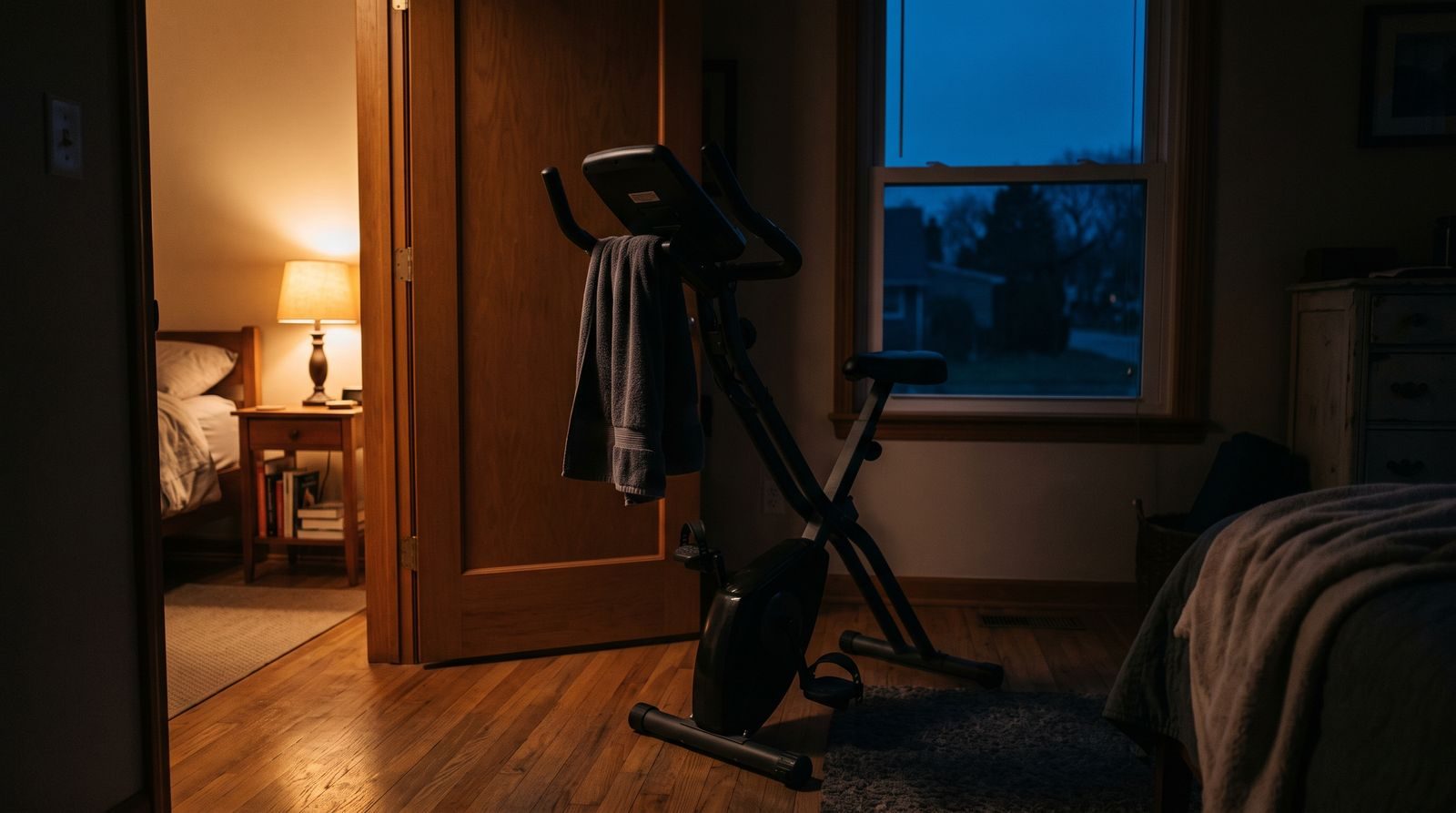
A trial published online in Sleep on 26 August, led by Emmanuel Frimpong at Concordia University in Montreal, took 88 healthy young adults and did something deliberately unpleasant to half of them: cut their night to 4.5 hours in bed instead of 8.5.
Before sleeping, some of them cycled for 30 minutes at moderate intensity — 55 to 60% of VO2max, which is conversational, not hard. A few hours later, everyone learned 80 face-name pairs. Then they slept, and were tested on delayed recall.
The short-sleep group that exercised performed comparably to the group that got a full night. The short-sleep group that did not exercise did not. Thirty minutes of easy cycling appears to have absorbed most of the memory cost of losing four hours of sleep.
The mechanism is the interesting part
The authors attribute the effect to slow-wave sleep. Declarative memory — names, faces, facts, the hippocampal stuff — consolidates during deep sleep, and short sleep does not simply remove a proportional slice of it. What the exercise appears to do is improve the quality and density of the slow-wave sleep that remains, so a compressed night carries more consolidation per hour than it otherwise would.
That framing matters because it explains the limits. This is not a finding that exercise substitutes for sleep. It is a finding that exercise makes a bad night less lossy on one specific cognitive axis, measured the next morning, in healthy young adults, after a single night.
Our take: the useful version of this is narrow and worth having anyway. If you already know tonight is going to be short — a flight, a deadline, a newborn, a shift rotation — 30 minutes of easy cardio in the evening is a cheap hedge on whatever you have to remember tomorrow. What it is not is a licence. One night of 4.5 hours in a lab is not four months of five hours in your actual life, and nothing here says the cardiovascular, metabolic and mood costs of chronic short sleep are touched at all. The study measured face-name recall. It did not measure your judgement, your temper, or your resting heart rate at 3 a.m.
Why "moderate" is doing real work
The prescription was 55–60% of VO2max for half an hour. That is the zone most people skip past on the way to something that feels more productive, and here it is the whole intervention. The wider sleep literature is consistent on this: moderate-intensity evening activity tends to help sleep, while vigorous work close to bedtime can interfere with it. Going harder is not a way to get more of this effect and may cost you the mechanism it depends on.
It is also a reminder that dose and intensity are separate levers with separate effects. Three minutes of all-out sprinting moves a quarter of your measurable blood proteins; ninety minutes of steady cycling moves almost none. Different intensities do different jobs, and the job here is sleep architecture, not a systemic signalling storm.
What to watch
- Replication in older adults. Slow-wave sleep declines with age, so the population with the most to gain is the one this trial did not test.
- Multi-night designs. A single restricted night is the easy case. Whether the effect survives a week of short sleep is the question that decides whether this is a hedge or a habit.
- Shift-work trials. The authors flag occupational sleep loss directly, and that is where a 30-minute intervention would actually be deployable.
- Whether it generalises past declarative memory. Face-name pairs are one narrow assay of one narrow system.
Treat it as a mitigation for a night you cannot avoid, not a strategy for nights you choose. That distinction is the entire difference between using this finding and misusing it.
Nothing here is medical advice. If you are managing a sleep disorder, that is a conversation with a clinician, not with a stationary bike.