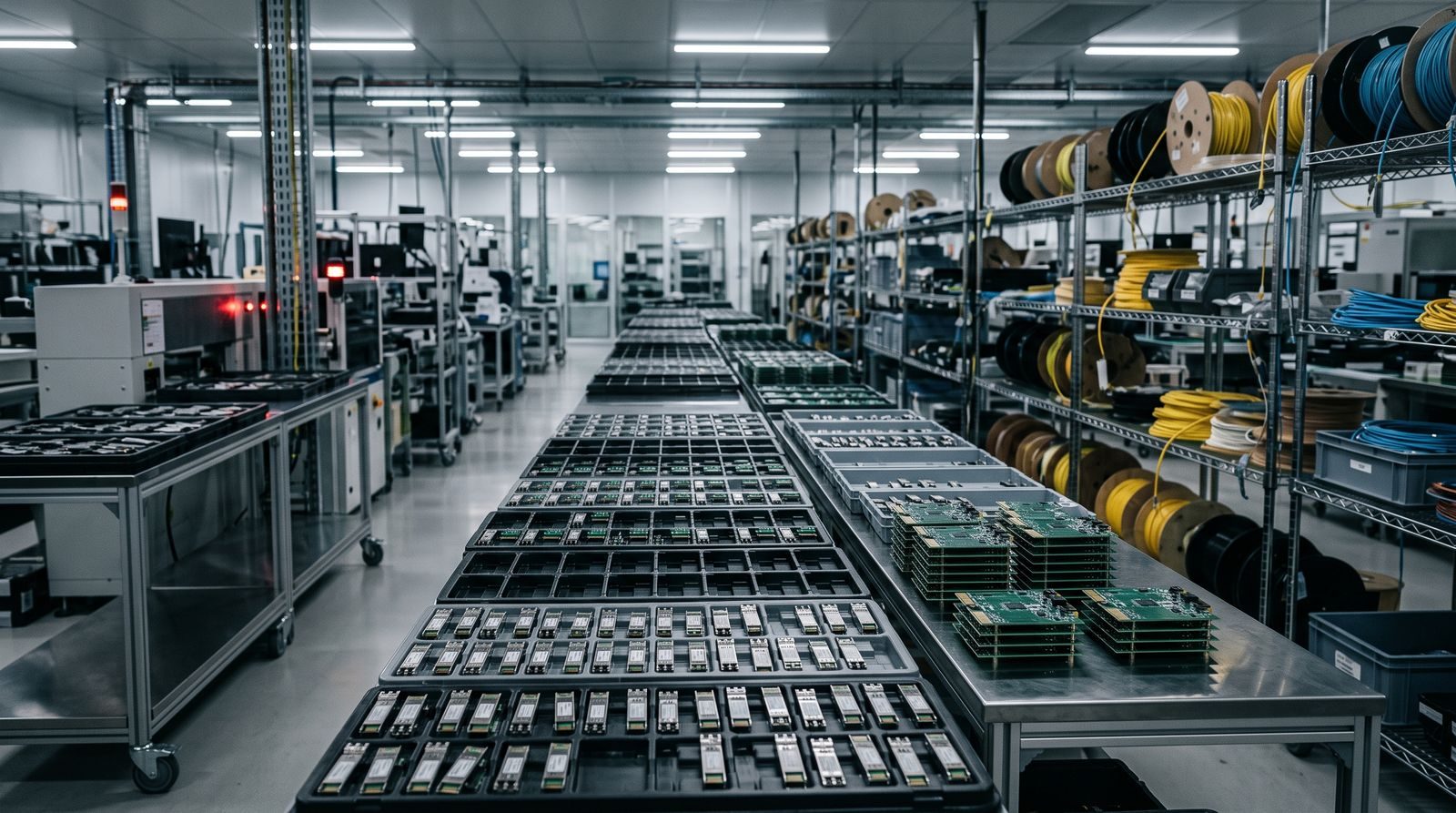
Fabrinet reported fiscal fourth-quarter results after Monday’s close and the headline was as clean as a headline gets. Revenue of $1,315.8 million against $909.7 million a year earlier — up 45%, above the top of its own guidance range. Non-GAAP earnings of $4.10 a diluted share versus $2.65. Full-year revenue of $4.64 billion, up 36% from $3.42 billion. CEO Seamus Grady called the quarter “exceptional.”
By midday Tuesday the stock was down roughly 20%, trading near $476, and it took the entire optical and connectivity complex with it: Marvell off nearly 8%, Coherent about 12%, Lumentum roughly 10%, Amphenol around 7%, Corning close to 8%.
The beat was real. The cash-flow statement underneath it is what the market actually read.
Our take: Fabrinet converted a 36% revenue year into $4.2 million of free cash flow, down from $207.3 million the year before. That is not a profitability problem — GAAP net income rose 42% to $473.0 million. It is a working-capital and capex problem, which is what happens when a supplier funds the AI buildout on its own balance sheet ahead of the orders. The question for fiscal 2027 is whether that inventory turns into shipped revenue or into a writedown.
Where the cash went
Operating cash flow for fiscal 2026 fell to $256.7 million from $328.4 million, even as net income climbed. Capital spending more than doubled, to $252.5 million from $121.1 million. Subtract one from the other and full-year free cash flow comes to $4.2 million. The fourth quarter alone was negative: $55.0 million from operations against $91.9 million of capex, for minus $36.9 million.
The working-capital build is the larger half of the story. Year-end inventory rose 76% to $1.02 billion — roughly twice the pace of annual revenue growth — absorbing $442.9 million of cash. Receivables rose 34% to another $1.02 billion, absorbing $259.3 million. A $370.8 million increase in trade payables covered part of it; supplier credit financed the expansion only in part. On August 17 Fabrinet’s Thai subsidiary borrowed 2.50 billion baht, about $75 million, to support capital spending.
This is not a liquidity story. The company ended June with $346.7 million of cash and $528.3 million of short-term investments. It is a conversion story.
The guide did the rest
First-quarter fiscal 2027 guidance is $1.375 billion to $1.425 billion. The $1.40 billion midpoint is about 6% above the record just delivered — a normal sequential step-up, and a very different number from 45%. Non-GAAP EPS guidance of $4.10 to $4.25 brackets the $4.10 already booked. Gross margin came in at 12.0%, against 12.2% a year ago.
Positioning made that arithmetic expensive. Fabrinet had run up roughly 25% in the month into the print. The release also disclosed a $56.7 million loss on non-marketable equity securities.
It landed on a bad afternoon for the whole trade. Anthropic’s $65 billion run rate came in below what some investors had modelled, the Wall Street Journal put roughly $3 trillion of off-balance-sheet AI commitments on nine big-tech balance sheets, and the 30-year Treasury hit a 19-year high. Long-duration hardware names were the natural place to sell.
What to watch
- Inventory versus revenue growth. The build is defensible while it is components staged for firm orders. It stops being defensible the quarter inventory keeps climbing and revenue does not.
- Operating cash flow in Q1. $55.0 million on $1.32 billion of revenue is the number that has to move.
- Receivables collection. A $1.02 billion balance in a business with heavy customer concentration is the risk Fabrinet flags in its own filings.
- Gross margin at 12%. A contract manufacturer running a low-teens margin has almost no cushion if capacity comes online ahead of the demand.
- Nvidia’s data-center commentary next week — the cleanest read on whether Tuesday was a positioning reset or the front edge of something slower.
Record revenue, record earnings, and $4.2 million of cash left over. Both halves of that sentence are true, and only one of them was in the headline.