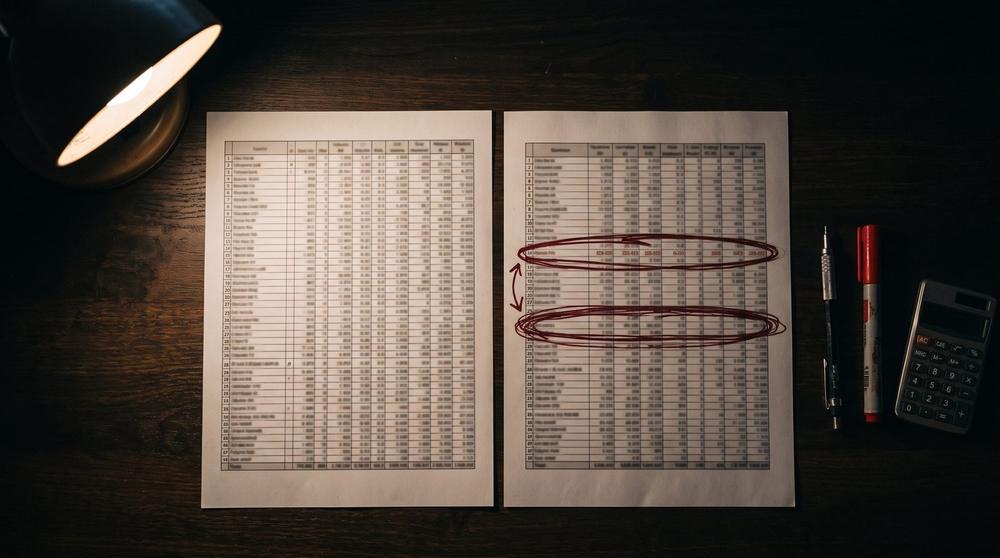
Here is the situation, and you have been in it this month. A vendor’s case study says the deployment cut costs 40%. The account team says 25%. A trade publication says “up to 60%.” All three describe the same deployment. You have a decision to make on Thursday.
The common moves are all bad. Averaging three unsourced numbers produces a fourth unsourced number with a false air of care. Taking the vendor’s is naive and taking the lowest is not conservatism, it is just a different arbitrary pick. Deciding the sources “basically agree” works until someone asks which one you used.
What follows is a pass that takes fifteen minutes on most disagreements and resolves a surprising share of them outright. It is the discipline that separates a number you can defend from a number you happen to have.
Step 1: write the claim as a sentence with a unit and a basis
Most figure disagreements are not disagreements. They are two correct answers to two different questions, and they collapse the moment you force each one into a full sentence.
The template: <subject> changed by <amount> <unit>, measured against <basis>, over <period>, as reported by <source> on <date>.
Run the cost-savings example through it and the conflict often dissolves: 40% against list price over the first year; 25% against the previous vendor’s actual invoices over eighteen months; “up to 60%” for a single named workload at peak. Three numbers, three bases, no contradiction. You now have a real question — which basis matches your situation? — instead of a fake one about who is lying.
If you cannot fill in the basis for a figure, that is not a gap in your notes. That is the finding. Write it down as “basis not stated” and carry it forward, because a percentage without a denominator is not a measurement.
Step 2: derive the implied value and check the source against itself
This is the step that does the most work and almost nobody does. When a source gives you a percentage, compute the absolute. When it gives you an absolute, compute the percentage. Then check whether the source’s own figures agree with each other.
A worked example from Tuesday. One outlet reported the Dow Jones Industrial Average up 0.86% and said it had closed above 50,000 for the first time, without printing a level. Monday’s close was 49,595.31. So:
- 49,595.31 × 1.0086 = 50,021.8. Above the line, consistent with the claim.
- A second outlet said the Dow “added 398 points, or 0.80%.” Check it: 398 ÷ 49,595.31 = 0.80%. Internally consistent. Implied close: 49,993.3. Below the line.
- The first outlet’s own sidebar read “50,003.10 +0.50%.” Check it: 50,003.10 from 49,595.31 is +0.82%, not +0.50%. Internally inconsistent — discard.
Three minutes of arithmetic and you have gone from “sources disagree” to something far more useful: two coherent accounts 28 points apart, one incoherent account eliminated, and a specific open question. A source that contradicts itself has told you something about its reliability that no amount of brand reputation overrides.
Do this to every figure before you do anything else with it. Percentage changes, growth rates, margins, headcounts, conversion rates — all of them have an implied absolute, and roughly one in five published figures fails its own cross-check.
Step 3: rank sources by distance from the primary record
Not by prestige. By how many hands the number passed through. Build the ladder for your domain once and reuse it:
- The primary record. The regulatory filing, the index provider’s official close, the signed contract, the database query, the instrument reading, the published policy page.
- The issuer’s own statement. Press release, earnings call transcript, support documentation. Self-interested but on the record and attributable.
- A reporter who read the primary record and names it. The quality here is the citation, not the masthead.
- A reporter citing an unnamed source. “A person familiar with the matter” is a real category of evidence, not a worthless one — but it is unverifiable by you, ever.
- An aggregator. Rewrites, roundups, auto-generated market summaries. Useful for finding stories, never for figures.
The rule: one tier-1 source beats any number of tier-4 and tier-5 sources agreeing with each other, because agreement among aggregators usually means they share an upstream. Three outlets with the same wrong number is one error with three distribution channels, and the way to tell is to trace each back and see whether you arrive at three records or one.
Corollary worth internalising: “widely reported” is not corroboration. Independent corroboration means two sources that could not have copied each other.
Step 4: ask the question that forces the basis into the open
Often you can just ask. The trick is asking in a way that cannot be answered with a restatement of the number.
To a vendor or an account team:
“I have three figures for the same result — 40%, 25% and up to 60% — and I need to put one in front of my CFO with a source next to it. Can you tell me, for the 40%: what was the denominator, what period, and is it one customer or a blend? If it is a single deployment I would rather cite that one accurately than use the blend.”
To a colleague whose number disagrees with the system of record:
“Your deck has 1.4 million and the warehouse query gives me 1.26 million for what I think is the same month. I am not assuming either is wrong — most likely we are counting different things. What is in yours that might not be in mine?”
To an analyst or a researcher:
“Is the figure in your note calculated from the filing, or is it your estimate? If it is an estimate, what is the input you are least confident in?”
All three share a structure: name both figures, state plainly that you assume a definitional difference rather than bad faith, and ask for the basis rather than the number. People defend numbers and explain bases. Ask for the thing they will explain.
Step 5: decide with the disagreement written down
You will often have to act before anything resolves. That is fine — what is not fine is acting as though it resolved. Record the decision in four lines:
- Figure used: the one you are acting on, with its source and tier.
- Range: the span of coherent estimates. Not an average — a range.
- Why this one: one sentence. Usually “closest to the primary record” or “basis matches our case.”
- What would change it: the specific document or event that settles it, and when you expect it.
Then make the decision robust to the range rather than to the point. If the choice flips between 25% and 40%, you do not have a number problem, you have a decision that is too tightly coupled to an unverified input — and the honest move is to restructure it. Stage the commitment, add a checkpoint at the date the primary record lands, or buy the smaller version first.
The four lines take ninety seconds and they are what let you say, six months later, exactly why you did what you did — rather than discovering you cannot reconstruct it.
Five failure modes
- Averaging to resolve. The mean of three numbers with different bases measures nothing. If the bases differ, pick the one matching your case. If they match, you have a genuine measurement dispute and averaging buries it.
- Precision as credibility. “49,993.31” feels more trustworthy than “about 50,000” and is not. Derived figures inherit the error of their inputs; two decimal places on a number computed from a rounded percentage are decoration.
- Treating the round number as the event. Milestones are artefacts of the unit. “Crossed 50,000” and “crossed 1 million users” describe the base-ten system as much as the subject, which is why a milestone claim is the one most worth checking and the one least often checked.
- Stale-number drift. A figure gets cited, re-cited, and loses its date. The vendor’s “4x faster” was measured eleven months and two hardware generations ago. Always carry the measurement date alongside the measurement.
- Range laundering. “Up to 85,000” and “80,000 to 85,000” are not the same claim, and the first is usually the second with the inconvenient end removed. When you see “up to,” ask for the bottom of the range — and when you see a lone bound, treat the missing one as unknown rather than as equal to the one you have.
The fifteen-minute version
When you do not have time for the full pass, this order captures most of the value:
- Write each figure as a sentence with unit, basis, period and date. (4 min)
- Derive the implied absolute or percentage for each; drop anything that fails its own cross-check. (4 min)
- Trace the survivors upstream one hop. Collapse any that share a source. (4 min)
- Write the four-line decision record. (3 min)
The habit this builds matters more than any single reconciliation. Once deriving the implied value is automatic, you stop being able to read a percentage without computing it — and you start noticing, several times a week, that the number everyone is repeating does not survive one subtraction.