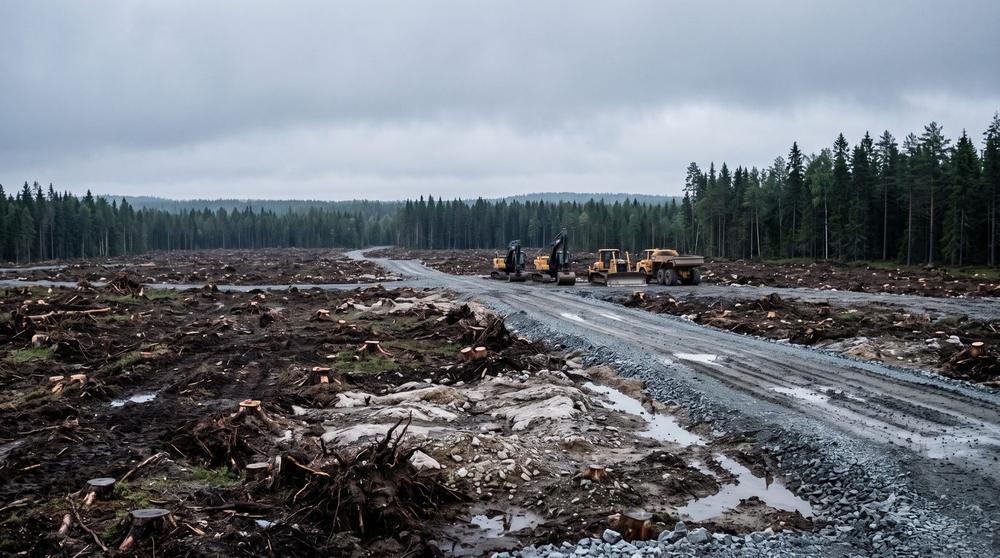
Finland's permit and supervision agency ordered Google on Wednesday to stop preparatory work at two data centre sites in the north of the country — Muhos and Kajaani — because the environmental impact assessments the law requires had not been finished. More than 300 hectares of forest had already been cleared.
The agency's description of the sites is the part worth reading twice. Trees removed. Topsoil stripped. Site roads and storage areas built. Ditches altered. None of that is a planning dispute over a drawing; it is a landscape that has already changed. Google has until 14 October to respond, and the suspension bites on 23 October. The regulator said it may open enforcement proceedings if the order is ignored.
Google announced the Finnish build in September: €13 billion over two years, one of the largest single commitments to European AI capacity anyone has made. Three weeks later the shovels are on hold. The company's statement conceded the point — it said it understood the concerns and had fallen short of its own standards. Finland's environment minister was blunter, saying the projects will probably be delayed and that every company operating in Finland has to comply with the law.
Our take: Everyone models the AI buildout as a chip problem, then as a power problem. Google spent this week solving the power problem in public — 3,590 megawatts contracted from Constellation, a quarter of it new nuclear. Then a Finnish permit office stopped the same buildout cold over a document. Electrons were never the binding constraint at Muhos. Paperwork was. That is the risk nobody has in a spreadsheet: the capex is committed, the power is contracted, the models are waiting, and the schedule belongs to a regional agency with a 14-day reply window.
Why northern Finland in the first place
Cheap hydro and wind, a cold climate that cuts cooling load, a stable grid and a government that has spent years marketing itself as the place to put compute. It worked — which is exactly why the enforcement matters. A jurisdiction that courts hyperscalers and then halts one three weeks after the press release is sending a more credible signal than any of the glossy investment summits: the incentives are real and so are the rules.
For Google the direct cost is probably schedule rather than money. Assessments get completed; projects restart. But in a market where a European lab just trained a trillion-parameter model on 4,000 GPUs, a six-month slip in capacity is not a rounding error. Compute delivered in Q3 is worth more than the same compute in Q1 of the following year, because the models that need it are shipping now.
What to watch
- 14 October. Google's formal response. Whether it contests the finding or simply commits to completing the assessments tells you how long this runs.
- Whether the order widens. Two sites were named. Finland has more than two in the pipeline, and other regulators read each other's files.
- Restoration obligations. Clearing 300 hectares before an assessment can mean replanting conditions attached to the eventual permit. That is a line item, not a press release.
- Whether other EU states copy it. The EU has spent two years trying to attract AI infrastructure. This is the first time a member state has publicly chosen process over speed.
The AI capex story has been told as a contest between companies with money and companies without. It is quietly becoming a contest between companies that can get permits and companies that assumed they could.