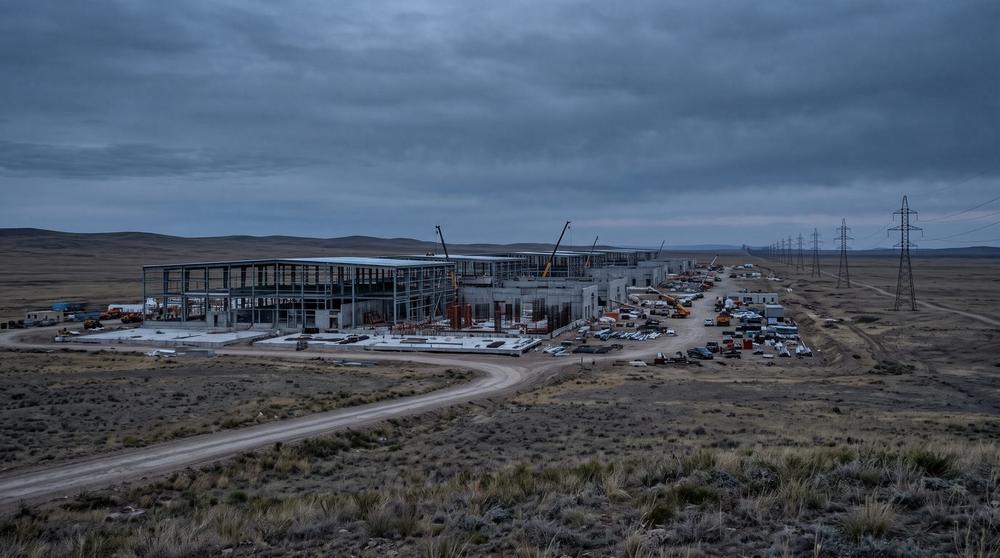
Nvidia said on 23 October that Firebird, a US AI cloud startup, holds a US export licence for 45,000 Grace Blackwell GPUs. The site is Ekibastuz, in north-eastern Kazakhstan, and the first phase is being built with the state telecom, Kazakhtelecom, at a complex the government calls Data Center Valley. Commercial launch is targeted for the third quarter of 2027.
The announcement landed during Jensen Huang's first visit to the country. He appeared at the alem.ai centre in Astana alongside Zhaslan Madiyev, the deputy prime minister and minister for AI and digital development, and met President Tokayev. Firebird signed an investment agreement with the government the same day.
Huang's framing was explicit: Kazakhstan could be “a computing hub, an AI factory hub for all of Europe,” and could export intelligence rather than only energy. He also noted that it is “the first country that I have been to where the president declared the country to be an AI nation,” and pressed the sovereign-model argument, calling AI data a national security concern.
Our take: The number to hold next to 45,000 is 880. That is how many Nvidia GPUs Kazakhtelecom runs today, across Astana and Almaty. The licence is roughly fifty times the installed base of the partner building the facility, and the concrete is at best eleven months out. So what has actually been created here is a permission, not a cluster — and permissions are the scarce asset in this market right now, not demand. Read it next to Andy Jassy saying this week that AWS is sold out through 2027: when the incumbents are turning customers away, an export licence on allied-adjacent soil is worth more than a signed order book.
Why the licence is the story
Central Asia has not been a straightforward destination for frontier silicon. The structure here is what makes it legible in Washington: American chips, an American cloud operator as licensee, a state telecom as local partner, and an export business model pointed at Europe rather than at any market the US restricts. Kazakhstan is not primarily buying compute for its own economy. Officials have said they hope compute exports eventually bring in at least $3 billion a year, and the project builds on accords worth up to $10 billion signed in June.
Capacity ambitions scale accordingly. A planned second phase would take potential capacity at Ekibastuz to around 500 MW, with 1 GW held out as a long-term target. Kazakhtelecom separately plans to deploy more than 2,000 additional GPUs in 2027, including over 1,000 Nvidia Vera Rubin processors at Ekibastuz. Nvidia's own footprint in the local ecosystem extends to Higgsfield, an AI video-generation startup valued at $5.4 billion that it has invested in.
The constraint nobody announced
None of this is a grid plan. Ekibastuz sits next to coal and existing generation, which is the reason the site was chosen, but the Carnegie Endowment has warned that unreliable grids, limited international connectivity and regulatory uncertainty are the binding constraints on Central Asia's digital ambitions. A 500 MW campus whose output is meant to be sold into Europe needs both firm power and fibre that does not bottleneck at a border. Neither was quantified this week.
What to watch
- Q3 2027. A first-phase slip announced in 2027 would tell you the constraint was physical, not political. Hold the date.
- The Vera Rubin units. Kazakhtelecom's 1,000-plus next-generation processors in 2027 are a separate commitment from Firebird's licence. If those arrive on time and Firebird's do not, the bottleneck is the licensee, not the country.
- Whether the template repeats. One licence of this size in Central Asia is a transaction. A second, in a neighbouring state, is a policy.
- Interconnection. Export revenue of $3 billion a year requires European customers to accept the latency and the jurisdiction. Watch for named anchor tenants, not megawatts.