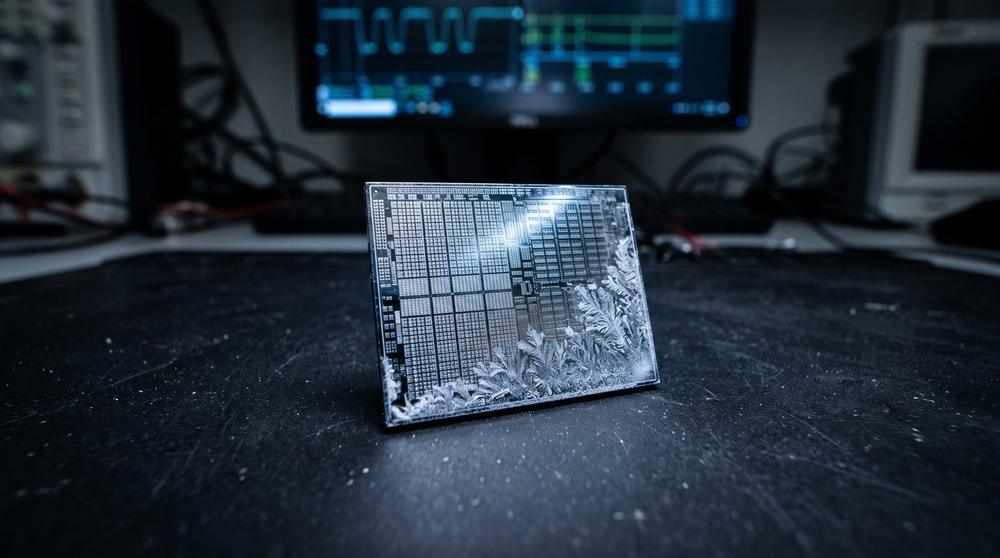
A Palo Alto startup called Architect Labs says it pointed swarms of AI agents at a blank page and got back a working general-purpose CPU — new instruction set, new microarchitecture, no human-supplied architectural priors. The headline number is 4.59x the performance per watt of a comparable conventional core. Tom’s Hardware, The Neuron and Notebookcheck all report it, and all three report it as a geometric mean across 25 workloads.
All three also report the number nobody is putting in a headline. Ten of those workloads were used to tune the design and returned 6.02x. The other 15 were held back until final evaluation and returned 3.83x. Performance per unit of chip area comes in at 8.77x, per The Neuron and Notebookcheck.
The architecture is the genuinely interesting part. Frostbite is built on interaction nets, a model of computation from 1990 in which a program is a graph and computing means rewriting pairs of connected nodes. Rewrites never overlap, so they run in any order and in parallel with the same result; each value is consumed once, so data can live in small local memories instead of a large shared cache. Notebookcheck reports programs are written in a language called Vine and compiled to an intermediate representation called Ivy, and that there is no central scheduler — tiles pull work from idle neighbours or power down.
Our take: 3.83x is the number. 4.59x includes the workloads the design was optimised against, which makes it a training score, not a result — and the company published both, which is more disclosure than most hardware launches manage. The harder problem is the denominator. The baseline core is unnamed, which Architect Labs attributes to legal reasons; Notebookcheck says the company calls it “TCPU” and gives its area as 0.895 mm² on the same 7 nm process. The Neuron, citing Tom’s Hardware, describes it as dual-issue and in-order. A dual-issue in-order core is a modest target: beating it by 3.83x in simulation says very little about a modern wide out-of-order design, and the company itself lists those comparisons as future work. Nothing here has been fabricated. Every figure is pre-silicon simulation of a 7 nm design that reached 800 MHz in synthesis and 500 MHz in final layout, published on the company’s own research blog with no peer review and no independent verification described in any of the three accounts.
What the agents actually did
Per Tom’s Hardware, the first artefact was a 141-page specification that was deleted outright because its numbers were physically implausible. What replaced it was a loop: specs written in a language called ASL that translates to the Lean proof checker for machine checking, a software model that ran roughly 200x faster than RTL simulation, and an automated correction pass that pulled power estimates from nearly 250% off down to within 5% of the circuit design. The Neuron and Notebookcheck both report 58 agent-proposed ideas tried across four search rounds, with 37 kept.
The detail the company leads with is work stealing — idle tiles pulling tasks from neighbours — which it says no human specified. On interaction nets, where rewrites are independent by construction, that is close to the obvious move. It is a good result for the search process. It is not evidence of invention.
The parts with no number attached
Tom’s Hardware alone reports a best case of 23.12x on conv2d and a worst case of 1.15x on recursive Fibonacci, both from the held-out set. Treat those as single-sourced — neither of the other two accounts carries them — but note the spread: a 20x range across workloads is what a specialised dataflow machine looks like, not a general-purpose CPU. None of the three accounts gives IPC, absolute power, absolute die area, cache sizes, or results on any standard benchmark suite. SPEC and PARSEC appear only as things coming later.
What to watch
- The baseline, named. Until someone can identify TCPU, 3.83x is a ratio with one known term. Every other question is downstream of this one.
- SPEC and PARSEC numbers against an out-of-order core. The company says these are due in the coming months. That is the comparison that decides whether this is a CPU or an accelerator.
- Silicon, or an FPGA at minimum. Architect Labs plans an FPGA-hosted playground and a preliminary OS. Simulated power at 7 nm is a model output; measured power is a fact.
- The RTL and ISA release. Promised, undated. Published RTL is what turns a blog post into something a third party can check.
- The held-out gap next time. 6.02x tuned versus 3.83x held out is a 36% drop. Watch whether that gap narrows as the workload set grows or widens.