Google DeepMind released Gemini Robotics 2 on Thursday, and for the first time one of its models drives an entire humanoid — legs, torso, arms and multi-fingered hands — from a single learned policy. The demo, shot on Apptronik’s Apollo 2, shows a robot take an instruction, walk to a table, pick up a watering can, cross the room and place it on a bottom shelf. Earlier versions handled the upper body and handed the legs off to a separate controller, stitched together at the handoff.
Three models shipped. Gemini Robotics 2 is the vision-language-action model that turns what the robot sees and hears into motor commands. Gemini Robotics ER 2 is the reasoning layer — it plans jobs that run several minutes and hundreds of decisions, knows when a step has actually finished, and now lets multiple robots split a task neither could do alone. Gemini Robotics On-Device 2 runs locally with no network, and adapts to an entirely new two-armed robot body in a few hours on typically fewer than 200 examples. ER 2 is available in Google AI Studio now; the other two go to early-access partners.
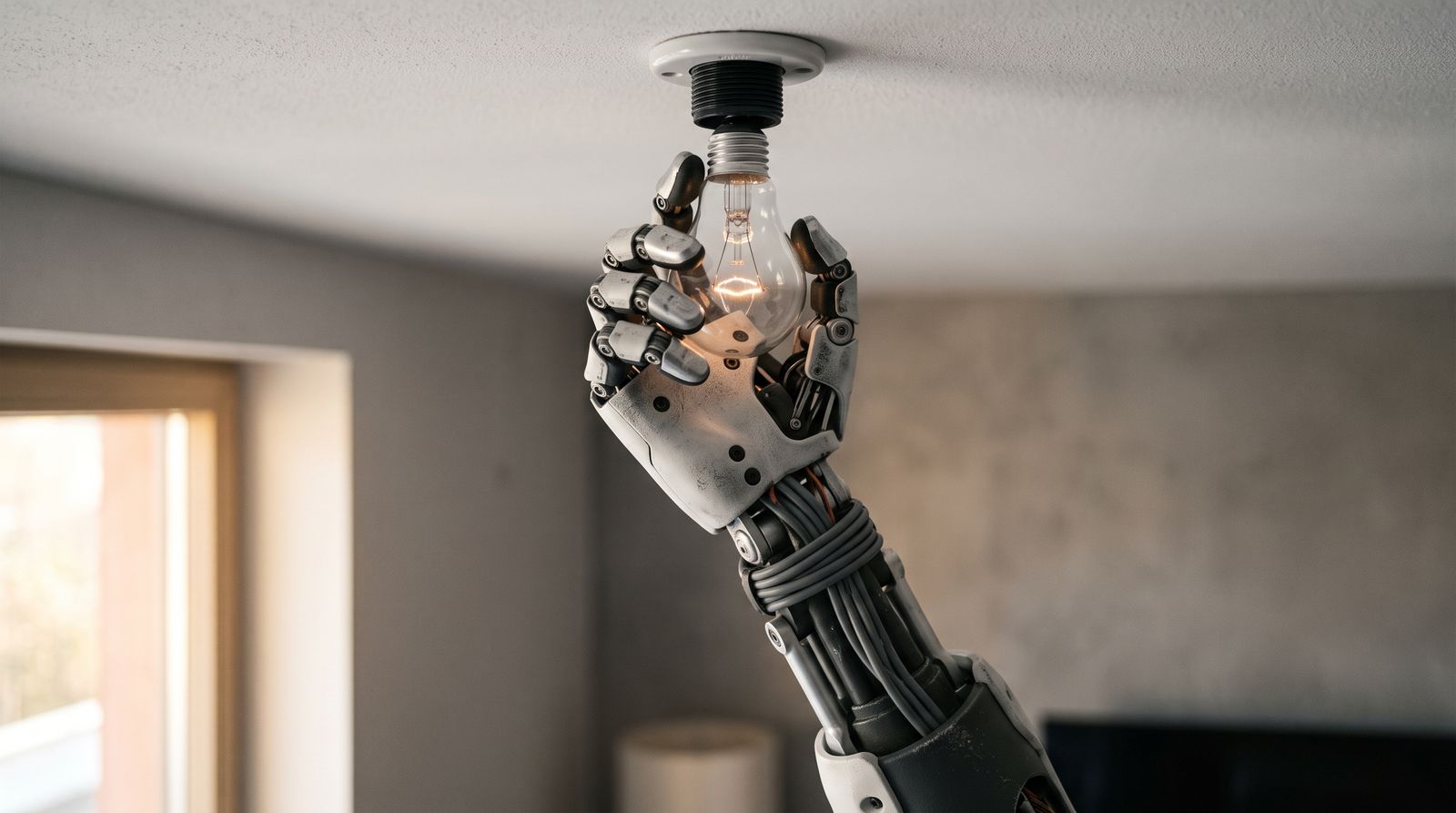
DeepMind also published the success rates. That is the part worth reading twice. On Apollo with the five-fingered, 22-degree-of-freedom SharpaWave hand: unscrew a light bulb, 92%. Screw the same bulb back in, 36%. Tie a trash bag, 44%. Sweep with a dustpan, 32%. Seal a ziplock, 40%. On whole-body pickups with Inspire hands: from a shelf 76.3%, from a table 68.4%, from the floor 45.7%. And on a plain two-fingered gripper mounted to a Franka Duo bench robot: precise insertion 89.6%, tool kitting 78.9%, general pick-and-place 74.2%.
Our take: The gap between 92% unscrew and 36% screw is the whole state of physical AI in one pair of numbers. Taking something apart tolerates error. Putting it together does not — threads have to align, force has to stay inside a narrow band, and the correction loop runs faster than vision. Then notice that the cheap two-fingered gripper beat the 22-degree-of-freedom hand on every task it attempted. More fingers bought worse numbers. If you are underwriting a humanoid thesis, the reasoning model is no longer the bottleneck. Contact is. DeepMind deserves credit for publishing the failure rate next to the highlight reel; most labs ship only the reel.
What the video does not say
The caveat is in DeepMind’s own materials and was flagged by Engadget: the model was trained to perform the specific tasks in the demo, using a mix of human teleoperation, video examples and simulation. This is not a robot that walked into an unfamiliar room and improvised. It is, however, genuinely autonomous — Google says the footage is real-time and unpiloted, which is a meaningful distinction in a field where at least one famous humanoid demo turned out to be run by people offscreen.
The sleeper in the release is On-Device 2. Fewer than 200 examples and a few hours to port the same intelligence onto a robot with different limbs, sensors and degrees of freedom means the marginal cost of supporting a new robot body drops from a research program to an afternoon. That is how a model becomes a platform, and it is the same economics that made running models on your own hardware viable everywhere else in AI.
What to watch
- The screw number. 36% is the benchmark to beat. Clear 80% inside a year and assembly work becomes something a manager can schedule. Below that, a human still has to stand there and finish the job.
- ASIMOV-Agentic. DeepMind introduced a new safety benchmark that measures whether the reasoning model refuses an unsafe tool call from the action model and asks for a human when it is uncertain. Watch whether any rival adopts it, or whether it stays a Google artifact.
- Grippers, not hands. The commercially usable numbers today sit on two-fingered end effectors. Anyone selling five-fingered dexterity in 2026 is selling the research version.
- The partner list. Apptronik, Boston Dynamics and Agile Robots are named. Whoever gets the action model out of early access first starts collecting fleet data, and fleet data is what closes the gap between 36% and 80%.
The robots-are-coming story has been told on video for three years running. This is the first time the lab put the failure rate on the same page, and the failure rate is the more honest product. A robot that screws in a light bulb one time in three is not ready for your building. A model that ports to a new robot in an afternoon may well be ready for the industry.