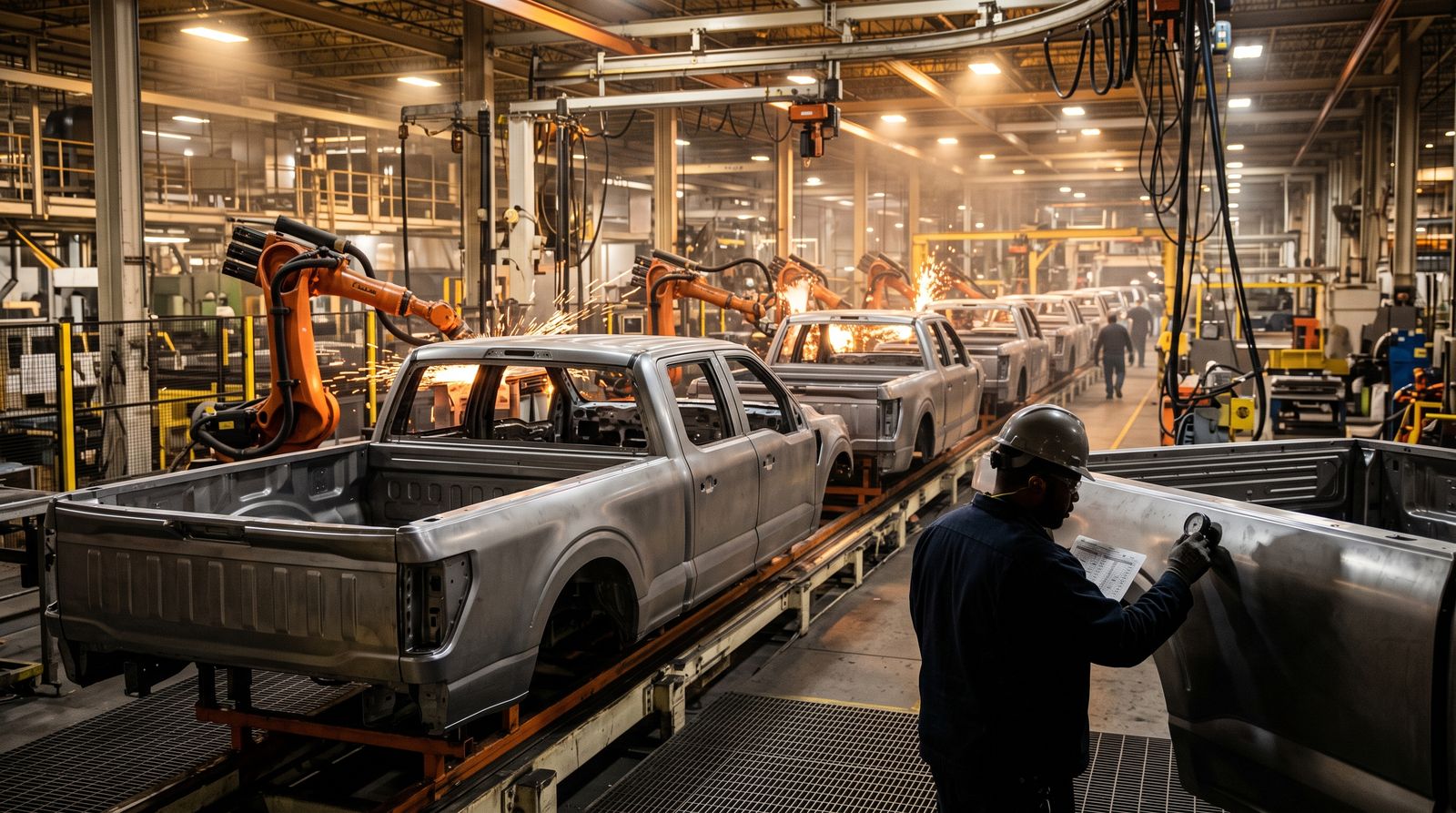
General Motors handed Wall Street two numbers before Tuesday’s open, and they point in opposite directions. Adjusted earnings per share: $3.57, up 41% from a year ago and well clear of the roughly $3.20 analysts expected. GAAP net income: $1.3 billion, down 31%. Both are true. The stock picked the first one — shares opened at $75.91 and pushed to record territory, with CFO Paul Jacobson calling the stock a “bargain” on the call.
The quarter itself was solid by almost any cut. Revenue rose 1.9% to $48.0 billion against estimates of $47.0 billion. Adjusted operating profit jumped 30% to $3.9 billion, and North American margins hit 8.6%, up from 6.1% a year ago, on firm truck pricing and lower warranty costs. GM raised full-year guidance for the second time in 2026: adjusted operating profit of $14–16 billion, adjusted EPS of $12–14, and adjusted automotive free cash flow of $9.5–11.5 billion.
So why did GAAP profit fall by nearly a third? Adjustments — $2.5 billion of them in the quarter. The big one is a $2.3 billion charge for what GM calls “EV strategic realignment”: the real cost of shrinking an electric-vehicle footprint the company spent years building. Add $177 million of China restructuring and the year-to-date tab for unwinding old strategy hits $3.5 billion — all excluded from the numbers the market trades on.
Tariffs, refunded
Buried in the guidance math is a plot twist: tariffs went from headwind to partial refund. After the Supreme Court struck down duties imposed under the International Emergency Economic Powers Act, GM booked a favorable adjustment of roughly $0.5 billion and cut its expected gross tariff bill to $2.5–3.5 billion, down from an original $3.0–4.0 billion. A day after Steel Dynamics showed what tariffs look like as revenue, GM showed what they look like coming back.
The trade-offs are visible if you look past the headline. U.S. market share slipped to 16.6% from 17.4% a year ago, and fleet sales — the less profitable kind — climbed to 22.3% of volume from 17.8%. GM is holding price and letting share go. That works beautifully until it doesn’t.
Our take: This earnings season, the news lives in the spread between GAAP and adjusted. GM’s beat is real — adjusted automotive free cash flow of $5.0 billion, up 78%, is hard to fake. But “adjusted” now excludes $3.5 billion this year for dismantling the last strategy. When a company hits records while writing off its previous pivot, the question isn’t whether the quarter was good. It’s what today’s strategy will cost to unwind later — and whether you’ll be told that number is “one-time” too.
What to watch
- The rest of the tape: Tesla, Alphabet, and IBM report later this week. After Domino’s rallied on a miss and GM spiked on a beat, positioning — not results — is setting reactions.
- Tariff refunds spreading: GM quantified its IEEPA benefit at ~$0.5 billion. Every importer reporting this earnings season now gets asked the same question.
- The EV charge total: $3.5 billion year to date. If it grows again in Q3, “one-time” stops being the right word.