Run the checklist. A shooting war involving the United States, Israel and Iran that has been going since February. Crude above $100. The US 10-year yield pressing toward 5%. A hot core CPI print that has rate-hike odds for Wednesday’s Fed decision running around 90%. Sovereign debt loads that make central bankers wince.
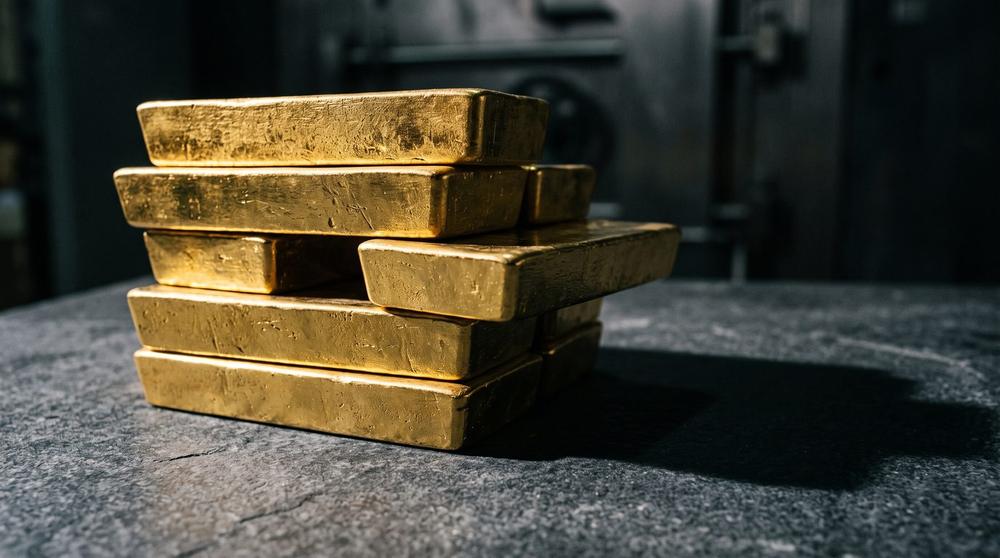
That is the textbook environment for gold to be making records. Gold is not making records. It settled at roughly $4,348 an ounce on Friday — a 0.77% gain that recovered only part of Thursday’s 1.8% slide, after opening the session at its lowest level in over a month. Silver settled near $64.39, up 1.46%.
The record high for gold was $5,597.23, set on January 29 of this year. Eight months and one war later, the metal sits roughly 22% below it.
The hedge that stopped hedging
Gold pays nothing. That is its entire pricing problem and the whole of this story. When the safe asset that does pay something offers close to 5% nominal, the opportunity cost of holding a bar rises every time the Fed is repriced hawkish — and it has been repriced hawkish all summer.
So the two forces that normally point the same way have separated. War and inflation say buy gold. A hiking central bank and a firm dollar say sell it. Since the spring, the second pair has been winning, which is why the geopolitical bid keeps showing up as a one-day pop that fades by Thursday rather than as a trend.
Our take: Most portfolios that own gold own it as war insurance. This year has run something close to a live test of that premise — and the insurance paid out at about 78 cents on the January dollar. The lesson is not that gold is broken. It is that gold hedges one specific thing, negative real rates, and has been mislabelled for a decade as hedging everything scary. If your allocation is there because of headlines rather than because of the real yield, you are holding the wrong instrument for the risk you are actually worried about.
The inverse case matters too, and it is not small. If the Fed hikes on Wednesday and signals that this is the peak, the opportunity-cost argument stops getting worse. Every hawkish repricing since March has arrived faster than the metal could absorb it; a pause changes the direction of that pressure without requiring a single headline about the Middle East to improve.
Where the rest of the complex sits
- Silver is doing something different. Near $64 with a sharper rebound than gold, it carries industrial demand gold does not — and it also carries a rougher drawdown when growth expectations wobble. Treating the two as one trade has been expensive this year.
- The dollar is doing the heavy lifting. A firm dollar mechanically pressures dollar-denominated metals. Much of what gets written up as “safe-haven demand failing” is a currency story wearing a commodity costume.
- Oil is the inflation input, not the hedge. Crude above $100 is precisely what keeps the Fed hawkish, which is what keeps real yields high, which is what keeps gold capped. The war is hurting gold through the rates channel faster than it is helping through the fear channel.
What to watch
- Wednesday’s Fed decision and, more importantly, the language after it. The size of the move is close to priced; the guidance is not.
- Real yields rather than nominal ones. The 10-year TIPS yield explains more of gold’s path this year than any geopolitical headline has.
- Central bank buying. Official-sector demand has been the floor under this market since 2022. If reserve managers step back while the retail bid is already soft, the floor is lower than most models assume.
- August retail sales, also Wednesday. A weak print revives the “hike and stop” case, which is the single most plausible route to gold getting its bid back.
The story is not that the metal failed. It is that a lot of people found out this year what they were actually hedging.