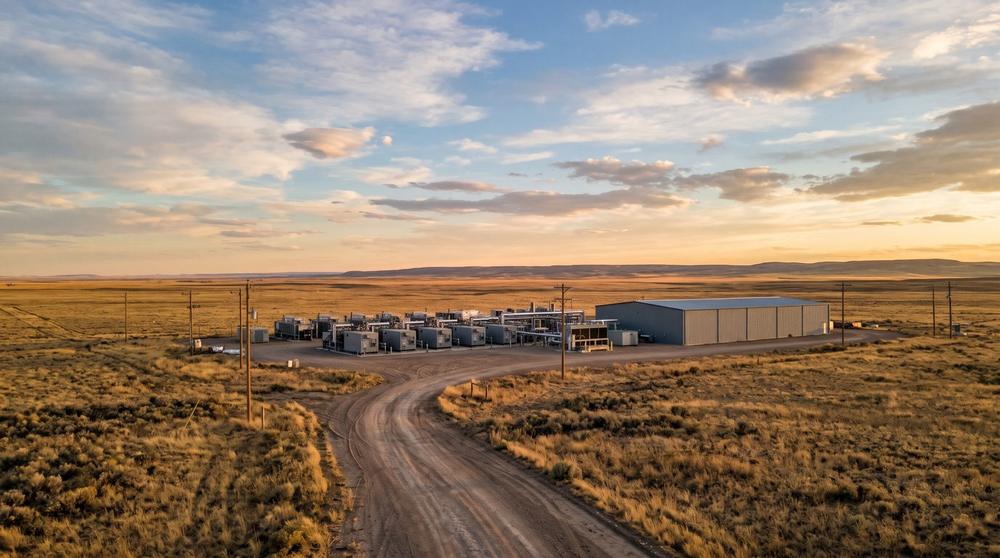
Google said on Thursday it will make a long-term investment of $17 billion in its first Wyoming data centre, in Laramie County near Cheyenne. The power comes from a planned 702-megawatt natural-gas fuel-cell development with carbon capture: Bloom Energy manufactures the cells, American Electric Power is the utility partner, and captured CO2 goes into permanent underground storage at Tallgrass Energy's Eastern Wyoming Sequestration Hub. Black Hills Energy and Tallgrass also supply electricity from gas generators. Related Digital is named as a partner without a stated role.
Google says a “large majority” of emissions will be captured. It has not given a tonnage. Its contracted carbon-capture capacity across projects now approaches a gigawatt, and it is running a front-end engineering study on fitting capture to Tallgrass's combined-cycle turbines. Reporting puts the plant fully running by the end of 2028, though that date appears in only one account.
The timing is not a coincidence
The announcement came two days after US voters rejected data centres in 40 of 41 local ballot measures, per Ballotpedia. In the same window, Microsoft declined to expand a Texas deal with Nscale, and governments from New York to Amsterdam tightened data-centre restrictions. Reuters framed Google's choice plainly: political resistance is growing after the midterms, and Wyoming is a state where Donald Trump took more than 70% of the vote in 2024.
Which is the point. Hyperscaler siting used to be an engineering problem — fibre, water, cheap power, cool air. It is now a political one, and the asset being acquired in Laramie County is not land or megawatts. It is permission. That is why the package includes a pledge to pay for the grid upgrades its own growth requires, a Community Council on the effects of expansion on Cheyenne, and an expected several hundred million dollars in local property tax for the county and School District 1.
It is also why the generation is on site. Nobody has used the words behind-the-meter, and Google's grid-upgrade pledge implies a connection; but building 702 megawatts of your own supply rather than queuing for an interconnection is a decision about who can say no to you. Compare OpenAI's Georgia campus, where 1,000 of 3,200 megawatts are explicitly curtailable at the grid operator's discretion. Two different answers to the same constraint: one buys flexibility by giving the utility a veto, the other buys independence by bringing its own plant.
Our take: Read the $17 billion as a political risk premium, not a capex line. Wyoming is not the cheapest place to build and gas fuel cells with carbon capture are not the cheapest electrons; a hub-state site on the grid would be cheaper on both counts and is no longer reliably available. What Google is buying is a jurisdiction that will still say yes in 2028, plus a power source that does not depend on a hearing. Every operator now faces the same arithmetic, and it has a second-order consequence worth watching: if the industry's answer to local opposition is to self-generate on gas, the grid loses the large flexible loads it was starting to count on, and the emissions argument moves from “which grid” to “does the capture actually work.” On that, Google has given a direction and no number.
What to watch
- A capture tonnage. “Large majority” is a claim. A measured figure, with who measures it, is evidence.
- Water. Cheyenne halted some data-centre wastewater discharges in July after a contractor incident. Google's air cooling is the answer offered; the city's tolerance is the variable.
- Whether the 2028 date holds, and whether AEP's reported ~$4 billion Bloom plant spend near Cheyenne is confirmed in its own filings.
- Who else files in a red low-population state next. If the pattern repeats, the midterm ballot results will have redrawn the industry's map in a fortnight.
Note on sourcing: the $17 billion, the 702 MW, the fuel type, Bloom's manufacturing role and the Tallgrass storage hub are consistent across independent reports. The 2028 completion date and the AEP spend figure each appear in a single account, and no named Google or Wyoming official is quoted in any of them. The market already repriced this trade — see the post-midterm rotation.