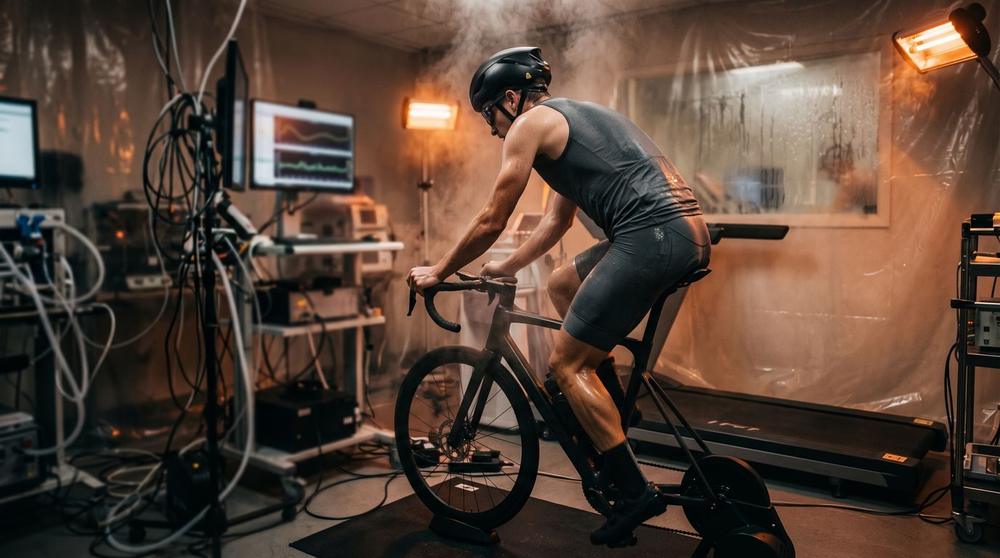
Heat is being sold as the poor man’s altitude tent, and the blood data supports the pitch. A controlled trial in the Journal of Applied Physiology added three weekly heat sessions to a moderate-altitude training camp in well-trained endurance athletes and found a greater increase in haemoglobin mass than altitude training alone. Across the wider heat literature, four to six weeks of structured exposure produces haemoglobin mass gains of roughly 3–4% and VO2max gains of about 1–5%.
Those are not trivial numbers. Haemoglobin mass is the mechanism altitude camps exist to move — more oxygen-carrying capacity, more aerobic ceiling. If a sauna suit and a stationary trainer at sea level can move it as reliably as three weeks in Sierra Nevada, the economics of endurance preparation change for everyone who is not on a WorldTour budget.
A separate study found heat-suit training preserved the elevated haemoglobin mass elite cyclists gained at altitude after they returned to sea level — addressing the oldest complaint about altitude camps, which is that the benefit decays in the weeks it takes to get to a start line.
The gap between the blood and the stopwatch
Here is the part the marketing skips. In the altitude-camp trial, the haematological improvements were not accompanied by significant between-group differences in submaximal or maximal roller-ski performance. The blood moved. The performance did not measurably follow.
That disconnect is common in this literature and it is not evidence the intervention is useless. Trials of trained athletes are typically small, performance tests are noisy, and a 3% haemoglobin change sits close to the measurement error of many field protocols. But it does mean the honest claim is “this reliably changes a biomarker that usually predicts performance,” not “this makes you faster,” and those are different sentences.
Our take: Heat training is the rare performance intervention with a plausible mechanism, replicated biomarker data, near-zero equipment cost and no travel — and it is still being oversold. The strongest current evidence is for heat as an adjunct: stacked onto an altitude block, or used to defend gains after one. The evidence that heat alone replaces altitude and delivers faster race times is not there yet. Treat it as a cheap addition to a plan that already works, not as a substitute for the training that makes the plan work.
What this looks like in practice
The protocols that generated these results are unglamorous and specific: roughly three sessions per week, sustained core-temperature elevation, four to six weeks minimum, layered onto normal training rather than replacing it. The dose is the study. Sitting in a sauna twice after a hard week is not the intervention that was tested.
The risk profile is also not zero. Heat stress compounds with training load, dehydration and sleep debt, and the athletes in these trials were monitored. Anyone with cardiovascular conditions, or pregnant, should treat deliberate hyperthermia as a medical question first — and it is worth raising with a clinician regardless.
What to watch
- A trial powered for performance, not haemoglobin. The field needs an adequately sized study with a race-specific outcome before the causal claim is safe.
- Decay curves. How long the elevated haemoglobin mass persists after the protocol stops determines whether this is a taper tool or a base-phase tool.
- Heat plus altitude versus either alone. The most promising result so far is the combination, which is also the least studied configuration.
- Whether governing bodies take a position. Altitude tents drew regulatory scrutiny. Deliberate hyperthermia has so far drawn none.
This is a summary of published research, not medical or training advice. Deliberate heat exposure carries real physiological risk — talk to a qualified professional before trying any of it.