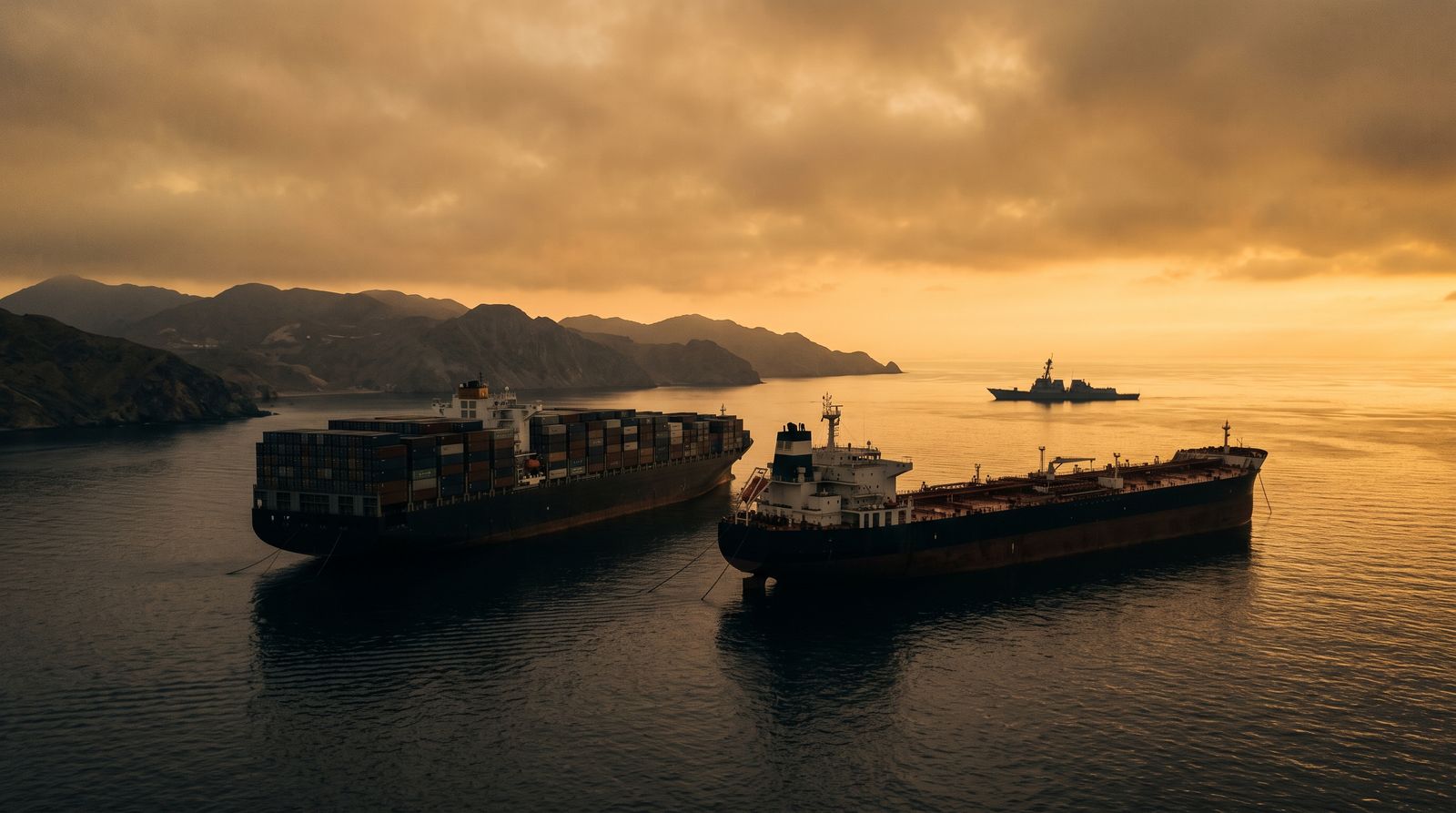
The announcement came in two parts, and both hit the shipping industry at once. President Trump said Monday the United States will be “the guardian of the Hormuz strait” and demanded a 20% “reimbursement” on all cargo shipped through the waterway — compensation, in his framing, “for any and all costs necessary to do the job of providing safety and security” in one of the most volatile stretches of water on Earth. At the same time, U.S. Central Command confirmed the blockade of Iranian ports near the strait will resume Tuesday at 4 p.m. ET, after a week in which Iran attacked multiple commercial vessels and fighting between the U.S. and Iran resumed.
The market didn’t wait for the fine print. Tanker transits through Hormuz have fallen to their lowest level in two months, with ship-tracking data showing just six vessels moving through on Sunday — the fewest in five weeks. Carriers have been pulling back since the crisis began this spring: Maersk has suspended Hormuz transits outright, while MSC, Hapag-Lloyd, and CMA CGM have all issued fresh guidance and Gulf surcharges. Roughly a fifth of the world’s oil moves through this strait. Monday it helped push crude back above $82 and dragged stocks lower into the close.
The pushback was just as fast. The UN’s International Maritime Organization came out against transit fees, and James Kraska, a maritime-law scholar at the U.S. Naval War College, noted the world has an unimpeded right of transit through Hormuz under international law — a toll is simply illegal. Industry wasn’t kinder: Nordic American Tankers CEO Herbjorn Hansson called the 20% fee unrealistic, and one analyst told CNBC that if the U.S. could safely escort ships through, it would have done so weeks ago — calling the plan “really just bluster.”
Our take: The toll probably never gets collected. It doesn’t have to — the announcement alone reprices the strait. War-risk insurance premiums, rerouted voyages, idle tankers, and delayed sailings all land in freight rates within days, which means the 20% arrives anyway — just as a market price instead of an invoice. The deeper shift is that chokepoint risk is now policy risk: the cost of moving goods through Hormuz can change by executive announcement, from Washington as easily as Tehran. If your business touches Gulf supply chains, the question isn’t whether the toll sticks. It’s how you quote a price this week when a fifth of the world’s oil sits behind a chokepoint whose cost structure changed overnight — twice.
What to watch
- Tuesday, 4 p.m. ET: the blockade restarts. Watch whether any actual collection mechanism for the 20% appears — or whether it stays rhetorical.
- War-risk premiums: insurance on Gulf port calls is the first hard number that moves, and it moves before freight rates do.
- Transit counts: six tankers on Sunday. If that number keeps shrinking, Gulf exporters start shutting in supply — and oil’s $82 becomes a floor, not a spike.
- Tuesday’s CPI print and bank earnings calls: this is where an oil shock turns into an inflation-and-guidance story.