Vultr has placed a $1.2 billion order with HPE for AMD Helios AI racks, destined for Vultr’s US cloud data centres. It is the first commercial order for the Helios architecture since HPE and AMD announced it in December 2025. HPE shares rose on the day, somewhere in the mid single digits depending on which print you take, and the order landed alongside a raised outlook for HPE’s networking business.
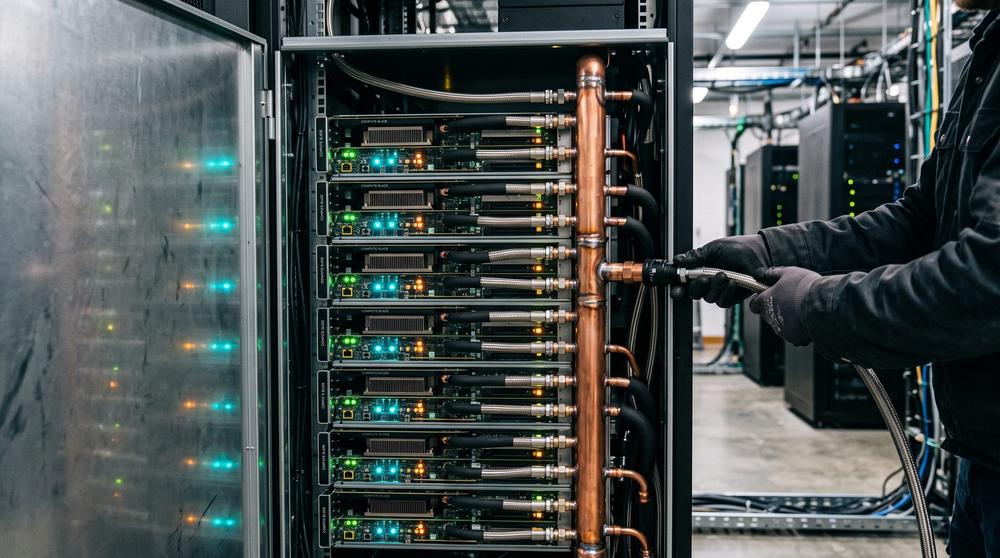
The specification is where this gets interesting. Each rack carries 72 AMD Instinct MI455X accelerators, AMD EPYC “Venice” CPUs and AMD Pensando Vulcano AI network cards, with six HPE Juniper QFX5252 switch trays and direct liquid cooling. The scale-up interconnect is UALink over Ethernet. Neither company disclosed how many racks that $1.2 billion buys, or when they go live.
Seventy-two accelerators in a box, on open plumbing
For two years the hard part of AI infrastructure has not been the accelerator. It has been the rack: getting dozens of chips to behave as one machine, keeping them cool enough to stay at clock, and making the whole assembly a thing a data centre operator can buy rather than integrate. That is the layer where the margins and the lock-in live, and until now there has been one credible way to buy it.
Helios is the second, and it is built on Ethernet. A scale-up fabric that speaks a standard rather than a vendor dialect means the switching, the optics and the operational tooling come from a competitive market. Vultr’s chief executive J.J. Kardwell framed the purchase in the plainest possible terms: demand for high-performance AI infrastructure, he said, “continues to exceed available capacity.” That is a buyer telling you why it went to the second door — not because the second door was cheaper, but because the first one had a queue.
HPE’s own read on it is a networking story. Antonio Neri pointed at the combination of rack-scale compute, scale-up networking and liquid cooling in one integrated design — which is HPE saying the Juniper acquisition has found its use case. The company raised its networking revenue growth outlook through fiscal 2029 and lifted the Juniper cost-synergy target to $800 million by fiscal 2028, and separately deepened an Oracle partnership on networking inside AI data centres.
Our take: An order is not revenue, and an undisclosed rack count with an undisclosed delivery schedule is a headline number doing a lot of work. What matters is not the $1.2 billion — it is that a second rack-scale architecture now has a paying customer with a name. Buyer leverage in this market has been close to zero because there was one product; the value of a credible alternative to the operator placing the order is real even before the first rack ships. Watch whether a second and third Helios customer appears in the next two quarters. One order is a design win. Three is a supply chain.
What to watch
- Rack count and delivery dates. Until one of them is disclosed, the order converts to revenue on a timetable nobody outside the two companies can model.
- Whether UALink over Ethernet holds up in production. An open fabric that underperforms at scale is worse than a closed one that works, and the first real benchmark will come from an operator, not a vendor deck.
- HPE’s networking margin, not its networking growth. A $800 million synergy target by fiscal 2028 is the number the raised outlook rests on.
- MI455X supply. A design win the supply chain cannot feed is a press release. Watch AMD’s packaging and memory commitments rather than its order book.
The accelerator was never the bottleneck. The rack was. That just got a little less true.