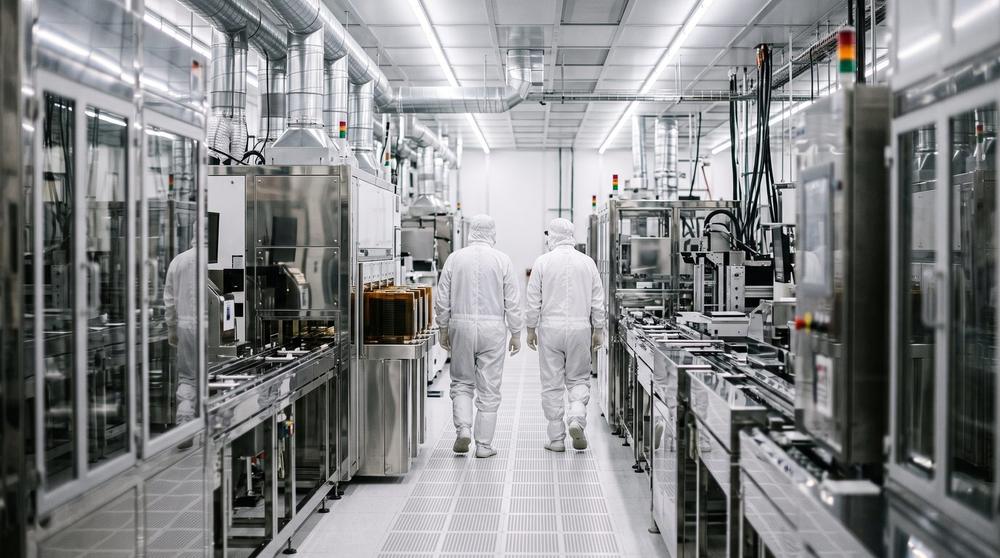
GlobalFoundries said Wednesday it will build two new 300mm wafer fabs at its Malta, New York campus, financed with up to $21bn from Japan under the trade and investment agreement the Trump administration struck with Tokyo. Roughly $10bn goes to the first fab, accelerating a facility expected to open in 2029. Another $10bn is earmarked for a second plant, with no timetable disclosed.
GlobalFoundries is not putting up the capital. It is supplying the process technology, the manufacturing expertise and the operations. Chief executive Tim Breen called it “a bold new initiative for semiconductor manufacturing, bringing together the United States and Japan.” Each fab is expected to add about 900,000 US 300mm wafers a year at full run rate, and the company says the build will create more than 1,000 skilled manufacturing jobs in New York’s capital region. Renesas Electronics is the named partner, treating the expanded New York capacity as an extension of its own production footprint.
Two further pieces landed the same day. The Commerce Department is taking roughly 4% equity in GlobalFoundries — President Trump posted that the government “will receive shares in GlobalFoundries,” the same structure applied to Intel. And GlobalFoundries is amending its existing CHIPS and Science Act award, moving $955m toward silicon photonics, silicon-germanium and advanced packaging at Malta and at Burlington, Vermont. A company spokesman said the earlier federal money will now go to other semiconductor investments.
Three different funding models in one announcement
Read the structure rather than the headline. A foreign government provides the capital. The American government takes an equity stake in the operator. The operator contributes capability and keeps the keys. And the grant programme that was supposed to do all of this on its own gets quietly re-pointed at packaging and photonics.
That is a sharp departure from how CHIPS was designed in 2022, which was straightforward: federal grants and tax credits to subsidise private capex, with no government ownership and no foreign sovereign cheque. What replaced it is closer to a joint venture in which Washington holds paper instead of writing it.
Our take: The reallocation is the most informative line in the release. GlobalFoundries is moving $955m of CHIPS money away from bulk capacity and into silicon photonics, silicon-germanium and advanced packaging — the parts of the stack where AI data centres are actually supply-constrained. Capacity for mature-node logic can now be funded by a sovereign partner who wants the output. Packaging and optical interconnect cannot be bought that way, because the bottleneck is process capability, not money. The company is using someone else’s capital for the thing that scales with cash and its own grant for the thing that does not.
What Japan is buying
The obvious question is what a Japanese cheque earns at a plant in upstate New York. The visible answer is Renesas: a Japanese chipmaker that would rather source US-made wafers from a US-based foundry than build and run a fab in America itself. Tariff exposure, customer-location requirements and automotive supply security all point the same way.
The terms are the gap. None of the filings or reports released Wednesday specify whether Japan’s $21bn is equity in the fabs, debt, guarantees or something structured — and no ownership split for the two facilities has been disclosed. Until that is public, the return Japan expects and the obligations GlobalFoundries carries are both unknown.
What to watch
- The terms of the Japanese financing. Equity, debt or guarantee changes who bears the risk if 2029 demand disappoints.
- Whether the second fab gets a date. The first $10bn is committed to a dated facility. The second is a stated intention.
- The Commerce equity stake’s final size. Reported at about 4%; confirm against the filing rather than the announcement.
- Who else signs. Renesas is the only named customer. A second anchor would say the capacity is pre-sold; silence would say it is speculative.
- Whether this becomes the template. If sovereign capital plus a US equity stake works here, expect it proposed for the next fab, and the one after.