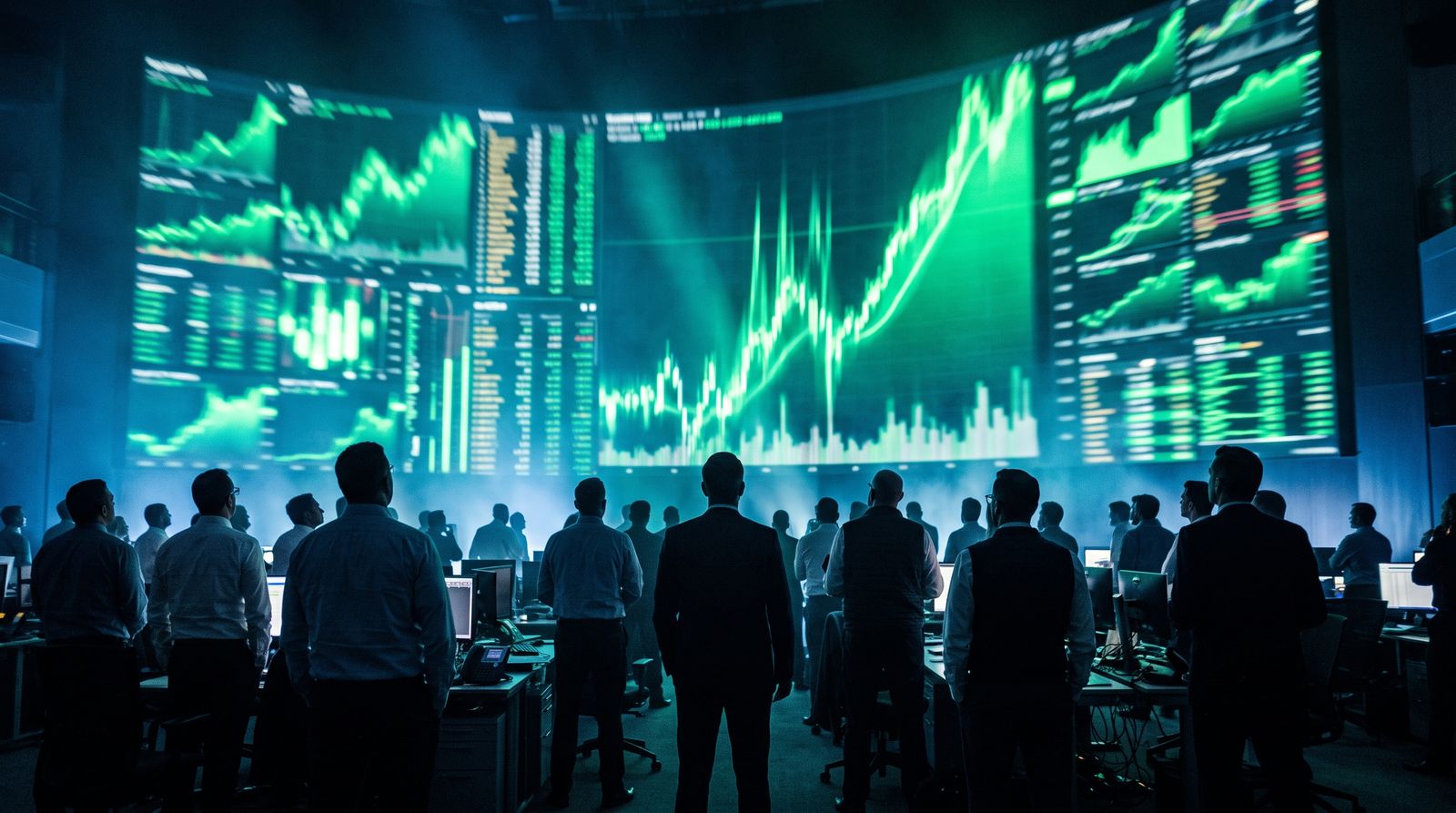
The Kospi closed Friday up 17.9%, back above the 6,500 level. It is the largest single-day gain in the index’s history. The record it broke was set in October 2008, when the benchmark rose nearly 12% in the middle of the global financial crisis.
Underneath it: SK Hynix closed up 29.95% at 1,718,000 won, pinned against Korea’s 30% daily price limit. Samsung Electronics rose 26.81% to 262,500 won. Both are memory names, and both had spent the previous three sessions being sold on the theory that AI capital spending was about to break.
Microsoft’s Thursday results are what broke the theory instead. Strong earnings from the biggest buyer of AI infrastructure landed overnight in Seoul, and Korea — a market whose index is effectively a leveraged bet on two memory manufacturers — did what a heavily shorted, heavily levered market does when the story flips.
The arithmetic nobody puts in the headline
Across July 28–30, the Kospi shed more than 17%, sliding from above 6,700 to roughly the 5,500 area. Friday it gained 17.9% back. Those two numbers look like they cancel. They do not.
A 17% drawdown requires a 20.5% gain to break even. A 20% drawdown requires 25%. The index is still trading below where it sat before Tuesday’s selling began, and it remains far below the peak above 9,000 it printed in June — more than 25% below, depending on where you mark it. The best day in the history of Korean equities did not recover one bad week.
Our take: Record up days are not a bull-market phenomenon. They are a bear-market phenomenon. The previous record was October 2008 — five months before the bottom. Violent upside happens when positioning is crowded short, leverage is forced to unwind, and liquidity is thin. All three describe Korea this week. That does not make Friday fake, and it does not mean the memory cycle is over. It means a single-day percentage is the least informative number on the screen, and anyone reading “biggest gain ever” as an all-clear is reading the wrong statistic.
It travelled
The move did not stay in Seoul. An ETF tracking chip stocks gained 3.3% in early U.S. trading Friday. Intel rose 4.6%, Micron 3.5%, AMD 3%, Nvidia 1%, with SanDisk and Western Digital each up more than 5% in the premarket. That is the second consecutive session of the memory complex rallying on the same input: hyperscalers confirming, in writing, that the spending is real.
Which is the actual signal here. The Kospi is not telling you about Korea. It is the highest-beta expression of one global question — does AI infrastructure spending hold? — and it answers that question louder and faster than any U.S. index, in both directions. Three days ago it said no and hit a circuit breaker. Friday it said yes and hit a record. Nothing about the underlying demand changed in 72 hours. Only the confidence did.
What to watch
- Whether the gap closes. The index needs another few percent just to recover the week. If it stalls below the pre-slide level, Friday was a short squeeze, not a turn.
- The 30% limit. SK Hynix locked limit-up, which means the price never found a clearing level. Monday’s open in Seoul is the first honest print.
- Leverage. Korea’s retail base runs heavy leveraged-ETF exposure. Moves this size in both directions force liquidations that have nothing to do with fundamentals.
- The next hyperscaler datapoint. This entire round trip was driven by earnings commentary on capex. The next one moves it again.
The useful lesson is smaller than the headline. When a market falls 17% in three days and rises 17.9% in one, the second number is not good news arriving. It is the same volatility, wearing a friendlier sign.