A company you depend on gets sued. The headline says a lawsuit has been filed seeking to unwind a $110bn merger, or alleging a product is defective, or claiming a platform destroyed a category of business. Your inbox fills with people forwarding it to each other. Someone asks you what it means.
Almost always, the honest answer is “nothing yet.” Occasionally it is “everything, and we should have moved last quarter.” The difference between those two is readable from the filing itself, and reading it takes about forty minutes. This is the playbook for those forty minutes.
One thing up front: this is not legal advice, and it will not make you a lawyer. It is a framework for a different job — deciding whether a lawsuit changes a business decision you own. Those are separate questions, and the second one is yours whether or not you have counsel.
Part 1 — The mental model: a complaint is a marketing document
The single most common error is treating a complaint as a finding of fact. It is not. A complaint is the most favourable possible version of one side’s story, written by advocates who are paid to be one-sided, filed before any evidence has been tested, and subject to essentially no accuracy requirement beyond a good-faith basis.
That does not make complaints worthless. It makes them a particular kind of evidence: they tell you reliably what the plaintiffs wish were true and what documents they think they can get. Both are useful. Neither is a verdict.
So read a complaint the way you read a pitch deck. Assume the strongest claims are load-bearing and look for what is conspicuously absent. The absences are where the information is.
Part 2 — The six questions, in order
Work these in sequence. Most filings die at question three, and you can stop there.
- Who filed, and what do they have to lose? A government enforcer with subpoena power is a different animal from a consumer class funded by contingency fees, which is different again from a competitor, which is different again from a disgruntled former executive. Rank by cost of losing: enforcers can lose cheaply and sue anyway; contingency firms cannot.
- What relief do they actually ask for? This is the most under-read line in any filing and the most diagnostic. Damages means they want to be paid. An injunction means they want behaviour changed. Divestiture or unwinding means they want the transaction undone. The relief tells you what a win would cost the defendant, and the gap between the rhetoric and the relief tells you how serious the filing is.
- Has this been dismissed before? A refiling is not a second opinion, it is a second attempt after a judge said no. Count the dismissals. If reporting says the plaintiffs are out of amendments, you are watching the endgame, not the opening.
- What is the specific mechanism of harm? “Reduced competition” is a conclusion. “Two services that priced against each other will now be sold as one bundle at an unannounced price” is a mechanism. Mechanisms can be checked against reality in six months. Conclusions cannot.
- Which of the defendant’s own numbers does the complaint quote? Plaintiffs quote the defendant’s public statements because those are admissible and undeniable. Anything the complaint borrows from an earnings call, a press release or a synergy target is the part of the case that will not go away, because the defendant said it.
- What would have to be true for this to matter to me? Write the sentence out. If you cannot complete it, the answer to “what does this mean” is “nothing,” and you are done.
The shortcut: If the complaint’s most alarming number came from the defendant’s own mouth, the number is real and the lawsuit is probably noise. Go read the source document instead. That is where the signal was all along — the filing just pointed at it.
Part 3 — The relief ladder
Rank the relief sought from least to most disruptive. This is your severity scale, and it is far more reliable than headline language.
- Damages only. A cost of doing business. Priced into insurance, reserved against, rarely changes behaviour. Treat as financial noise unless the sums approach a material share of equity.
- Declaratory relief. Plaintiffs want a court to say something is unlawful. Slow, and the practical consequence is a later lawsuit by someone else.
- Behavioural injunction. Stop doing a specific thing. This one can genuinely reach your business, because it can change a product you depend on, a price you rely on, or a contract term you negotiated.
- Structural relief — divestiture or unwinding. Maximally disruptive and maximally rare, especially from private plaintiffs after a deal has closed. Ask immediately who else could have sought this and didn’t.
That last question is the one professionals ask first. When state attorneys general and a major union had standing and leverage before a merger closed and chose to settle instead, they were pricing the merits. A private class asking a judge to unscramble the same transaction afterwards is not bringing new information; it is bringing less leverage, later.
Part 4 — The forty-minute read
You do not need the full docket. Here is the sequence, with time budget:
- Minutes 1–5: the prayer for relief. Last section of the complaint, usually a numbered list beginning “WHEREFORE.” Read it first. It is the ask, stripped of narrative.
- Minutes 5–15: the parties and jurisdiction section. Who is actually named as a defendant? Frequently fewer entities than the headline implies, and often not the parent you assumed.
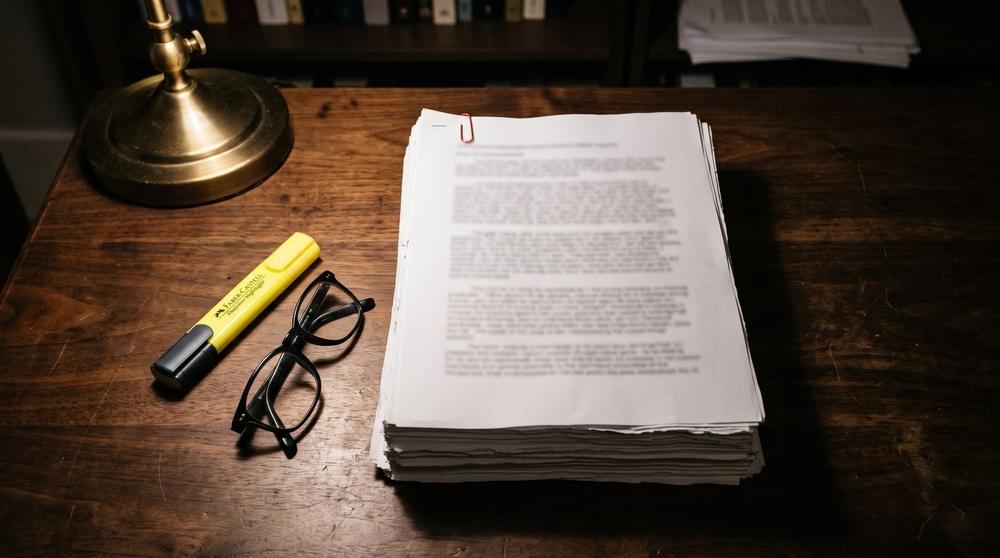
- Minutes 15–30: the factual allegations, skimming for quoted material. Highlight everything in quotation marks sourced to the defendant. That is your real reading list.
- Minutes 30–35: the causes of action. How many counts, under what statutes. Many counts is usually weakness, not strength — it means the plaintiffs are unsure which theory survives.
- Minutes 35–40: search for a hearing date. No scheduled date means nothing happens for months. A motion-to-dismiss schedule is the only calendar entry worth having.
Part 5 — The one-paragraph brief
Whoever asked you what it means gets this, and only this. Fill in the blanks:
“On [date], [who] filed in [court] against [named defendants only]. They are asking for [relief, in plain words]. This is [filing number] — the previous [number] were dismissed. The mechanism they allege is [specific mechanism]. The strongest material in it is [the defendant’s own quoted figure], which we can verify independently. Nothing happens procedurally until [date or ‘a motion-to-dismiss schedule is set’]. My recommendation is [no action / monitor these two numbers / start the contingency work on X], because [the completed sentence from question six].”
If you cannot fill every blank, you have not finished reading. If you can, you are better briefed than almost everyone discussing it.
Part 6 — Worked example
Take the November 2026 consumer suit against the Paramount–Warner Bros. Discovery combination. Run the questions.
Who: a consumer class, contingency-funded. Relief: structural — unwinding, or divestiture of HBO Max, CNN and the studio. Top of the ladder. Prior dismissals: at least one, possibly two, with reporting suggesting no further amendments permitted. The case dies at question three for most purposes. Mechanism: two streaming services that priced against each other merging into one bundle at an unannounced price — checkable, in early 2027. Defendant’s own numbers: a cost-savings target of at least $6bn, published voluntarily. What would have to be true for this to matter: for a vendor or employee, essentially nothing about the lawsuit; everything about the $6bn.
Conclusion in one line: ignore the filing, diary the bundle price, and go read the synergy target. And note the awkward fact the case has to live with — the company stops disclosing quarterly subscriber counts next quarter, which is the series any consumer-harm claim would need.
Part 7 — The seven failure modes
- Reading the press release, not the filing. Plaintiffs’ firms write both. Only one is constrained.
- Mistaking volume for strength. Fourteen counts across six statutes signals uncertainty.
- Ignoring who declined to sue. The parties with the best information and the most leverage, who settled or stayed out, told you something.
- Treating a refiling as new news. It is the same news, weaker, with a judge’s prior rejection attached.
- Trusting one outlet’s version of a key figure. Two reputable outlets read the same filing and reported the same savings target as a three-year total and as an annual run-rate — a threefold difference. Check two sources on any number you will act on.
- Acting on the allegation instead of the mechanism. Allegations are unfalsifiable for years. Mechanisms produce an observable in a quarter or two. Diary the observable.
- Forgetting the discovery channel. Even a weak case that survives dismissal can pull internal documents into daylight. That is a real, separate risk, and it is the one reason to keep watching a case you have otherwise written off.
The asymmetry worth remembering: lawsuits rarely change outcomes, and discovery frequently changes information. Most filings are safe to ignore. The ones that survive a motion to dismiss deserve a calendar entry, because what comes out of them is often more consequential than what they were asking for.
Part 8 — Your standing monitors
For any lawsuit you decide to keep watching, track exactly four things and nothing else:
- The motion-to-dismiss ruling. The only binary event that matters. Everything before it is procedure.
- The mechanism’s observable. The price, the term, the headcount, the disclosure — whatever the complaint said would get worse. Check it on schedule, not when prompted by news.
- What the defendant stops publishing. Disclosure that disappears right as a claim depends on it is worth noting, even when the timing is innocent — and usually it is.
- Whether an enforcer joins. A regulator arriving behind a private suit converts it from noise to signal in a single docket entry.
The objection clinic
“Surely a $110bn deal being challenged is inherently major news?” The size of the transaction and the strength of the challenge are unrelated. Big deals attract filings precisely because the damages arithmetic is attractive to contingency firms.
“Isn’t ignoring lawsuits how people get blindsided?” People get blindsided by ignoring mechanisms. This playbook does not say ignore the lawsuit; it says extract the mechanism, diary the observable, and stop re-reading the complaint.
“We have lawyers for this.” Good — they will answer whether you are exposed. They will not answer whether to renegotiate a contract, delay a migration, or start sourcing a second supplier. That decision needs this read, and it needs it from you.
Your first forty minutes
Find the complaint. Read the prayer for relief. Place it on the relief ladder. Count the dismissals. Highlight the defendant’s own quoted numbers and write them down with their source. Complete the sentence “for this to matter to me, X would have to be true.” Write the one-paragraph brief. Put one observable in your calendar with a date on it.
Then close the file. If the paragraph says no action, the right amount of further attention is none until the motion-to-dismiss ruling lands — and the discipline to spend none is most of what this playbook is for.