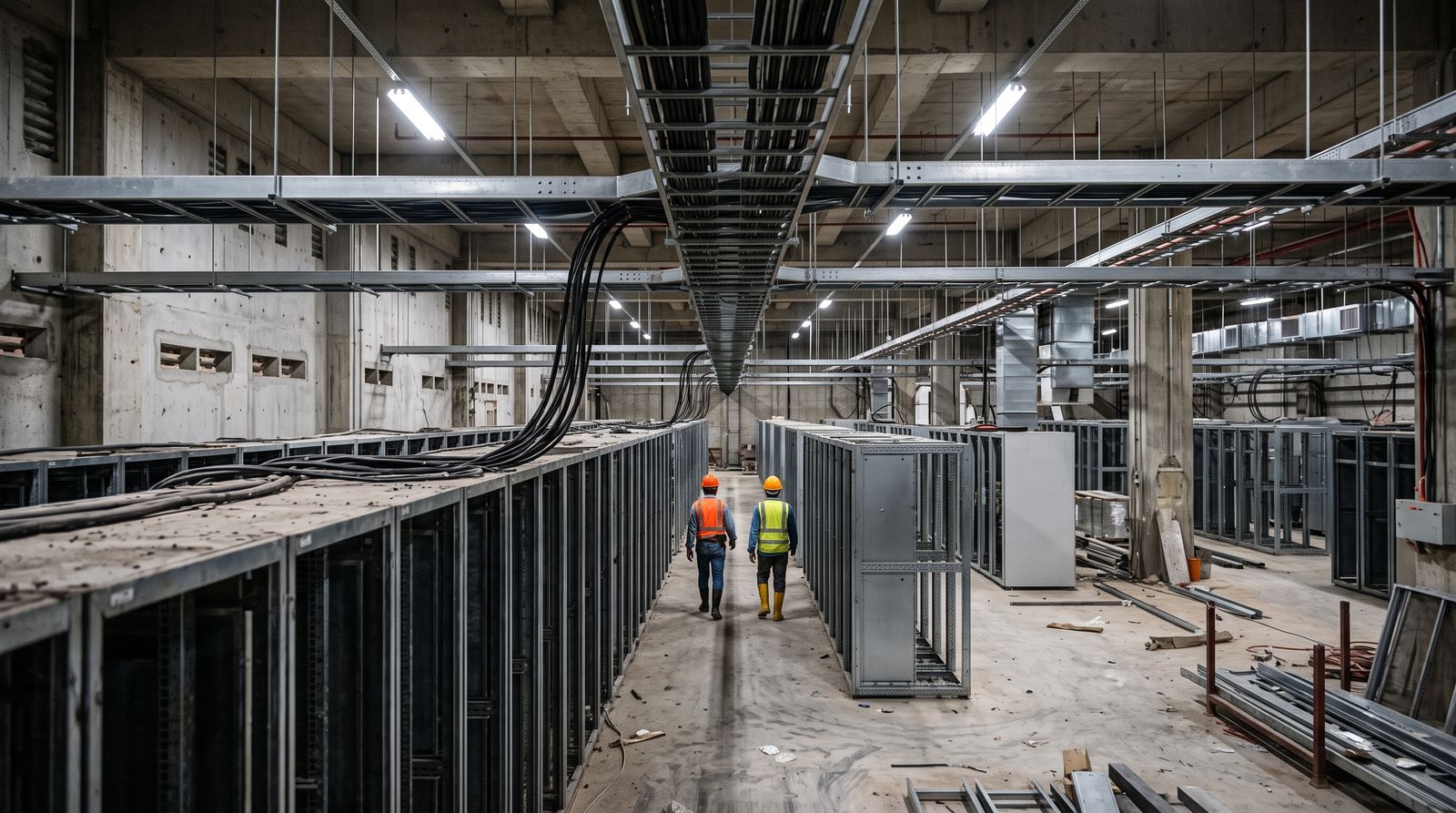
Larsen & Toubro builds refineries, metro lines, bridges and defence hardware. As of this week it also builds and operates AI data centres, and its first announced tenant is an American cloud company.
The company said its AI infrastructure subsidiary, LTN Compute, has won an order in the range of ₹10,000 crore to ₹15,000 crore — roughly $1.2 billion to $1.57 billion at the top end — from US-based Together AI. The centre will be hosted at L&T’s Vyoma.AI unit on its Chennai campus and will run 10,000 Nvidia B300 chips, which the company says is the largest such deployment in India. It will serve Together AI’s platform for inference, fine-tuning and training.
For L&T this is a declared entry into what it calls the AI factory business. For Together AI it is capacity, in a jurisdiction with cheaper construction and cheaper power than the US markets where GPU capacity is currently rationed.
The part worth reading twice
The order is a range, not a number. ₹10,000 crore to ₹15,000 crore is a 50% spread, which usually means the scope is phased, the drawdown is conditional, or both. Announced order values in Indian infrastructure are booked as they are executed, not on signature day, and a 5,000-crore gap is the difference between a good year and a very good one.
The chip count is the harder constraint. Ten thousand B300s is a real deployment but it is not a hyperscaler campus — it is roughly the scale a single well-funded lab reserves for one training programme. The more interesting question is whether this is a first tranche with follow-on capacity attached, which is how these facilities are almost always sold, or a one-off anchor tenant that has to be joined by others before the economics work.
Our take: This is the compute build-out finding its second geography. The first wave went where the power was already permitted — Virginia, Texas, the Nordics. The second wave goes where an engineering-and-construction firm can pour concrete fast and a government wants the industry. L&T is not a cloud company and does not need to become one; it is renting out the one thing it is genuinely world-class at, which is building large complicated things on schedule. Watch whether the contract is take-or-pay. If the capacity is committed for years regardless of utilisation, L&T has an annuity. If it is not, L&T has just underwritten someone else’s demand forecast with its own balance sheet.
Why an American company builds in Chennai
Three reasons, in descending order of how often they get said out loud. Power availability and cost. Construction timelines that are measured in quarters rather than years. And proximity to a customer base that is being courted by every large tech firm simultaneously — a facility inside India is also a data-residency answer for Indian enterprise buyers.
Against that: single-site concentration, a grid with its own reliability profile, and the fact that inference latency to non-Indian users is not improved by any of this.
What to watch
- Whether L&T discloses the contract term and whether capacity is committed or on-demand.
- Execution timeline — the gap between order announcement and energised racks is where these deals are actually won or lost.
- Whether LTN Compute signs a second tenant, which is the test of whether this is a business or a bespoke build.
- Power procurement for the Chennai campus, the number that determines the margin.
An engineering contractor just priced itself into the AI supply chain without buying a single chip on its own account. If the contract is committed, that is one of the better risk-adjusted trades in the entire build-out.