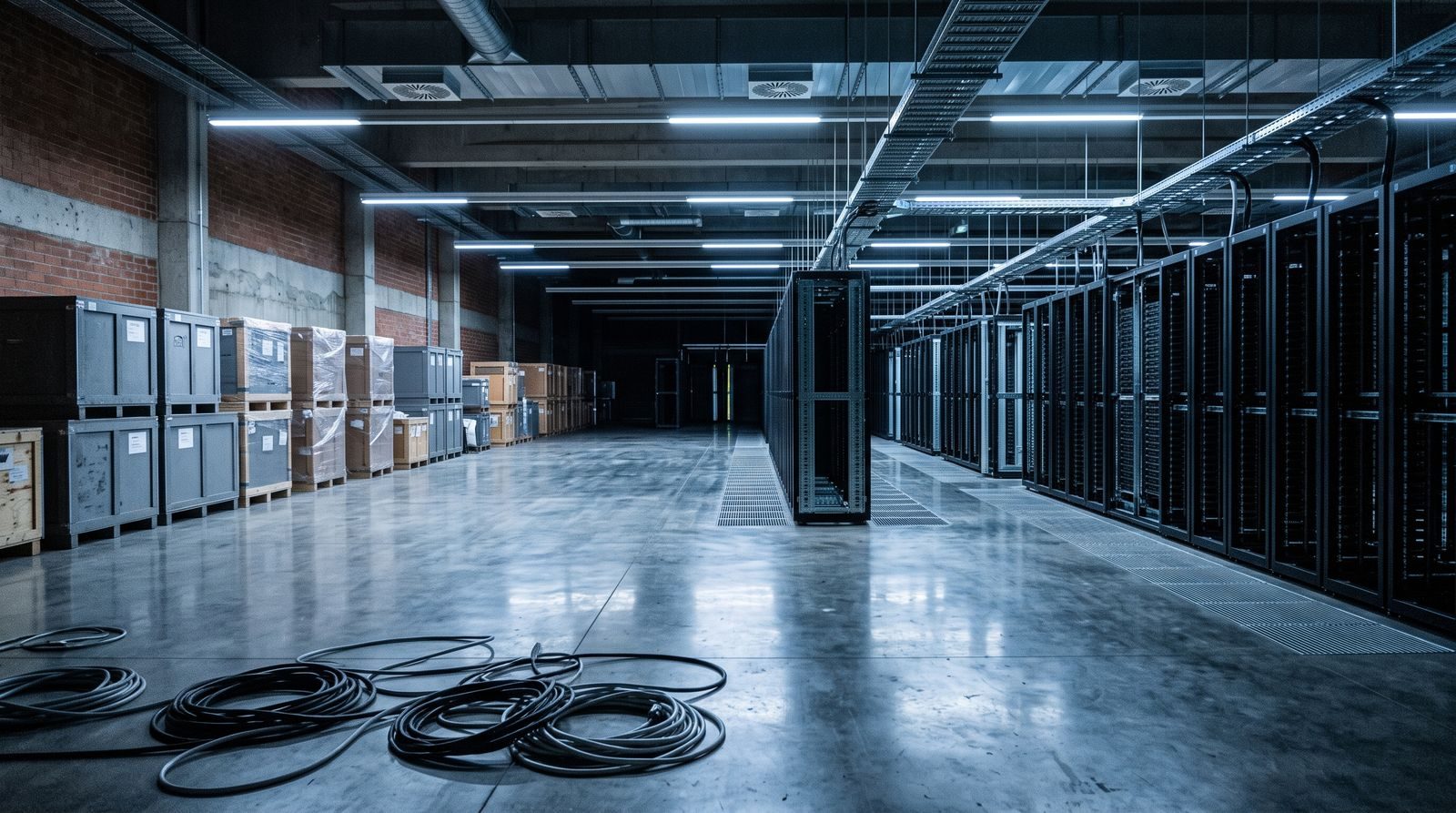
Microsoft has never told anyone how many AI accelerators it owns. On Monday, someone else did. A Guardian investigation, working from internal company documents, put the figure at roughly 2.2 million installed as of mid-2026 — and framed it against the gigawatts of data-centre capacity Microsoft has publicly said it is adding.
The arithmetic is what moved the stock. Rack-scale AI capacity of the density Microsoft has described implies a GPU count in the multiple millions; some outside estimates run past six million for a 10-gigawatt fleet. Against those back-of-envelope numbers, 2.2 million looks thin. Microsoft rejected the calculation, saying the estimates were built on incorrect assumptions. Shares closed at $479.15 on Monday, down more than 3%.
Here is the part the headline flattened: a low chip count is not necessarily a chip shortage. Satya Nadella has been saying the opposite for months, in plainer language than any analyst has managed. “It’s not a supply issue of chips,” he has said. “It’s the fact that I don’t have warm shells to plug into.” Translation: Microsoft can buy silicon faster than it can pour concrete and land an interconnect agreement. Accelerators sitting in a warehouse do not show up as installed.
Our take: This is the first serious attempt to audit a hyperscaler’s AI fleet from the inside, and the interesting finding isn’t the number — it’s that nobody outside Redmond could check it. Microsoft discloses capex, gigawatts and Azure growth. It does not disclose accelerators. That gap is where the entire AI capex debate now lives, and one leaked spreadsheet was enough to knock roughly 3% off a company whose cloud line grew 43%.
The constraint has changed shape
For two years the bottleneck story was Nvidia allocation. It isn’t any more. It is powered shells: finished buildings with a grid connection, cooling, and an energised substation. Microsoft’s own build schedule tells that story. The first Fairwater facility in Mount Pleasant, Wisconsin came fully operational in June, with a second adjacent site not due until 2028. The planned Pecos, Texas campus is expected to add about two gigawatts and will initially lean on a co-located natural-gas plant behind the meter before it connects to the regional grid.
That is a company solving for electrons, not for orders. And the macro backs it up: RAND estimates roughly 300 GW of announced US generation capacity through 2030 nets out to something closer to 82 GW once you account for projects that never finish, retirements and reliability margins — and not necessarily in the places the new load is showing up.
The demand side is not the problem
Microsoft’s July 29 quarter had Azure and other cloud services up 43% year over year, ahead of consensus near 40%, with the company adding 31 data centres and roughly another gigawatt of capacity in the period — and still saying demand exceeded available capacity. Guidance pointed to constant-currency Azure growth near 45% this quarter. When a business is capacity-constrained rather than demand-constrained, the chip count is a supply metric, not a health metric.
Which is why the sell-off is more about disclosure than about hardware. Investors underwriting a nine-figure-per-quarter buildout have been asked to take gigawatts on faith. Monday established that they don’t have to — and that the number they get from a leak may not flatter the story.
What to watch
- Whether Microsoft starts disclosing accelerator counts. Once one hyperscaler does it, the rest inherit the question.
- Powered-shell delivery, not capex. Data centres added per quarter and gigawatts energised are the honest read on how fast chips convert to revenue.
- The Pecos grid connection. Behind-the-meter gas is a bridge. How long the bridge has to hold tells you how bad the interconnect queue really is.
- Azure’s capacity language on the next call. If “demand exceeds capacity” disappears, the constraint has moved again.
Microsoft’s problem, if it has one, is not that it can’t get chips. It’s that it has spent two years asking the market to value a fleet the market cannot count.