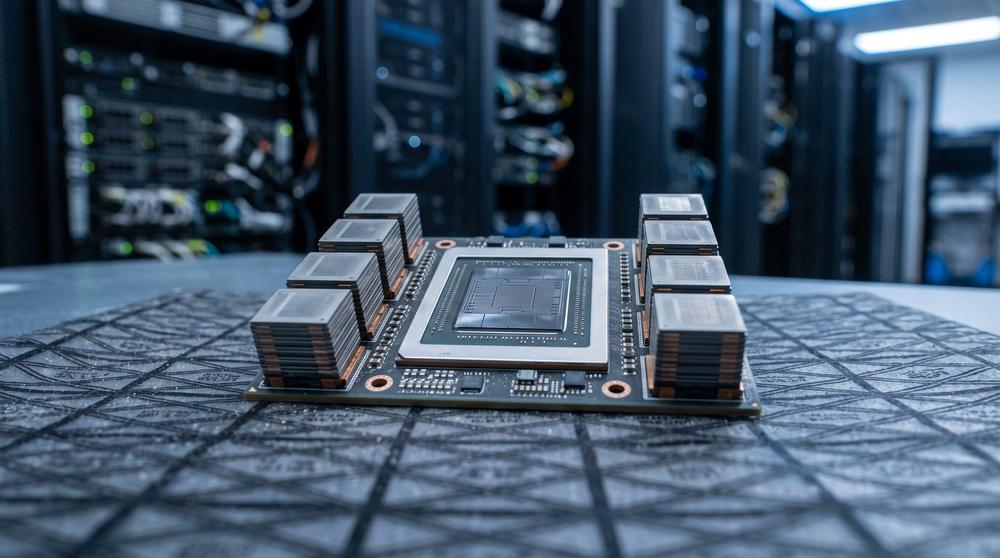
Microsoft announced the Maia 300 on Monday, and the headline is not the silicon. It is the sentence attached to it: Microsoft says the Maia family will become its primary inference system. That is a company that spends more on Nvidia hardware than almost anyone alive telling the market it intends to move its largest and fastest-growing cost line onto a chip it designed itself.
The part shipped is a specification. Scott Guthrie, executive vice-president of Cloud + AI, announced the chip in a Microsoft blog post. Maia 300 carries 288GB of HBM4 across eight 36GB stacks with 18 TB/s of peak memory bandwidth, draws 950W per package against the Maia 200's 750W, and builds its compute chiplets on TSMC's N2P node. Racks hold 96 accelerators inside a 167kW envelope, giving 27.6TB of HBM and 1.7 PB/s of aggregate bandwidth per rack, with scale-up clusters of roughly 12,000 accelerators.
The part not shipped is the chip. Production deployments begin in 2027. Reuters reports Microsoft could put more than a million Maia 300s in the field that year. Nothing lands in 2026.
Read the claim carefully
Microsoft says Maia 300 delivers 40% more tokens per megawatt than "leading GPU-based AI systems," and up to seven times the rack-scale token throughput of Maia 200. Note what the first number is measured in. Not tokens per dollar, not tokens per second, not tokens per chip — tokens per megawatt. That is the metric of an operator who has run out of power, not out of silicon.
It is also unverifiable as stated. Microsoft has not named the comparison systems or published the workload, and a 40% efficiency claim means very little without knowing whether the baseline is a current-generation rack or a two-year-old one. Nvidia is not named anywhere in the announcement.
The positioning is narrow and deliberate. Maia 300 is inference-first — built for long-context, memory-intensive, decode-heavy work, with enhanced MXFP4 precision to shrink the KV cache and on-die SRAM used as a software-managed scratchpad to take pressure off HBM. Microsoft made no training claims at all. Training stays where it is.
Our take: This is a cost announcement wearing an engineering announcement's clothes. Inference is the line item that scales with usage rather than with ambition, and it is the one Microsoft can actually attack with its own silicon because inference workloads are narrower and more predictable than training runs. But the gap between "we announced it" and "it is carrying our traffic" is fifteen months, and in that window Microsoft keeps buying GPUs. Treat 2027 as the date the pricing conversation changes, not this week.
What to watch
- Whether Microsoft publishes a benchmark. The tokens-per-megawatt figure needs a named baseline before it means anything. If no detail arrives by the 2027 deployment, assume the comparison was flattering.
- HBM4 supply. 288GB per package across a million chips is an enormous memory order. The constraint on this plan is more likely to be HBM allocation than TSMC wafer starts.
- Power, not chips. "Multi-gigawatt deployments" starting 2027 is the real commitment. Watch the datacentre and interconnect announcements, which are the leading indicator for whether the silicon has anywhere to live.
- Nvidia's response on inference pricing. Three hyperscalers now have in-house inference parts. The competitive pressure shows up in rental pricing long before it shows up in unit share.
Microsoft has said out loud where it wants its inference bill to go. The chip that takes it there is a year and a quarter away.