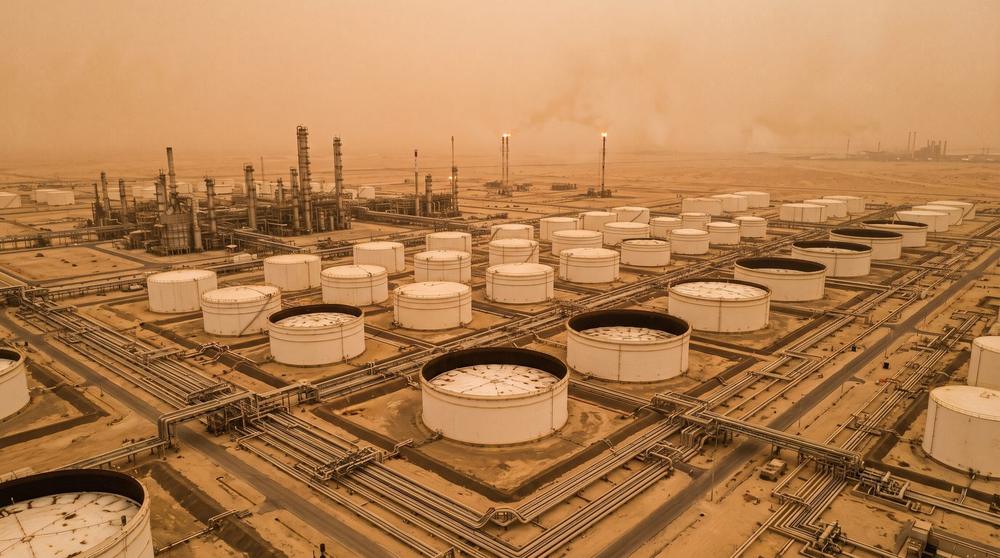
Oil closed the week above $100 and stayed there. WTI settled Friday at $100.30 a barrel, down $1.61 or 1.58% on the day. Brent settled at $103.87, off 95 cents or 0.91%. Both are lower than Thursday and both are in a place the market spent most of the last three years assuming was structurally out of reach.
The daily direction is noise. The level is the story. Crude is up roughly 20% over the past month and around 62% against this time last year, and the reason is not demand.
Supply came out, and it has not come back
Iran-aligned Houthi forces have run drone and missile attacks on Saudi Aramco installations and other energy infrastructure across southern Saudi Arabia. Saudi Arabia’s energy ministry suspended operations at several oil facilities and utilities after the strikes. Analyst estimates put the cumulative damage at an additional 4% to 5% of global crude supply offline — and repair-and-restart timelines on export infrastructure are measured in months, not days.
That has shown up in inventories with unusual speed. The EIA’s Short-Term Energy Outlook has global oil stocks falling by an average of 3.9 million barrels a day in the second quarter of 2026 and a further 3.0 million barrels a day on average in the third. Inventories are the buffer that normally absorbs a geopolitical shock and lets prices mean-revert. This time the buffer was already draining when the shock arrived.
Our take: The market has stopped treating $100 as a spike and started treating it as a floor. That is a different regime, and it changes the arithmetic for everyone downstream. A one-week oil spike is a headline. A sustained triple-digit crude price with a depleted inventory cushion is an input cost that works its way through freight, chemicals, plastics, airlines and food over two to three quarters — arriving in the data well after the event that caused it has left the news cycle. The supply loss is physical, not speculative, so it will not be talked down.
It collides with a central bank that just moved
The timing is awkward. The Federal Reserve raised rates 25 basis points this week, its first hike since 2023, and the Bank of Japan went to 1.25%, a 31-year high. Both were responding to inflation that had already shown up. Neither has yet had to price in an energy shock that is still feeding through.
An oil-driven price increase is the hardest kind for a central bank to answer. It is a supply shock, so rate rises do nothing to fix the cause — they only suppress the demand side hard enough to offset it. That is the setup that produces policy mistakes in both directions.
Equity markets did not treat Friday as a crisis. The S&P 500 finished up 0.17% at 7,650.50 and the Nasdaq Composite gained 0.39% to 26,522.55, while the Dow shed 95.40 points, or 0.18%, to 51,682.64. The index level is being carried by companies whose cost base is electricity and silicon rather than diesel.
What to watch
- Saudi export restart timelines. The single biggest variable. Any concrete guidance on when suspended facilities resume loading moves the whole curve.
- The inventory print, not the price. Weekly builds returning would signal the floor is softer than it looks. Continued draws confirm the regime.
- Diesel and jet crack spreads. Refinery limits have supported distillate margins, and that is where the consumer-facing pain lands first — freight and airfares before petrol.
- Q3 guidance language. Late-October earnings calls from transport, chemicals and consumer goods are where a sustained $100 crude stops being a commodity story and becomes a margin story.
Two of the past three years, oil above $100 lasted a few weeks and the market was right to fade it. The difference now is the inventory cushion that made fading it the correct trade.