The University of Hong Kong put out a press release this weekend, and by Sunday the story had a shape: one workout a week works as well as three. The underlying trial — 315 adults, four months, randomized, published in Nature Communications — is real, well run, and better than most of what gets written up in this category. The claim being hung on it is not quite what it says.
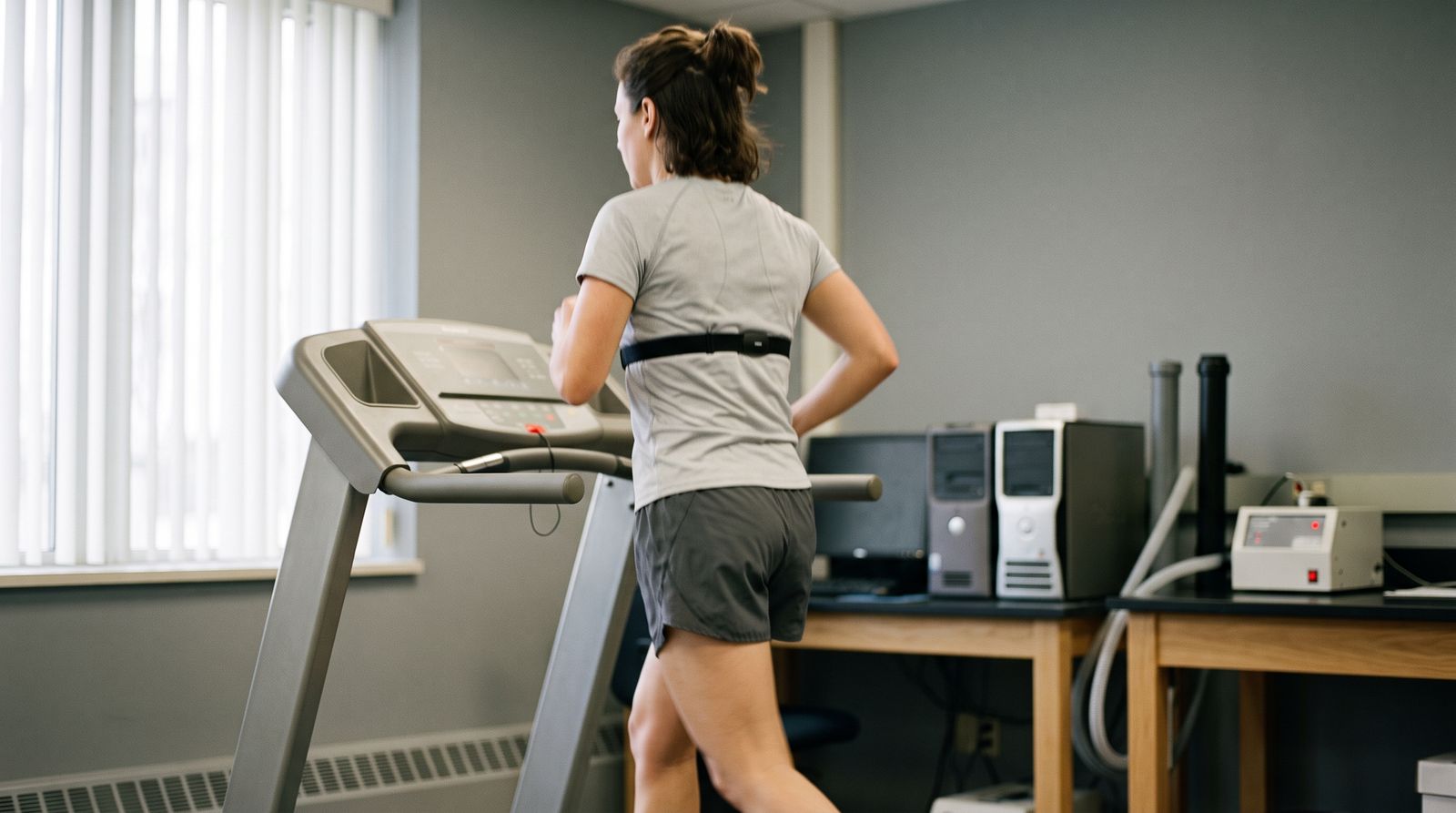
Parco Siu’s team at HKUMed’s School of Public Health recruited 315 inactive Chinese adults with central obesity — mean age 48, mean BMI 28.7, 65% women — and split them three ways. One group did supervised interval training once a week. One did it three times a week. The third sat through a 150-minute health education class every fortnight. Both exercise groups got the identical weekly dose: 75 minutes of hard intervals, four minutes at 85–95% of peak heart rate against three minutes of active recovery, on a treadmill, with a trainer watching and a chest strap on. Body fat was measured by DXA at baseline, at 16 weeks, and again at 32.
At 16 weeks, both training groups beat the control group. Once-weekly cut total fat mass by 0.8 kg (95% CI −1.4 to −0.2, P = 0.0107). Thrice-weekly cut it by 1.0 kg (−1.6 to −0.5, P = 0.0003). The gap between the two exercise groups — 0.3 kg — came back at P = 0.36. Waist circumference and body-fat percentage fell in both. Fitness rose about 6% in the once-weekly arm and about 11% in the thrice-weekly arm.
Our take: P = 0.36 is not a tie. It is the study telling you it cannot see the difference, and the authors say why in plain text: “our study was not powered to detect the differences between the H1 and H3 groups.” They write it twice. The trial was sized to test exercise against no exercise, and that is exactly the question it answers well. Everything else — the “as effective as,” the “you can skip the gym” — is a null result being read as equivalence, which is the single most common way a good exercise study gets laundered into bad advice. There is no non-inferiority margin anywhere in the paper. The honest headline is narrower and still useful: one hard session a week is dramatically better than nothing, and it clears a bar most people assume requires three.
The once-weekly session is not 75 minutes
This is the detail the coverage dropped. The thrice-weekly group did 35 minutes a visit — warm-up, a 25-minute interval block, cool-down. The once-weekly group did that 25-minute block three times in a single visit, with 15 to 30 minutes of rest between each. Add the warm-up and cool-down and the “one workout” is roughly two hours in the building, three consecutive rounds of four-by-four intervals at near-max heart rate, supervised.
The researchers costed it out. Counting travel, the once-weekly group spent about 4.5 hours a week on this and the thrice-weekly group about 8.2. So the time saving is real — it is just a saving on commuting, not on suffering. Anyone reading this as permission to do one easy session on Saturday has the protocol backwards.
What did not move
Lean mass, blood pressure, fasting glucose, cholesterol and triglycerides stayed flat in every group across the whole study. Only the thrice-weekly group significantly reduced body weight and BMI against control. And at the 32-week follow-up, 16 weeks after the training stopped, only waist circumference was still better in both exercise groups; the fat-mass and body-fat-percentage advantages were no longer statistically detectable, and only the thrice-weekly group was still measurably fitter.
Adherence was strong — 94% completed, attendance 86% and 83% — and there were no study-related adverse events, serious or otherwise. That matters: this was a hard protocol delivered to sedentary middle-aged adults without incident.
What to watch
- Whether anyone runs the non-inferiority trial. The claim now circulating requires a study designed to test it, with a pre-specified margin and roughly triple the sample. Until that exists, “once is as good as three” is a hypothesis with good press.
- Generalizability. The authors flag it themselves: all participants were ethnic Chinese adults with relatively healthy glucose, lipids and blood pressure at entry. This says little about anyone already managing type 2 diabetes.
- The detraining cliff. The most instructive result here is the 32-week data. Almost everything reverted within four months of stopping. The variable that survived was the habit, not the dose.
The useful reading is a floor, not a substitute. If your week has one slot in it, the evidence now says a single hard, structured session is worth putting there — and the price of admission is intensity, not calendar space.
Reporting on published research, not medical advice. High-intensity interval training carries real cardiovascular risk for some people; talk to a clinician who knows your history before starting.