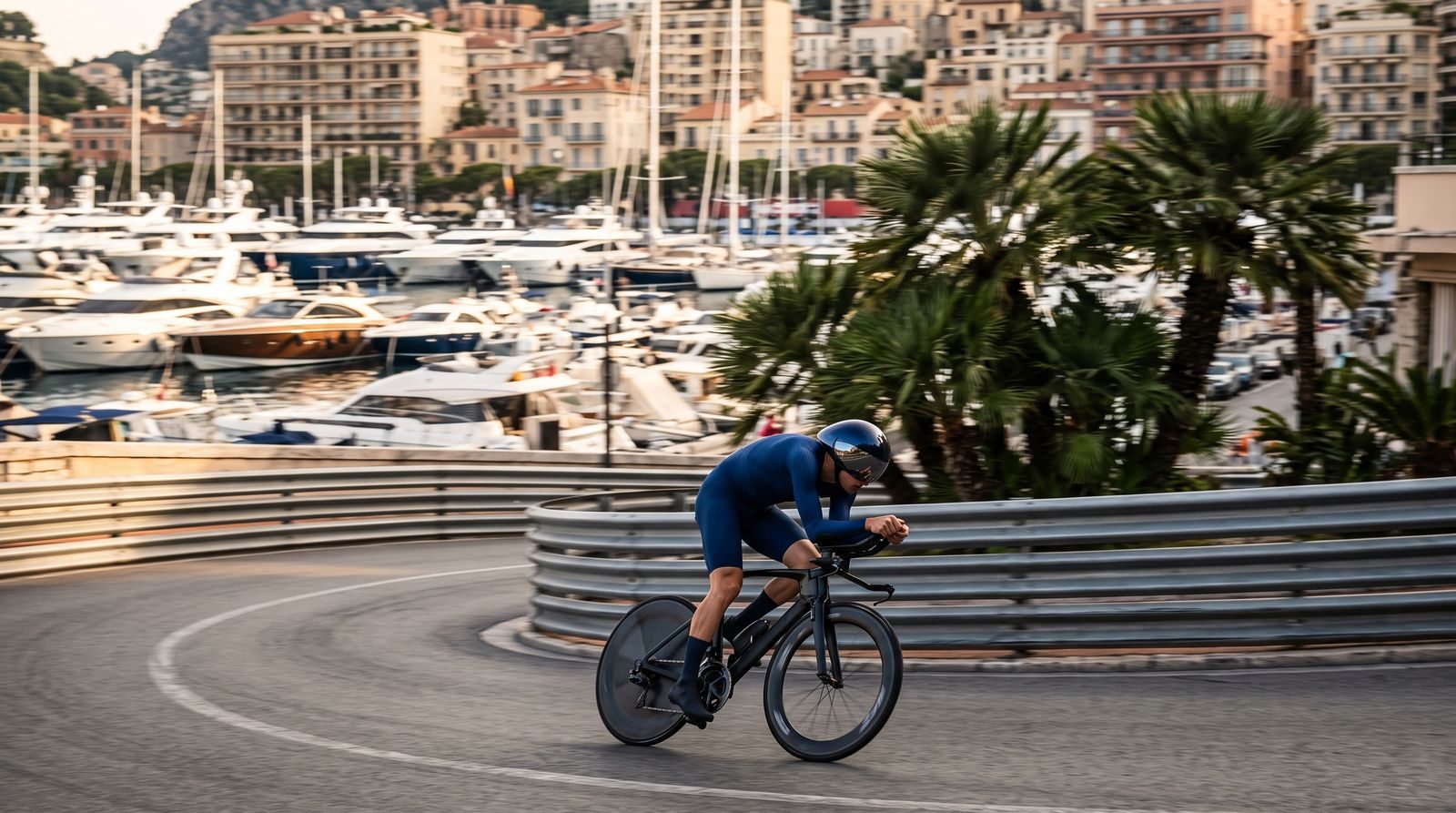
The 81st Vuelta a España started on Saturday with a 9.4-kilometre individual time trial that never left the Principality of Monaco, running over parts of the Formula One street circuit and climbing a grand total of 55 vertical metres. On paper it was a formality — too short to separate anyone, a prologue with a stage number attached.
Tadej Pogačar (UAE Team Emirates-XRG) won it in 10:57. Ethan Hayter (Soudal Quick-Step) finished 0.09 seconds behind him.
That is nine hundredths of a second across roughly 657 seconds of racing — a margin of about 0.014% of the winning time. Hayter had been the first rider under 11 minutes and was three seconds up on Pogačar at the intermediate check. He lost his first Grand Tour stage win in the second half of a course with 25 corners, where the deciding variable was not power but how late you were willing to brake.
The result
- 1. Tadej Pogačar (UAE Team Emirates-XRG) — 10:57, red jersey
- 2. Ethan Hayter (Soudal Quick-Step) — +0.09s
- 3. Joshua Tarling (Netcompany-Ineos) — +4s
- 4. Callum Thornley (Red Bull-Bora-Hansgrohe) — +5s, on his Grand Tour debut
- 5. Christophe Laporte
Tarling rode to third place a little over a week after the death of his younger brother, Finlay. Three of the top four were British.
The number that actually decides the race
The 0.09 seconds is the headline. It is also, for general classification purposes, meaningless — Hayter is not riding for the overall. The figures that will still be on the board in Granada three weeks from now sit further down the sheet.
Pogačar’s nearest overall rival after stage one is his own team-mate João Almeida, 18th on the day and 18 seconds down. Carlos Rodríguez (Netcompany-Ineos) is 27 seconds back. Oscar Onley lost 50 seconds. On a stage barely longer than a warm-up, before a single mountain has been climbed, the man chasing the only Grand Tour missing from his collection has taken most of a minute out of one podium contender and half a minute out of another.
Our take: Short courses do not compress margins — they change which margin you are measuring. Nobody loses 50 seconds on 9.4 kilometres through fitness. They lose it through cornering, pacing discipline, equipment choice and the willingness to take risk on a road with barriers on both sides. The stage was decided on execution, not engine, which is precisely why a rider three seconds down at halfway still won it. The general rule travels well beyond bike racing: when the task is too small for capability to separate people, technique and nerve do it instead.
Context
This is Pogačar’s first Vuelta since his Grand Tour debut in 2019, when he finished third. The Spanish race is the only three-week race he has not won. Primož Roglič, a four-time Vuelta champion, was the last rider down the start ramp at 19:20 local time. The route ahead is not gentle: Andorra on stage four, Aramón Valdelinares on stage seven, the Sierra de la Pandera on stage 14 and a second time trial from El Puerto de Santa María to Jerez on stage 18.
What to watch
- Stage 4, Andorra la Vella: the first genuine mountain test, and the first chance for the riders who lost time on Saturday to get it back.
- Almeida’s role: UAE now has the two strongest riders in the race on the same team and 18 seconds between them. That is a team-management problem, not a tactical one.
- Stage 18 time trial: a second race against the clock, this time long enough that engine beats nerve. If the GC is still close, that is where it ends.
- Hayter: a rider who has now been within a wheel of a Grand Tour stage win will get more chances in the flat first week.
Three weeks is a long time to defend a jersey won by nine hundredths of a second. It is also, historically, exactly the kind of start that stops being a curiosity and becomes the reason a race was won.