Positron AI raised $875 million and came out at a $5 billion valuation, the company announced Thursday. Seven months ago it raised $230 million at roughly $1 billion. That is a five-fold repricing in two quarters, in a category — inference silicon — where the incumbent has a 90-plus percent share and infinite money.
The round is split: a $375 million Series C at a $3.5 billion pre-money valuation, plus a Series C-1 of up to $500 million led by NEA and Jim Clark, the founder of Silicon Graphics. Co-leads include Atreides Management, Valor Equity Partners, Andra Capital and SemiAnalysis Capital. Qatar Investment Authority, Cisco Investments and Naver Ventures joined.
The money funds the tapeout of Asimov, Positron’s next-generation part, on TSMC’s N3P process at the end of 2026, with production targeted for the second half of 2027. It also pays for a 2MW-plus engineering data centre and emulation platform, and the production ramp of Titan, the current-generation system.
The number that matters is not FLOPS
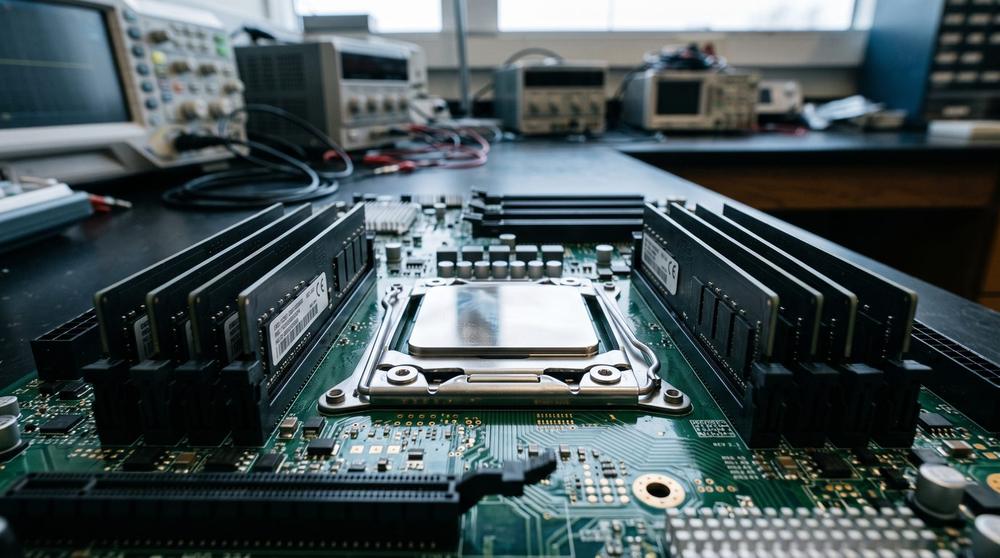
Asimov pairs Positron’s compute architecture with between 288GB and 2,304GB of memory per chip — built from commodity LPDDR5X, not exotic HBM. Set that against a flagship GPU carrying under 200GB of high-bandwidth memory and the design philosophy is obvious: Positron is not trying to win the multiply-accumulate race. It is trying to make the memory wall someone else’s problem.
That bet is well timed. Modern inference is dominated by the KV cache — the running memory of a conversation or an agent trajectory — and the cache scales with context length and concurrency, not with model size. Long-context agents are memory-bound workloads wearing a compute-bound costume. It is why DeepSeek’s headline achievement this week was a cache reduction rather than a benchmark score. Whoever puts the most usable memory behind a die serves the most concurrent sessions per rack, and cost per token is a rack-density question long before it is a silicon question.
Using commodity LPDDR5X rather than HBM is the second half of the bet. HBM supply is allocated years out and priced accordingly; LPDDR5X is the memory in phones and laptops, made in enormous volume by multiple suppliers. Trading peak bandwidth for capacity, availability and price is a defensible trade if your workload is capacity-starved — and a bad one if it is bandwidth-starved.
Our take: The valuation is not paying for a shipping product — Asimov has not taped out and will not be in production until late 2027. It is paying for a thesis: that the inference bottleneck has moved from arithmetic to memory, permanently, and that the architecture optimised for the old bottleneck is now carrying dead weight. That thesis is looking better every month. But note the gap between the cheque and the chip. Eighteen months is a long time in this market, and the incumbent has a memory roadmap too. What Positron has actually bought with $875 million is the right to still be standing when Asimov arrives.
What to watch
- The N3P tapeout at year-end. Slip it and the 2027 production window compresses against the next GPU generation.
- Titan customer names. The current system shipping into real production workloads is the only evidence that the memory-first thesis survives contact with a customer’s serving stack.
- Whether LPDDR5X holds up. If agent workloads turn out to be bandwidth-bound rather than capacity-bound, the commodity-memory choice inverts from advantage to ceiling.
- Cisco and QIA on the cap table. Strategic money in a silicon round usually signals a distribution conversation happening in parallel.
The inference market is quietly splitting into two questions: who owns the compute, and who owns the memory next to it. The first question has an answer everyone knows. The second one just attracted $875 million and a $5 billion price tag — alongside a wave of capital betting on silicon that is not a GPU and an incumbent buying its way toward the same idea.