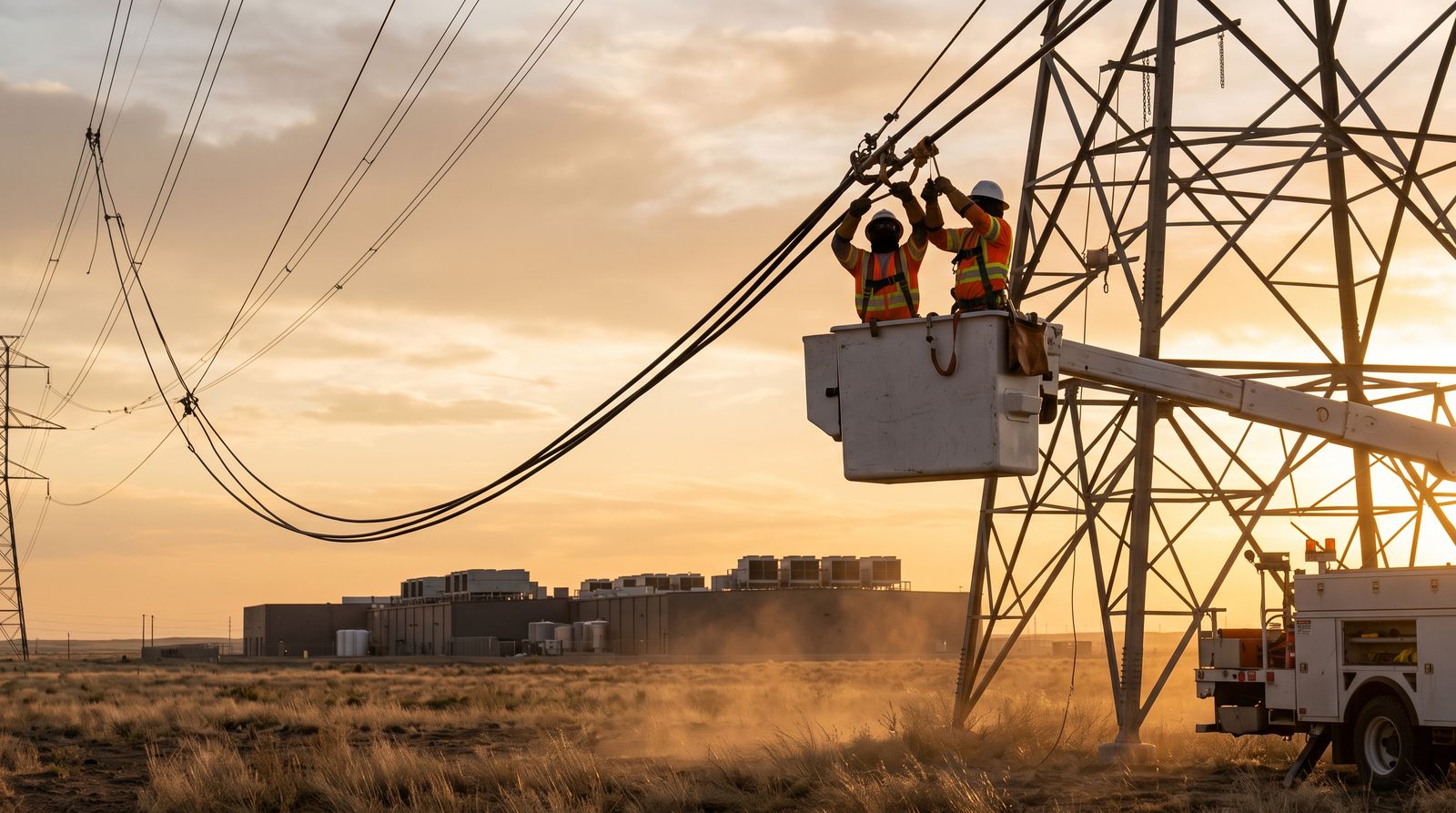
Quanta Services builds the unglamorous half of the AI boom — transmission lines, substations, generation tie-ins, the underground guts that connect a data center to actual electricity. On Thursday morning it reported a quarter that makes the glamorous half look almost restrained.
Second-quarter revenue came in at $9.56 billion, up 41% from $6.77 billion a year ago and roughly a billion dollars past the $8.5–8.6 billion analysts expected. Adjusted earnings were $4.24 a share against a $3.30 estimate, up from $2.48 last year. Adjusted EBITDA was $1.1 billion versus roughly $875 million expected. Shares jumped more than 13% Thursday morning.
Then management raised full-year revenue guidance to $39.3–$39.7 billion, up from $34.7–$35.2 billion three months ago. That is about $4.5 billion of revenue added to a single year’s outlook in one quarter. Adjusted EBITDA guidance went to $4.09–$4.21 billion from $3.49–$3.65 billion, and adjusted EPS to $16.45–$16.95 from $13.55–$14.25.
The backlog is the actual headline
Total backlog hit a record $53.44 billion, up 49% year over year and up from $48.5 billion just one quarter earlier. Within it, the Underground Utility and Infrastructure Solutions segment’s backlog grew 74% year over year to $9.65 billion.
Backlog is a harder number than a quarterly beat. A beat tells you what customers paid last quarter; backlog tells you what they have already committed to pay. Quanta attributed the growth to increased customer investment in electric grid, power generation and mission-critical infrastructure — which is contractor language for “data centers, and everything that has to exist before a data center can turn on.”
The read-through moved the whole complex. EMCOR also rose on results and guidance, lifting engineering and construction names across the board, and Bloom Energy was upgraded to Outperform at Mizuho after its own beat-and-raise quarter.
Our take: The market keeps pricing the AI buildout through semiconductors, but the schedule is set by electricians. A chip order can be filled in weeks; an interconnect queue runs years, and no amount of capex shortens it. That is why AMD paid up for 530 megawatts of committed capacity and why Meta had to guarantee $13 billion of debt to get a campus financed — power is the scarce asset, not silicon. A 49% backlog increase at the company that installs it is the cleanest confirmation yet that hyperscaler capex is landing as signed contracts, not slideware. It also cuts the other way: Quanta’s backlog is now a leading indicator for everyone else’s. If it flattens, the buildout is slowing well before the chip names admit it.
What to watch
- Whether backlog growth outruns headcount. Quanta’s constraint is skilled linemen, not demand. A record book means nothing if the crews to burn it don’t exist.
- The composition of the guidance jump. Management flagged contributions from recently completed acquisitions. Organic versus bought growth is the difference between a structural boom and a roll-up.
- Margin behavior at scale. Adjusted EBITDA margin ran roughly 11% this quarter. Contractors historically trade margin for growth when they scale this fast; this one hasn’t yet.
- The rest of the power complex. Utilities, turbine makers and grid equipment names report over the next two weeks. If their backlogs echo Quanta’s, the constraint story is confirmed across the supply chain.