Samsung Electronics reported its second quarter on Thursday and the headline is almost comically large. Consolidated revenue of 171.5 trillion won, an all-time quarterly high, up 28% sequentially. Operating profit of 89.5 trillion won — roughly $58 billion in three months, and about 19 times the year-ago figure. Earnings per share rose 52% to 10,849 won.
Now the part that matters. The Device Solutions division — chips — posted 127.5 trillion won of revenue and 89.2 trillion won of operating profit. The company total was 89.5. Everything else Samsung does — phones, TVs, appliances, displays, networks, Harman — netted out to roughly 300 billion won, or about one third of one percent of the profit.
And the MX and Networks businesses, which include every Galaxy phone sold on earth, reported 33.2 trillion won of revenue and an operating loss of 700 billion won. Revenue was up about 14% year over year on solid Galaxy S26 and A-series sales. A year ago that same unit earned 3.1 trillion won. It is the first quarterly deficit the segment has recorded since Samsung began breaking it out in 2011.
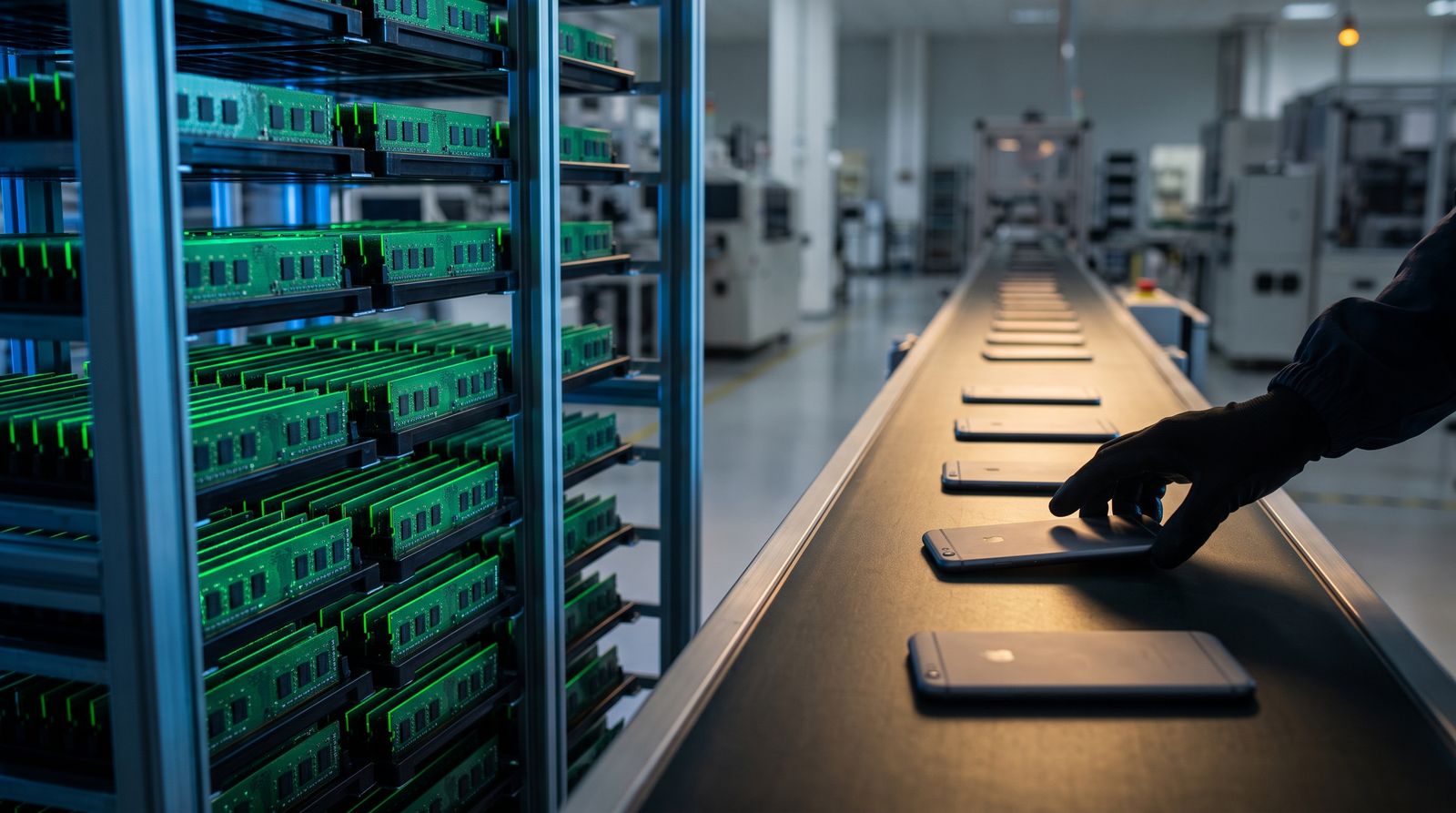
Our take: This is the cleanest picture anyone has published of what the AI memory shortage actually does to a P&L. Samsung is the rare company that sits on both sides of it — it makes the memory and it buys the memory — and it charges itself the going rate. The chip division booked a 70% operating margin selling DRAM into AI servers. The phone division ate that same price as a cost and could not pass it to a buyer choosing between a Galaxy and an iPhone. Same company, same quarter, one shortage: 89.2 trillion won of profit on one floor, a loss on the other. If Samsung cannot absorb component inflation, no handset maker can.
Why the phone unit could not win
Nothing went wrong with the product. Flagship demand held, the A series grew, revenue climbed. What broke is the bill of materials. DRAM and NAND are the second-largest cost in a premium phone after the processor, and their prices have gone vertical because AI server builders will pay more for the same wafers. Samsung's memory business said outright that its record came from prioritizing server products under limited capacity, with server revenue hitting a record share of the mix.
That is a decision, and the phone division is on the other end of it. Handset makers replace their bill of materials once a year at design freeze and sell at a price consumers have been trained to expect. Memory repriced mid-cycle. Qualcomm guided its next quarter below consensus for the same reason a day earlier and said prices go up September 1.
The rest of the release
- Display (SDC): 7.5 trillion won revenue, 0.7 trillion won operating profit — exactly offsetting the phone loss.
- TVs and appliances: 14.5 trillion won revenue and a slight operating loss, with cost pressure cited again.
- The whole DX consumer side: sales down 9% sequentially.
- Memory technology: HBM4 sales scaled up and Samsung shipped what it says are the industry's first HBM4E samples to major customers.
- Foundry: earnings improved materially before incentive-related provisions, on HBM base-die demand and U.S. orders, including 2nm HPC design wins.
What to watch
- Whether Samsung raises phone prices. Management said it will pursue "efficiency initiatives to mitigate the impact of rising costs." That is the polite version of a choice between margin and market share, and it lands right before the Galaxy Z8 launch.
- The H2 guidance nobody should skip. Samsung expects the memory market to stay undersupplied through the back half even with partial demand moderation in mobile and PCs. Translation: the cost side of every consumer device gets worse before better.
- HBM4E timing. First samples out the door is the supply side executing. It is also, eventually, what ends the shortage — and SK hynix said something near-identical a day earlier.
- Who else reports a divisional split like this. Apple and Amazon report after Thursday's close. Neither sells memory. Both buy it.
The AI trade has spent a year being told it is a story about demand. Samsung just published the invoice: the money moved from the device in your hand to the rack in a data center, inside one balance sheet, in ninety days. Consumers get the bill next.