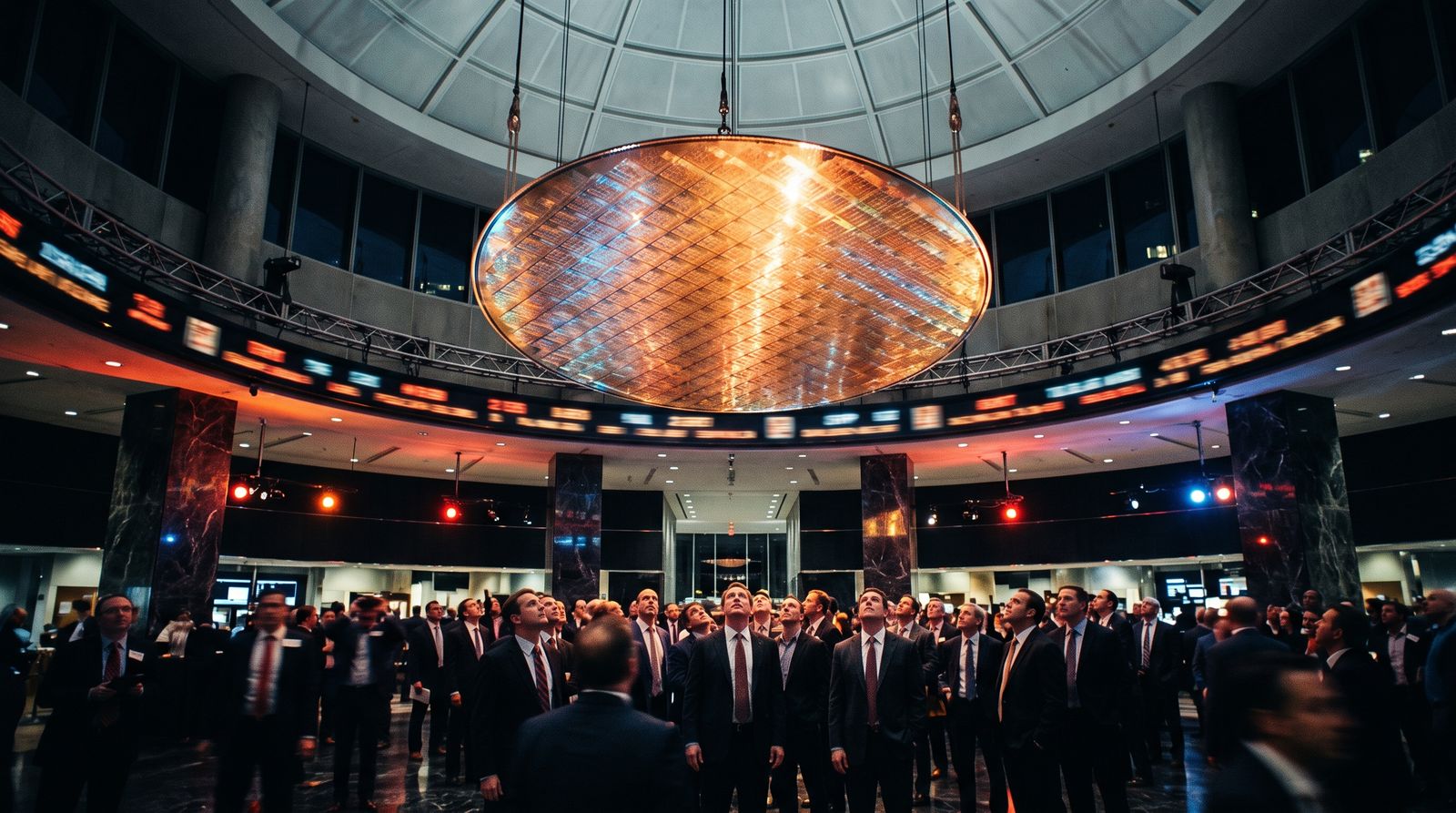
SK Hynix — the world's second-largest memory chipmaker and the dominant supplier of the high-bandwidth memory that feeds AI accelerators — is set to start trading American depositary shares on the Nasdaq as soon as Friday, July 10, under the ticker SKHY. The company is selling roughly 17.8 million new shares in an offering worth up to $29 billion. If it prices near the top, it becomes the largest ADR listing on record, comfortably past the $21.8 billion Alibaba raised in its 2014 New York debut.
The machinery moves this week: Bank of America, Citigroup, Goldman Sachs and JPMorgan are running the book, with bookbuilding opening Monday and final pricing expected late in the week, per Korean and US reports. Then the first trade Friday — while the rest of the market is still digesting a holiday-shortened week.
Why a Korean national champion is crossing the Pacific: money, and the multiple attached to it. US investors have spent 2026 paying scarcity premiums for AI exposure — a record $510 billion of venture funding went out in the first half, nearly half of it to two AI labs — while Seoul-listed SK Hynix has traded at a persistent home-market discount. The ADR is the arbitrage: same business, American price tag.
Tollbooth economics
High-bandwidth memory is the choke point of the AI buildout. Every frontier accelerator needs it stacked on-package, and SK Hynix controls roughly 60% of the market. The demand side keeps escalating: Nvidia is now financing its own customers' GPU fleets to keep orders flowing, and Meta just claimed it caught OpenAI's flagship by throwing 10x the compute at the problem. Every one of those chips ships with high-bandwidth memory attached — or doesn't ship.
Our take: The $29 billion isn't vanity — it's a capacity war chest in a market where whoever adds HBM lines fastest wins the next allocation cycle. The listing is SK Hynix's bet that Wall Street will price it as AI infrastructure rather than cyclical memory. Watch the print, because it cuts both ways: price at the top and pop, and the AI-hardware trade has fresh legs into earnings season. Struggle, and some of the most informed capital in the world just told you the memory cycle is closer to its peak than the headlines admit.
The warning label arrived the same day
Hours before the book opens, the Bank of Korea publicly warned that single-stock leveraged ETFs tracking Samsung Electronics and SK Hynix are amplifying volatility and deepening concentration in a market where those two names already account for more than half of total capitalization. The 2x daily products have swollen to roughly $9 billion in assets, overwhelmingly held by retail investors, and their mechanical end-of-day rebalancing makes them forced buyers into rallies and forced sellers into declines. Translation: the home crowd is already levered to this story. Friday just gives the global crowd a bigger door into the same trade.
What to watch
- The book. Oversubscription chatter — or silence — during this week's bookbuilding is the first honest read on US appetite for the AI-memory trade.
- The final price. Top of the range says the scarcity premium is intact. Anything soft says memory-cycle doubts are winning the argument, whatever the roadshow slides claim.
- Micron's tape. The only direct US-listed memory play loses its monopoly on the trade Friday. Money rotating out is a one-stock problem; the whole complex re-rating higher is the bull case.
- Seoul's counter-move. Korea's central bank spent the weekend warning about leveraged bets on this exact name. If the ADR starts draining liquidity from the home listing, that fight gets louder fast.