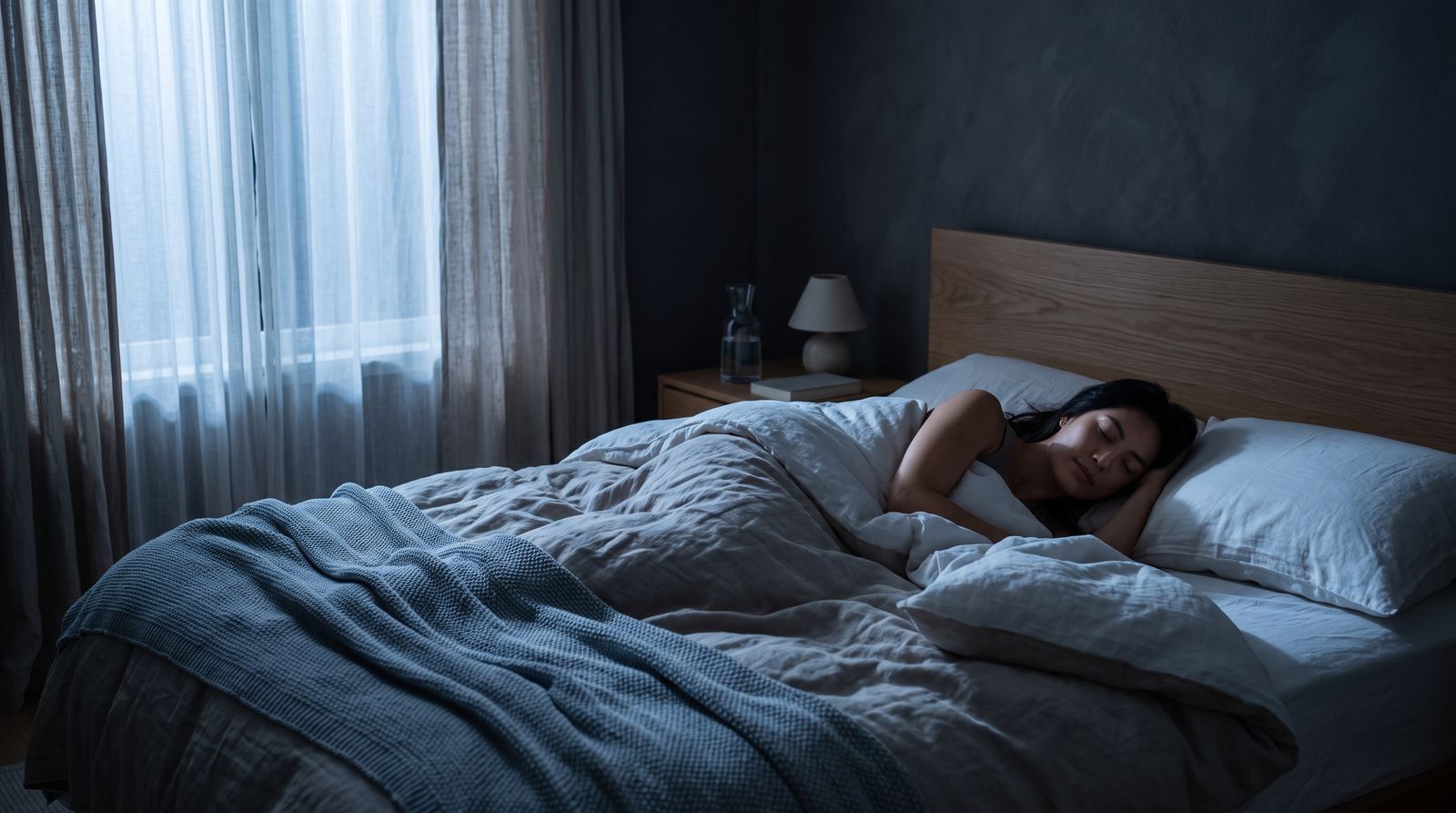
Every productivity system you'll ever build — the deep-work blocks, the weekly reviews, the AI stack — runs on the same hardware: your brain. And that hardware gets rebuilt nightly, or doesn't. Run a week at six hours and you're effectively operating a degraded machine while feeling normal, which is the truly dangerous part: impaired judgment includes impaired judgment about your own impairment.
The good news is that sleep responds to engineering more reliably than almost any other health input. You don't need supplements or gadgets. You need four levers pulled consistently. (Standard note: this is a performance framework, not medical advice — persistent sleep problems, loud snoring, or gasping awake deserve an actual clinician, because treatable disorders like apnea masquerade as "just bad sleep.")
Lever 1 — Light: the master clock's input signal
Your circadian rhythm is set by light hitting your eyes, full stop. Work the signal at both ends:
- Morning: bright light, fast. Within an hour of waking, get outside for 5–10 minutes (longer if overcast). Outdoor light is orders of magnitude brighter than indoor light, and morning photons are what anchor tonight's sleepiness to the right hour. Coffee on the porch beats coffee at the desk — the timing of your morning light literally schedules your evening melatonin.
- Evening: dim and warm. After sunset, drop household lights lower than feels natural — lamps, not overheads. The last hour before bed: screens dim or off, warm color temperature everywhere. You're not being precious; you're refusing to tell your brain it's noon at 10 PM.
Lever 2 — Temperature: the descent trigger
Falling asleep rides on a falling core temperature. Engineer the drop:
- Cool room, warm extremities: bedroom in the mid-60s °F range (experiment 63–68), body under enough blanket that hands and feet stay warm — warm skin radiates heat and drops your core faster. Cold room, warm bed is the formula.
- The hot shower paradox: a warm shower or bath 1–2 hours before bed dilates surface blood vessels; you dump heat afterward and the resulting core-temp dive drags you toward sleep. Counterintuitive, effective.
- Late intense exercise raises core temp for hours — if evening is your only slot, keep the buffer between finishing and bed as wide as you can, and let the shower trick help.
Lever 3 — Timing: same wake-up, every day
Of all sleep advice, this is the one with the worst effort-to-glamour ratio and the best results: fix your wake time within 30 minutes, seven days a week. A stable wake time anchors the entire cycle — your body starts sleep-preparing on schedule because it can finally predict the schedule. Weekend sleep-ins feel like repayment but function as self-inflicted jet lag: sleeping to 10 on Sunday makes Sunday-night sleep late and shallow, and Monday inherits the wreckage.
- Count backward from your fixed wake time to place your bedtime window: in-bed time = target sleep + ~30 minutes of overhead. Protect the window like a meeting.
- Napping: fine, before mid-afternoon, 20 minutes. The 90-minute 5 PM nap is a loan shark — it collects at midnight.
- Can't fall asleep after ~25 minutes? Get up, dim room, boring book, return when heavy. Lying awake practicing frustration trains the bed to mean frustration.
Lever 4 — Chemistry: caffeine and alcohol, honestly
- Caffeine has a half-life of roughly 5–6 hours — a quarter of your 2 PM coffee is still on duty at midnight-ish. It doesn't just delay sleep; it shallows it, so you "sleep 8 hours" and wake unrestored. The protocol: hard cutoff 8–10 hours before bed. For a 10:30 bedtime, that's lunchtime. Yes, really. Try it for ten days before appealing the verdict.
- Alcohol is sedation, not sleep. It knocks you out, then fragments the back half of the night and suppresses the RAM-consolidation stages. A nightcap is borrowing sleepiness from sleep itself. Performance framing: drink early, lightly, or not on nights before days that matter.
- Late heavy meals compete with the temperature drop. Finish big eating ~3 hours out; a light snack is fine.
The daily protocol, assembled
- Wake (same time daily): light within 60 minutes, outside if possible. Caffeine after, not before, the light.
- Midday: last caffeine by ~10 hours pre-bed. Exercise anywhere here — it's one of the best sleep aids known, just not adjacent to bedtime.
- Evening: dinner ~3 hours out; lights low after sunset; warm shower in the 1–2 hour window if you like the trick.
- Last hour: screens down/dim, tomorrow's worries written onto paper (the brain releases what's been captured — same principle as the deep-work capture pad), room cold, dark, quiet.
- In bed: the bed is for sleep — not email, not feeds, not planning. Context is a trigger here exactly as it is at your desk.
Troubleshooting table
- Fall asleep fine, wake at 3 AM: suspect alcohol, late heavy food, or a too-warm room first — that trio owns most middle-of-night wakings.
- Can't fall asleep: suspect caffeine timing, late bright light, or an unanchored wake time. Fix the morning to fix the night.
- Eight hours but never rested: audit the last-hour screen habit and alcohol; if both are clean and it persists, that's the see-a-clinician flag.
- Shift work / travel: hold the light rules relative to your target schedule — light is the lever that moves the clock fastest in either direction.
The performance frame: track your deep-work hours against your sleep for two weeks and the correlation will end the debate better than any article. Sleep isn't the tax you pay after productive hours. It's where those hours are manufactured. Guard it like the production line it is.
The traveler's appendix: beating jet lag with the levers
Jet lag is just the four levers desynchronized, which means the four levers fix it. Rules of thumb: your body clock shifts about an hour per day on its own — light discipline doubles that. Eastbound (the hard direction): start two days early — light and caffeine immediately on (new-zone) morning schedule, dim evenings, bedtime pulled 45–60 minutes earlier each night. On arrival: morning outdoor light at destination no matter how wrecked you feel, no naps past 20 minutes, and hold the wake anchor from day one. Westbound: easier — seek evening light, delay bedtime, and you'll adapt nearly on schedule. Under 3 time zones or under 72 hours of travel: don't adapt at all; keep home schedule and book meetings in your biological daytime. The worst outcome is half-shifting for a short trip and being mediocre in two time zones at once.
The 10-day reset (for when it's all broken)
Months of bad sleep don't need a perfect protocol; they need sequenced repair. Days 1–3: anchor only. One fixed wake time, seven days a week, morning light within the hour. Change nothing else — evenings stay ugly if they must. Days 4–6: cut the chemistry. Caffeine cutoff at the 8–10 hour line, alcohol off (or early and light). Expect one grumpy afternoon around day five; it passes. Days 7–10: rebuild the descent. Cool room, dim last hour, the worry-dump onto paper, bed only for sleep. By day ten most people are falling asleep faster and waking before the alarm — not because of any single trick, but because the levers finally point the same direction. Then, and only then, is it worth tracking anything: run your deep-work tally against the new baseline and watch the correlation write this article's conclusion for you.