SpaceX agreed on Thursday to acquire all of Grain Management’s nationwide 800 MHz spectrum portfolio, up to 14 MHz of paired spectrum. Neither side disclosed a price; the Wall Street Journal put it at roughly $8bn. Grain had bought the licences from T-Mobile in August, paying cash plus its own 600 MHz holdings. The transfer needs FCC approval.
The market answered before the ink dried. AT&T, Verizon and T-Mobile each fell around 6% — T-Mobile down 6.3% — and European telecom shares came under pressure on Friday. American Tower, Crown Castle and SBA Communications moved the other way.
Note what SpaceX did not buy. Low-band spectrum is a coverage layer: it travels far and penetrates buildings, which is why SpaceX describes the licences as serving indoor connectivity and areas with thin terrestrial coverage, and why Elon Musk framed the deal as enabling “complete phone coverage in America.” What low-band does not do is carry dense urban data traffic. That takes cell sites, and a lot of them. Bernstein has put the cost of a competitive nationwide US network at $50bn to $130bn; BNP Paribas estimated roughly $100bn across 50,000 to 70,000 sites.
The repricing is a bet that SpaceX never has to build it
Pair nationwide low-band with a satellite constellation — the FCC cleared SpaceX’s 15,000-satellite direct-to-device plan on October 7 and waived leasing requirements on certain spectrum acquired from EchoStar — and the company does not need its own national grid to be dangerous. It can lease tower space or buy wholesale capacity and compete on price exactly where incumbents charge the most for the least: rural coverage and the “works everywhere” promise that carrier marketing has rested on for two decades.
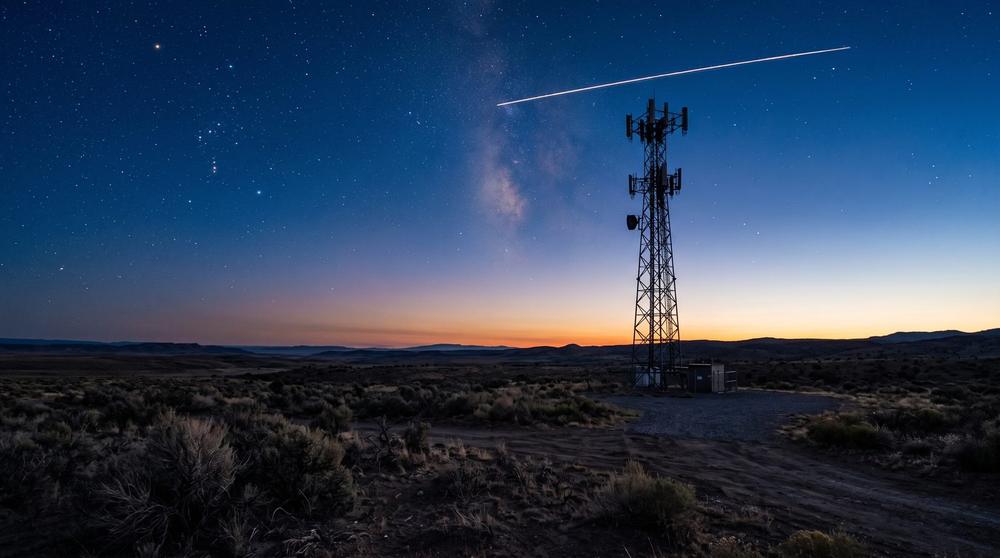
That is the trade the tower names are expressing. Every credible path SpaceX takes into terrestrial coverage runs through somebody’s steel.
Our take: An unlisted company took roughly 6% off three of the largest listed telecoms in a day without launching a product, publishing a price or signing a customer. Nothing in AT&T’s or Verizon’s cash flows changed on Thursday. What changed is the terminal-value story: a coverage moat built over thirty years is now being modelled as rentable. That still has to clear the FCC, and low-band without sites is a thinner weapon than the headline implies. But the asymmetry is the point — SpaceX only has to stay credible to compress carrier pricing. It does not have to win.
What to watch
- The FCC review. Timeline and conditions, and whether incumbents formally oppose. A conditioned approval is the cheapest outcome for the carriers.
- Tower contracts. If SpaceX signs leases with American Tower, Crown Castle or SBA, Thursday’s divergence becomes a durable earnings story rather than a one-day reflex.
- Carrier Q3 calls. Watch the language on rural pricing and capex. Management teams now have to answer a question nobody asked them last quarter.
- Actual service terms. Coverage claims are free. A published price, a device list and a capacity commitment are not, and none exist yet.