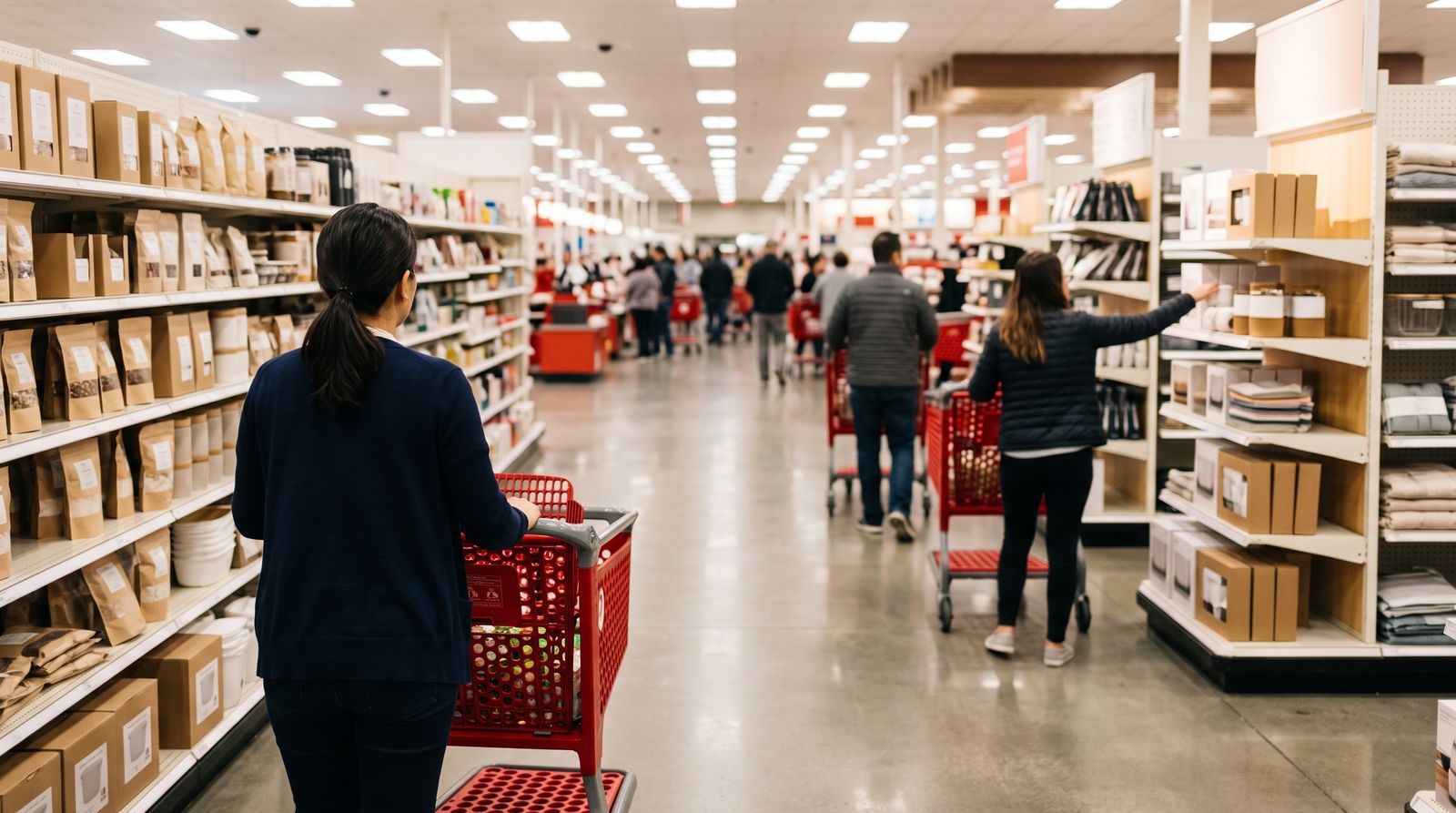
Target reported second-quarter net income of $1.88 billion, or $4.11 a share, against $935 million and $2.05 a year ago. Profit doubled. Net sales rose 5.3% to $26.5 billion, comparable sales rose 3.8%, and the company lifted its full-year outlook on both the top and bottom line. Shares dipped in premarket trading, then turned and touched a 52-week high during the session.
Then read the second paragraph of the release. A $994 million pretax benefit from tariff refunds under the International Emergency Economic Powers Act contributed $1.65 per share — roughly 40% of reported EPS, and about $752 million after tax. Strip it out and adjusted EPS was $2.46, against a $2.33 consensus. A beat, but a nine-cent one, not a doubling.
The same distortion runs through the margin line. Second-quarter gross margin printed 33.7%, of which 3.7 percentage points came from the refunds. Ex-refund, gross margin was roughly 30.0% against 29.0% last year — about 100 basis points of real expansion. Operating margin printed 9.6% versus 5.2%, again carrying 3.7 points of refund.
Our take: The refund is the headline and the wrong number. The number that matters is 3.6% — the increase in traffic. Comparable sales rose 3.8% and average ticket was roughly flat, which means Target did not buy this quarter with price. More people walked in and clicked through, and they spent about what they spent last year. That is the hardest kind of comp to fake and the only kind that compounds. A retailer that grows on ticket is passing through cost. A retailer that grows on traffic has won an argument with the customer. Michael Fiddelke, four months into the job, now has one clean quarter of evidence that the merchandising reset is landing. He also has a one-time government cheque sitting on top of it, obscuring exactly the thing investors most want to see. That is why the stock traded both ways before it settled.
The channel split says where the traffic came from. Store comps rose 2.7%; digital comps rose 8.7%, driven by more than 25% growth in same-day delivery. Same-day is the piece Target has spent three years and a great deal of capital building, and it is the piece Amazon cannot trivially copy in fresh and general merchandise at the same time. It is now the fastest-growing part of the business.
Guidance is where the refund gets separated cleanly. Target now expects full-year EPS of $9.90 to $10.90 including the tariff benefit. Excluding it, the range is $8.25 to $9.25, against a prior $7.50 to $8.50. So the underlying raise is 75 cents — real, but a quarter the size of the headline move. Full-year sales growth guidance went to about 5%, a full point higher than before.
Target is not alone in this. The IEEPA refunds have flattered a long list of Q2 retail prints this month; Home Depot booked $730 million of them and reaffirmed rather than raised. The refunds are a one-quarter event tied to a legal reversal, not a change in the cost structure. Every company banking them in fiscal 2026 faces the same arithmetic in fiscal 2027: the comparison includes the cheque, and next year's does not.
What to watch
- Traffic in Q3. One quarter of 3.6% is a data point. Two is a trend, and it is the only metric that validates the turnaround independent of the refund.
- Ticket. Flat ticket alongside rising traffic is healthy. Ticket turning negative would mean the traffic is being bought with markdowns.
- The ex-refund guide. $8.25 to $9.25 is the number that carries into next year. Management raised it by 75 cents; watch whether Q3 raises it again or quietly leans on the refund.
- Same-day delivery economics. 25%+ growth is impressive. Whether it is accretive to margin at that volume is the question nobody has answered on the record.