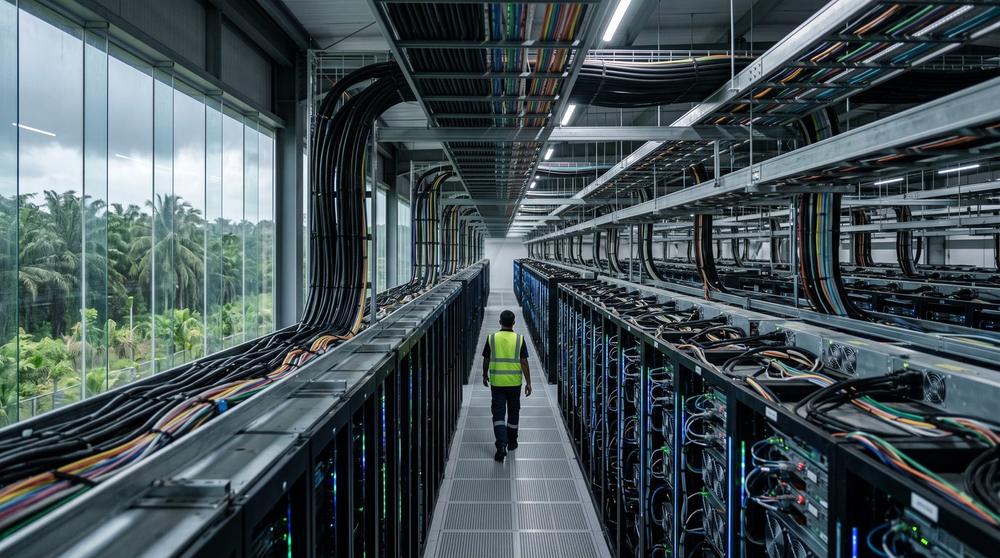
Tencent has agreed to pay Oracle roughly $7 billion over five years to rent about 100,000 advanced AI chips it cannot obtain inside mainland China, according to a Financial Times report citing people with knowledge of the arrangement. The chips sit in Oracle data centres across Southeast Asia. Tencent is paying around 30% up front — on the order of $2.1 billion before a single model finishes training.
Tencent has called it its largest overseas lease agreement to date. Oracle shares rose about 1.9% in pre-market trading on the news, to roughly $139.85. Neither company has commented publicly.
The strategic logic is blunt. U.S. export controls restrict which accelerators can be sold into China; they do not restrict a Chinese company from renting compute capacity located somewhere else. Tencent reportedly ran the same play last December, reaching Nvidia Blackwell silicon through a Japanese data centre via a third-party cloud structure. What is new is scale: this is a nine-figure annual commitment with a two-billion-dollar deposit, structured as a lease rather than a purchase, and it is the kind of deal that gets a name in a 10-Q rather than a footnote.
Our take: The export-control regime was designed around ownership, and the market has reorganised around access. If the binding constraint is where a chip physically sits rather than who computes on it, then every hyperscaler with capacity outside the United States is holding an arbitrage asset, and Oracle just priced it at $7 billion. That is the real reason this matters more to Oracle's story than to Tencent's: Oracle has spent a year selling a backlog built on AI leases whose counterparty quality investors keep questioning. A 30% prepayment from one of the most cash-generative companies in Asia is the best answer it has given yet. The policy question is separate and will not stay quiet — if leasing offshore compute is the workaround, the rule only ever restricted hardware logistics, not capability.
The spending that made this necessary
Tencent did not get here gently. Second-quarter capital expenditure rose 176% year on year to RMB 53 billion, about $7.9 billion, driven by AI infrastructure and prepayments for computing capacity. A company spending at that rate domestically and still leasing 100,000 chips abroad is telling you what it thinks of the compute it can buy at home: adequate for inference, insufficient for the frontier.
The stated use is model training and agentic tooling. That is the part worth tracking, because agents are where compute demand stops being a one-off training bill and becomes a per-query operating cost that scales with users. Tencent has over a billion of them.
What to watch
- Whether Washington responds. The obvious counter is extending controls to cover remote access to restricted chips by restricted entities, regardless of hardware location. That rule has been discussed for two years and never written. A $7 billion headline is the sort of thing that moves a draft to a desk.
- Whether Oracle names it. If this lands in remaining performance obligations without a disclosed counterparty, the backlog-quality debate gets louder, not quieter.
- Which Southeast Asian jurisdictions. Host-country governments now carry diplomatic exposure they did not choose. Singapore and Malaysia have both tightened chip re-export scrutiny.
- Whether Alibaba and ByteDance follow. Deals like this are never solitary for long, and lease pricing moves fast when three buyers appear.
The pattern is now unmistakable across the whole stack: capability is flowing to whoever will write the biggest cheque for access, not to whoever sits inside the most favourable rule. We have watched it in Chinese models taking U.S. token share on price, in pre-IPO raises that dwarf the IPO, and in Oracle's own contract fights over data centre delivery. Compute is a commodity with a border problem, and borders are the easiest thing in this market to route around.