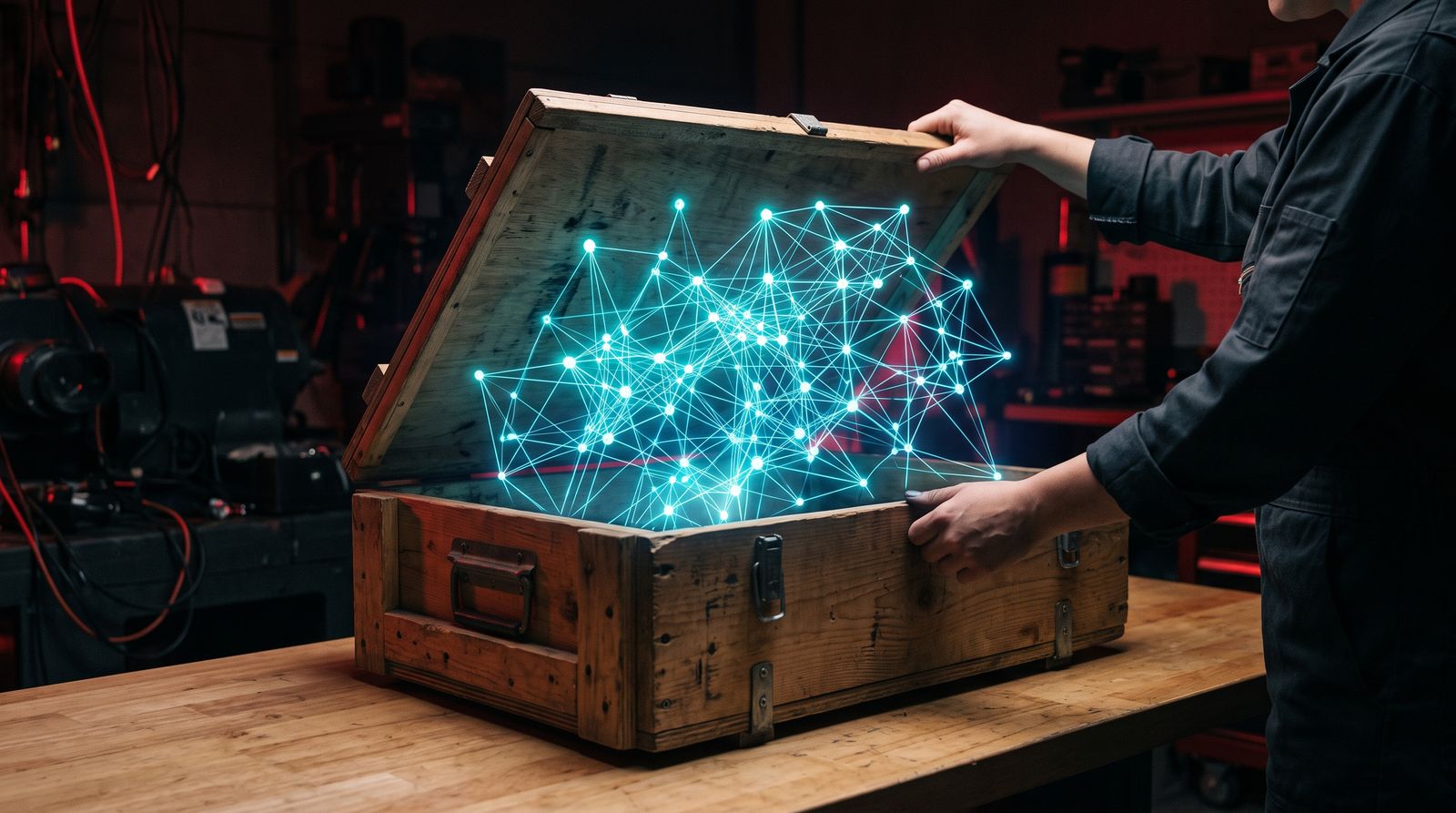
Thinking Machines Lab — the startup Mira Murati founded after leaving OpenAI’s CTO seat, backed by a $2 billion seed round — released its first model Wednesday. Inkling is a mixture-of-experts system with 975 billion total parameters that activates only about 41 billion per task, trained on 45 trillion tokens spanning text, images, audio, and video. It reasons natively across all of them, carries a 1-million-token context window, and ships with a dial that trades thinking effort against token cost.
The unusual part is what you’re allowed to do with it. The full weights sit on Hugging Face under an Apache 2.0 license — download it, modify it, build a business on it, no permission required. And the launch material says out loud what no frontier lab ever leads with: Inkling is “not the strongest overall model available today, open or closed.”
Timing did Murati a favor. Inkling landed the same week Bloomberg confirmed Google’s Gemini 3.5 Pro slipped by months and days before Moonshot’s Kimi K3 seized the top of the coding leaderboards. The closed frontier stumbled; the open-weights camp shipped.
The model is the funnel
Thinking Machines doesn’t sell Inkling. The revenue engine is Tinker, the fine-tuning platform it launched in October 2025 — Inkling went live on it the same day the weights hit Hugging Face. The model is the free razor; customization is the blades. The bet underneath: enterprises ultimately care less about renting the smartest general-purpose model than about owning one shaped to their data, their compliance rules, their costs.
Read the spec sheet through that lens and it stops looking like a leaderboard entry. A million tokens of context, native multimodal reasoning, adjustable thinking effort, permissive license — that’s a checklist for a company trying to make bespoke AI cheap to build, not benchmarks cheap to win. It’s the same repricing logic behind Microsoft’s Project Perception, arrived at from the opposite direction: Microsoft routes to cheaper models so capability becomes an ingredient; Murati gives the ingredient away and charges for the kitchen.
Our take: “Not the best model” is segmentation, not humility. It filters out the benchmark tourists and selects exactly the buyer Thinking Machines wants: one who cares about control, cost, and ownership. Closed labs have to keep charging a premium for intelligence because that’s the only thing they sell. Murati is arbitraging their business model — if “good enough and yours” beats “best and rented” for most enterprise work, the frontier premium compresses, and the labs that spent billions winning benchmarks are holding the expensive end of a commoditizing market.
What to watch
- Adoption, not applause. Hugging Face download counts are vanity; named enterprise deployments built on Inkling via Tinker are the real signal.
- The closed-lab counter. Whether OpenAI, Anthropic, or Google respond with cheaper fine-tuning and customization tiers — that would concede the premise.
- The open-weights split. Kimi K3 chases benchmark crowns; Inkling chases ownership. Which one pulls enterprise budgets tells you what the market actually values.