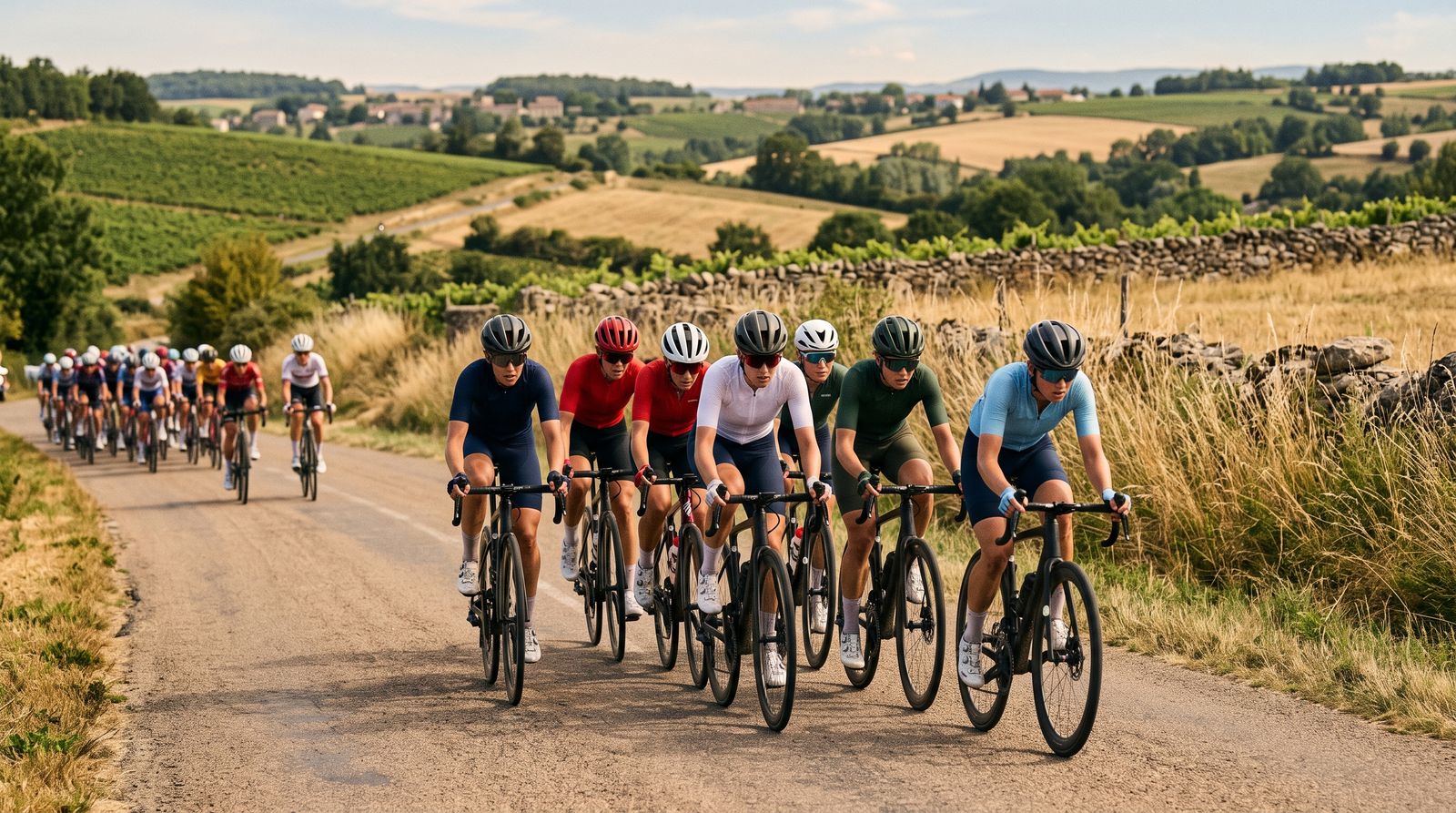
Stage 6 of the Tour de France Femmes ran 153.4 kilometres from Montbrison to Tournon-sur-Rhône, across the Massif Central, with roughly 2,600 metres of climbing stacked into it and a late sting over the Côte de Boucieu-le-Roi. Kim Le Court-Pienaar won it out of an eight-rider group that formed with about ten kilometres to go, beating Cédrine Kerbaol and Puck Pieterse to the line. It is her second Tour stage win in two years.
That was the day’s only clean result. Everything behind it was a chase that produced nothing.
Reusser started the stage in yellow, 12 seconds up on Vollering and 1:17 on Niewiadoma-Phinney. She finished it in yellow, 12 seconds up on Vollering and 1:17 on Niewiadoma-Phinney. Antonia Niedermaier sits fourth at 2:40. Two consecutive days of the hardest racing this Tour has produced — Wednesday’s double climb into Belleville-en-Beaujolais and Thursday’s trip through the Massif Central — have moved the top three by zero seconds.
Our take: Effort and progress are not the same variable, and this race is now a live demonstration of it. Vollering has spent two days riding at the limit against a rival who only has to match her, and the scoreboard has recorded none of it. That is what happens when you attack into a defence that is good enough: you pay the full cost, the other side pays a fraction, and the gap holds. The uncomfortable read for anyone grinding on a plan that isn’t moving the number — the terrain is the variable, not the intensity. Vollering doesn’t need to go harder. She needs a road where matching her is impossible. Friday, she gets one.
The break won because the favourites cancelled each other out
Le Court-Pienaar and Riejanne Markus went clear of the general classification group early enough to build the eight-rider move that decided the stage. They stayed clear because the riders behind them were not racing the stage — they were racing each other, and a group of contenders marking one another moves slower than a group of contenders cooperating. It is the oldest arithmetic in the sport and it delivered again.
Elisa Longo Borghini was the one GC rider who turned the confusion into time, taking around 26 seconds out of the Reusser group on her way to seventh on the stage. That is a real gain on a day the podium fight produced none. It is also a reminder of where the movement in this race is actually happening: not between first and second, where the gap has been frozen for 48 hours, but at fourth, fifth and sixth, where riders are still separated by margins a single climb can erase.
Everything is being deferred to one mountain
Stage 7 runs 144 kilometres from La Voulte-sur-Rhône to a summit finish on Mont Ventoux at 1,910 metres, with three categorised climbs before the main event and then 15.7 kilometres averaging 8.8 percent. There is no wheel to sit on for an hour and a quarter at that gradient. Whatever the two days of stalemate concealed, Ventoux publishes it.
Then it is 171.9 kilometres from Sisteron to Nice on Saturday — officially flat, arriving the day after a summit finish, which is a different thing entirely — and a 99-kilometre closing circuit in Nice with four ascents of the Col d’Èze before the Promenade des Anglais.
What to watch
- Twelve seconds into 15.7 kilometres at 8.8 percent. The margin that survived two hilly stages is smaller than the time gaps Ventoux routinely produces in its first five kilometres.
- Whether Reusser can defend on a sustained climb. She has matched Vollering on punchy terrain twice. A 75-minute ascent is not punchy terrain.
- Niewiadoma-Phinney at 1:17. Third, and still the rider who has spent the least energy getting there.
- The Saturday trap. A flat 171.9 km stage the day after Ventoux is where tired legs lose a Tour they survived on the mountain.
Peaking on a date you already know is a solvable problem, and this whole race has been pointing at one date since the route was announced. The protocol version is The Peak Day Playbook.