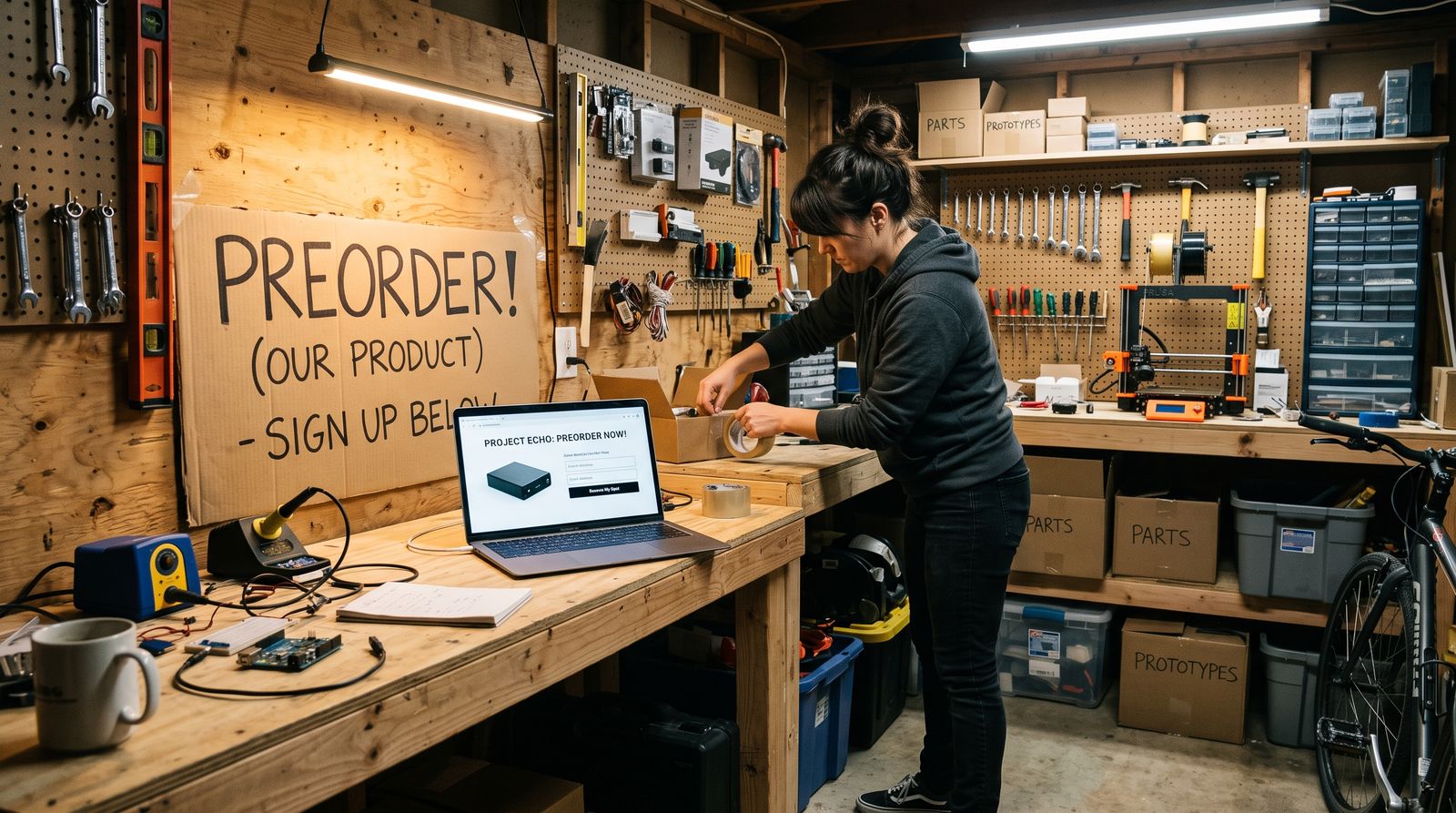
The standard side-business failure isn't dramatic. It's six months of nights and weekends building something, a launch post that gets eleven likes, three sales (two from family), and a quiet abandonment. The autopsy always finds the same cause of death: validation never happened. Enthusiasm was mistaken for evidence.
The fix is brutally simple to say and emotionally hard to do: sell it before you build it. Not "gauge interest." Not "build an audience first." Put a real offer in front of real strangers and count what they do — not what they say. Here's the 48-hour version.
The rule that governs everything
Words are free, so words are worthless. "I'd totally buy that" costs the speaker nothing and is social kindness, not market data. The validation ladder, in ascending order of truth: compliments < survey answers < email signups < booked calls < money. Every step of this weekend is designed to move you up that ladder as fast as possible.
Friday night (2 hours): forge the offer
You're not validating an idea — ideas are untestable clouds. You're validating an offer: a specific promise, to a specific person, at a specific price. Fill in one sentence:
"A meal-planning app" is an idea. "I build busy parents a personalized two-week dinner plan around their kids' allergies, delivered Sunday night, $49" is an offer. Then answer three questions in writing:
- Who exactly is person zero? Narrow until you could name real communities where they gather. "Everyone who eats" is nobody.
- What's the painkiller framing? People pay to end pain now; vitamins wait forever. Rewrite the promise until it ends something painful.
- What's the manual version? Your first ten sales should be deliverable by hand — you plus an AI stack can fake almost any "product" as a service. If there is no manual version, this weekend's test is a landing-page preorder instead. Either way: nothing gets built.
Saturday morning (3 hours): build the smallest sellable surface
- One page. Any landing-page builder, one hour, done. Headline = the offer sentence. Three bullets on what they get. One price. One button.
- The button is the experiment. Strongest: real checkout ("founding customer" slot, fully refundable). Strong: $10 deposit reserving a spot. Weakest acceptable: "Book a 15-minute call." Choose the highest rung you can stomach — the data quality is exactly proportional to the awkwardness.
- Set the gates before you launch. Written down, so future-you can't renegotiate: e.g., 100+ visitors, 15%+ engaged (clicked toward payment/booking), 3+ deposits or booked calls, 1+ actual payment. Numbers chosen in advance are the whole difference between an experiment and a mood.
Saturday afternoon → Sunday (the hard part): traffic
Nobody's coming on their own. Your job for the next 24 hours is putting the offer in front of 100+ of the right strangers:
- Communities where person zero lives (forums, subreddits, Discords, Facebook groups): don't spam the link. Post the problem, engage honestly, share the offer where the rules allow or in DMs with people who self-identify. Value first, always — both because it's right and because it works.
- Your own network, filtered: message the 10–20 people who actually match person zero. Script: "I'm testing something — not asking you to buy, asking who you know who struggles with [pain]. Forward this if anyone comes to mind?" The forward-ask outperforms the buy-ask and surfaces true believers anyway.
- One paid probe (optional, ~$50): a tightly-targeted ad to the page buys you cleaner stranger-data if your communities are thin. Fifty dollars to save six months is the best trade in business.
Log everything: visitors, clicks, conversations, objections, and the exact words people use to describe their problem — that language is gold for round two.
Sunday night: the five gates
- Reach: did 100+ target-market humans actually see it? If not, you learned nothing about demand — only about your distribution. Fix reach and rerun; don't judge the offer yet.
- Resonance: did anyone lean in — clicks, replies, questions? Silence = the pain isn't felt or the framing missed.
- Commitment: deposits, bookings, payments. The only gate that predicts revenue.
- Repeatability: can you name where the next 100 prospects come from? One lucky viral post is not a channel.
- Appetite (yours): after actually selling and talking to buyers for 48 hours — do you want ten more weekends of this? A business you'll hate is a failed test with extra steps.
The decision rule: pass all five → deliver to your first customers by hand, charge more than feels comfortable, and only then think about building. Fail gates 2–3 with good reach → one relaunch with rewritten framing (use the objection language you collected), one more weekend, then verdict. Fail twice → kill it clean, keep the audience research, and run the next idea. Two weekends and $100 versus six months and your soul — that's the entire pitch for this method.
The graduation path
Validated? The sequence that follows: deliver manually to 5–10 customers (learn everything), raise the price until roughly 30% of qualified prospects say no (you're underpriced until then), write down your delivery process, then automate the bottleneck steps — not before. Building comes last, after the market has voted twice: once with money, once with retention. That order is the whole secret. Everyone knows it. Almost nobody can stand to follow it.
Three miniature case studies
- The service (resume rewriting for engineers): Friday offer — "I rewrite senior engineers' resumes for FAANG-tier applications, 5-day turnaround, $149." Saturday page with three before/after bullet samples; traffic from two engineering career communities plus fifteen DMs. Sunday tally: 214 visitors, 31 clicks to checkout, 4 paid. Gates 1–3 pass loudly; repeatability is the question mark — communities cap out, so month one's job is testing a second channel. Verdict: deliver, raise price to $199, test channel #2.
- The digital product (a landlord bookkeeping template): the manual-version rule saves this one — instead of building an app, the founder sells a $39 spreadsheet system plus a 20-minute setup call. 130 visitors from two landlord forums, 9 preorders. Passes. The "app" can wait a year; the spreadsheet IS the business, and every setup call is paid customer research.
- The local service (mobile car detailing): gates work offline too — the "page" is a flyer with a QR code and the commitment gate is a $20 booking deposit via payment link. 60 flyers, 11 scans, 3 deposits in one weekend. Pass. Note what the founder never did: buy equipment before the deposits existed.
The objection ladder (what people say vs. what it means)
Sunday's conversation log is a diagnostic instrument. "How much?" — resonance confirmed; price is the negotiation, framing is fine. "Does it work for [my situation]?" — pain confirmed, trust missing; add proof, a guarantee, or a narrower promise. "I could do this myself." — you're selling a vitamin; reframe around time or consequence until it's a painkiller. "Interesting! Following your journey!" — the politest form of no; count it as silence. Actual silence — wrong audience or wrong pain; fix reach before touching the offer. Sort every response into this ladder and round two's rewrite practically writes itself.