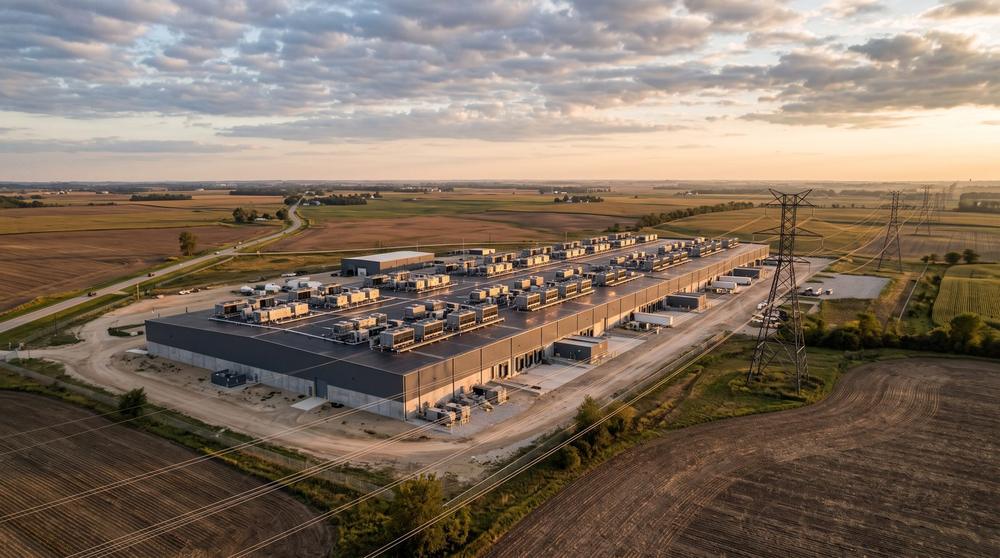
The constraint on AI is no longer chips. It is the interconnection queue — the multi-year wait to get a large new load plugged into the electricity grid. This week, Nvidia, Google and a startup called Emerald AI launched a coalition whose entire premise is that data centers should be allowed to jump that queue by promising to use less power when the grid is stressed.
The AI Energy Management Alliance went live Tuesday with those three as founding members. Anthropic, National Grid and 16 other organisations joined as launch partners.
The trade is straightforward. A data center commits, before it connects, to specific obligations: riding through brief grid disturbances instead of dropping offline, curtailing consumption when the system operator asks, and responding to emergencies. In return, it gets a faster connection route and a share of connection costs proportional to its actual impact on the grid rather than its nameplate peak.
Why the number is 100 gigawatts
The alliance's headline claim is that flexible operation could unlock up to 100 GW of capacity that already exists on the grid, and save roughly $733 million in system costs per gigawatt of new buildout avoided.
That figure is not about generating more power. It is about the gap between a grid sized for the worst hour of the year and a grid actually operating most hours. Interconnection queues are long partly because every new large load is assessed as if it will draw maximum power at the exact moment demand peaks. If a facility can credibly promise not to, the planning maths changes.
Data centers are unusually well suited to this. Training runs can be paused and resumed. Inference can be shifted between regions. On-site batteries, already installed for uptime, can discharge into the building instead of drawing from the grid. A workload scheduler turns a static 300 MW block into something a system operator can partly dispatch.
Our take: This is the AI industry negotiating with the only counterparty that can actually say no. Chips can be bought, capital can be raised, land can be zoned — but a utility's interconnection queue moves at the speed of regulatory process, and it has become the binding constraint on the entire buildout. The alliance is an attempt to buy queue position with operational flexibility. It is also, conveniently, the industry writing the first draft of the rules it will be judged by.
The unproven part
Flexibility that exists in a slide deck is not flexibility. The alliance's own principles concede the problem: it wants to standardise technical requirements, performance metrics and data sharing — which is another way of saying none of those currently exist in a form a regulator can enforce.
A curtailment commitment is only worth what it costs to break. Utilities have spent decades building demand-response programmes with penalty structures, measurement and verification, and audited baselines. AI data centers are asking for queue priority ahead of that machinery being built for them. Whether system operators accept a promise before the enforcement exists is the open question, and it will be answered jurisdiction by jurisdiction.
There is also a commercial tension nobody in the founding group has resolved out loud. A hyperscaler's revenue per megawatt-hour is high enough that curtailing during a peak event is expensive. The willingness to actually curtail, rather than pay a penalty and keep running, has not been tested at scale.
What to watch
- Whether any utility formalises a flexible-connection tariff. That is the moment the alliance stops being advocacy and starts being infrastructure.
- Published curtailment performance. The first real peak event where a member facility is asked to cut load, and what it does.
- Who else joins. Microsoft, Amazon and Meta are the conspicuous absences from a coalition founded by Google and Nvidia.
- Penalty structures. If flexible connections carry no meaningful downside for non-performance, regulators will treat the commitments as marketing.
The AI buildout has spent two years solving problems it could solve with money. The grid is the first one it cannot.