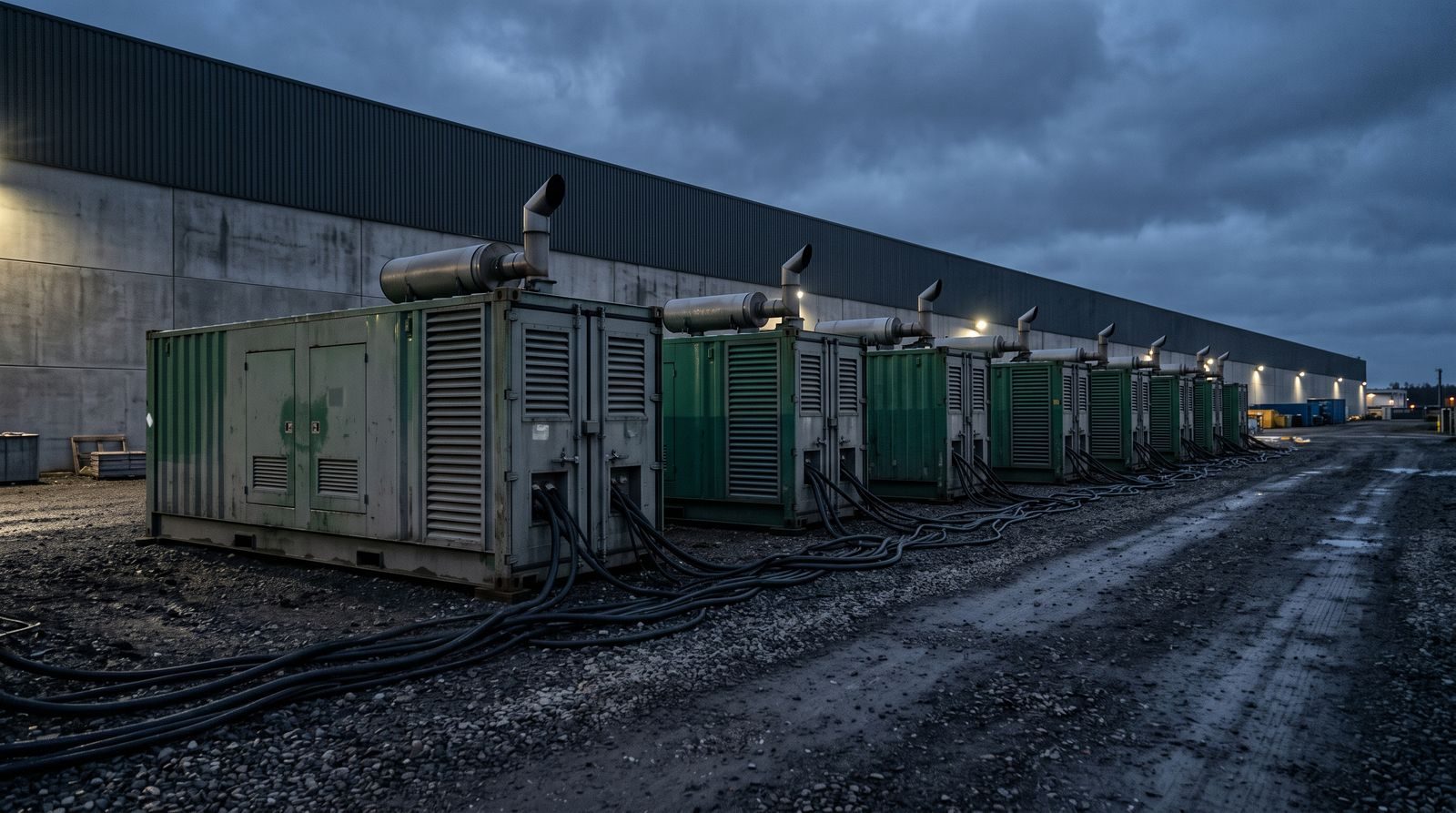
Aggreko filed an F-1 this week for a New York listing under the ticker AGKO. The Glasgow company rents modular power and temperature-control equipment — generators, chillers, load banks — to industrial, utility and commercial customers. It is a hundred-year-old kit-rental business, and it is going public as an AI infrastructure story.
The line that makes the case is a single percentage. Data centre work has gone from 2% of revenue to 19% in five years.
The rest of the filing shows what that did to the accounts. In the six months to July 4, Aggreko earned net income of $80 million on revenue of $1.92 billion. In the comparable period a year earlier it lost $189 million on revenue of $1.5 billion. Revenue up roughly 28%, and a $269 million swing on the bottom line.
Renting time, not selling power
Grid interconnection queues in the major US and European data centre markets run years. A hyperscaler that has land, capital and GPUs but no utility connection has a choice: wait, or bridge. Temporary gas generation on site is the bridge, and it is rented rather than bought because nobody wants to own a stranded asset once the substation energises.
That is a better business than selling equipment. The customer is paying for schedule, not for electricity, and schedule is the scarcest input in the entire AI buildout. It also means the demand is tied to the interconnection backlog rather than to power prices — a different exposure from anything in the traditional energy complex.
The offering is reported at roughly $1 billion, all primary, at a valuation around $15 billion. Aggreko carries about $7.0 billion of debt, and the filing earmarks proceeds mainly for repaying revolving and term loan borrowings.
Our take: Read the use of proceeds before the growth story. An all-primary raise going to debt repayment is a balance sheet transaction wearing a growth-narrative jacket — $1 billion against $7 billion of borrowings does not deleverage the company so much as buy it room. That does not make the data centre revenue less real; 2% to 19% is a genuine reallocation of a real business. But it sets what has to happen next. A company listing on the strength of a temporary-power bridge needs that bridge to stay busy for years, and the thing that keeps it busy is grid delay. Aggreko’s best case and the utilities’ worst case are the same scenario. Investors are underwriting a bottleneck.
What to watch
- Customer concentration in the final prospectus. Nineteen percent of revenue from data centres is only durable if it is spread across several operators. If it is two, the multiple should not look like an infrastructure multiple.
- Contract length. Temporary power is priced by the month for a reason. Multi-year take-or-pay commitments from hyperscalers would change the risk profile completely; spot rental would not.
- Interconnection reform. Anything that materially shortens grid connection queues shortens Aggreko’s runway. That is the structural risk, and it is regulatory, not commercial.
- Whether the H1 swing repeats. A move from a $189 million loss to $80 million of income in twelve months is a large step. The second half tells you whether it was operating leverage or a comparison flattered by one-offs.
- Pricing on the deal. Reported valuations before a roadshow are not terms. The gap between the $15 billion talked about now and the number printed at pricing is the market’s verdict on all of the above.