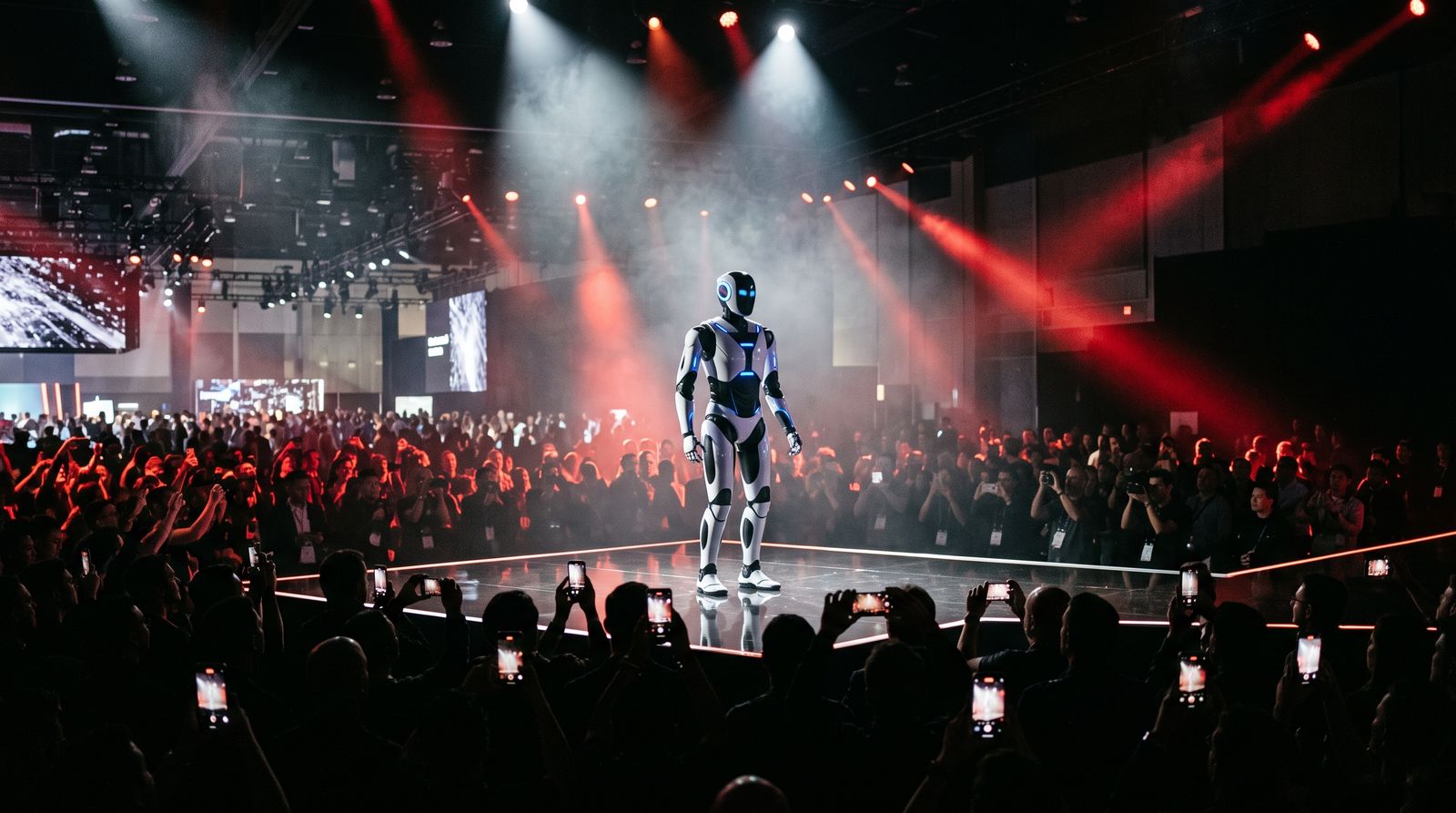
On Saturday at the World AI Conference in Shanghai, AGIBOT — one of China’s leading humanoid startups — launched four products in a single sitting: the A3 Ultra, its new full-size flagship humanoid; the X2 Edu, a 1.3-meter, 29-degree-of-freedom platform built for classrooms and robotics competitions; the G2 Max, its first heavy-payload, force-controlled robot for material handling and palletizing; and the OmniHand 3 Ultra-M, a new dexterous hand. One launch is a product. Four at once is a portfolio — factory, school, lab and showroom covered in one press conference.
The A3 Ultra is the tell. It runs on Nvidia’s Thor robotics chip, which AGIBOT pairs with a proprietary three-layer heterogeneous computing architecture rated at 700 TOPS — an arrangement that lets perception, motion planning and task sequencing run in parallel instead of queueing on one pipeline. The company also claims eight hours of runtime with hot-swappable batteries. Read that spec sheet again: eight hours is not a demo window. It’s a work shift. These are deployment numbers, pitched at buyers, not stage time pitched at cameras.
And the buyers AGIBOT wants are not just Chinese. Per Tech Times, an AGIBOT co-founder used the launch to declare the company’s intent to export its robots worldwide. The venue amplified the message: this year’s WAIC packed more than 1,100 exhibitors and 300-plus global product debuts into its largest-ever showcase, with Xi Jinping delivering his first WAIC keynote and 29 countries signing on to a new China-headquartered AI cooperation body — two days after day one put China’s answer to Nvidia on the show floor.
The two catches in the spec sheet
First: China’s export-ready humanoid has an American brain. After a year of export-control whiplash, that Nvidia dependency cuts both ways — Washington retains a kill switch on the A3 Ultra’s compute stack, and Nvidia books revenue on every unit either way. Second: AGIBOT, like every Chinese company, operates under China’s 2017 National Intelligence Law, which obliges firms to cooperate with state intelligence work on request. A humanoid robot is a walking bundle of cameras and microphones. Western buyers will run the same calculus on AGIBOT fleets that they ran on Huawei switches and TikTok feeds — except this time the hardware moves through the building on its own.
Our take: The AI race has a second front, and it’s embodied. While U.S. labs fight over coding leaderboards — a fight China is now crashing too — China’s robotics sector is building bodies for AI and openly pricing them for the world. The metric that matters isn’t the demo reel; it’s procurement. The first Western warehouse chain or school district that signs an AGIBOT fleet deal will tell you whether the security question beats the price question. Until then, watch the spec sheets: when a humanoid ships with shift-length batteries and a hand you can buy separately, the company has stopped building prototypes and started building SKUs.
What to watch
- Export pricing. AGIBOT hasn’t published international pricing or ship dates for the A3 Ultra — the number, when it lands, sets the bar Tesla’s Optimus and every U.S. rival has to beat.
- Washington’s move. Whether Chinese humanoids draw Huawei-style scrutiny — or Thor-class chips draw fresh export limits — decides how far the global push actually gets.
- WAIC’s final day. The conference closes Monday in Shanghai; expect a last wave of announcements to land while the U.S. frontier labs are stuck explaining delays.