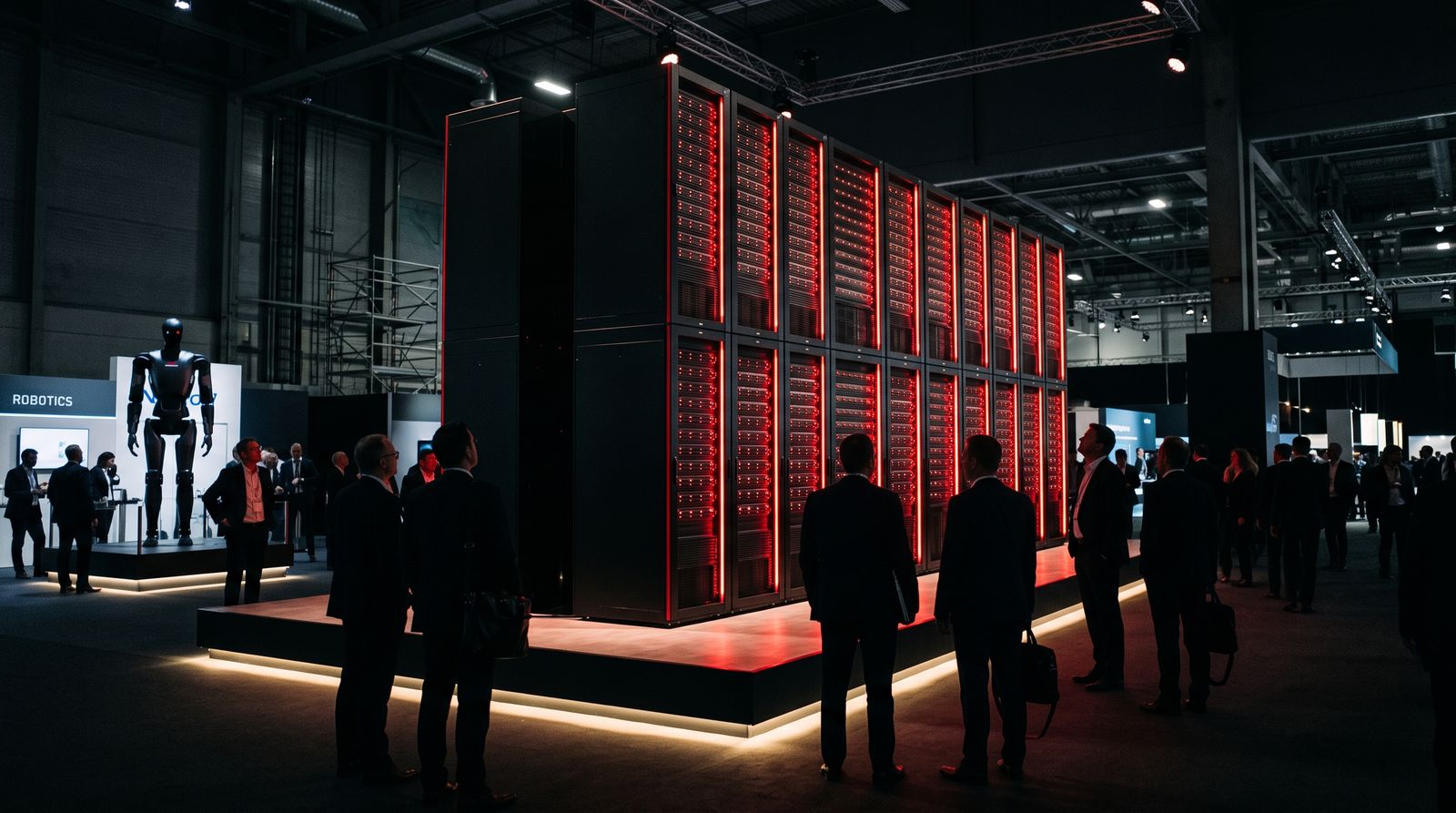
The 2026 World AI Conference opened in Shanghai on Friday with more than 1,100 exhibitors, over 3,000 exhibits, and 300-plus products making their global debuts, per state broadcaster CGTN. Xi Jinping’s first-ever WAIC keynote — and the 29-nation pact to stand up a World AI Cooperation Organization — carried the diplomatic headlines. But walk past the podium and the sharper message was parked on the show floor: rack after rack of Chinese-built AI compute that U.S. export controls were supposed to make impossible.
The centerpiece is Huawei’s Atlas 950 SuperPoD, on public display for the first time. The full system links as many as 8,192 of Huawei’s Ascend processors into a single node over the company’s proprietary interconnect, and Huawei claims it delivers 6.7 times the computing power of Nvidia’s NVL144 rack system. The floor unit — reportedly 1,024 Ascend chips across 16 cabinets — drew the kind of crowds usually reserved for the robots.
The robots delivered too. Unitree showed the GD01, billed as the world’s first mass-produced transformable robot: 2.7 meters tall, 500 kilograms, able to carry a person and switch between walking on two legs and four. MiniMax debuted its M3 multimodal foundation model, and exhibitors touted what CGTN called the world’s first agentic AI phone — all landing days after Moonshot’s Kimi K3 claimed the largest open-weight release in history. The whole floor is a coordinated answer to one question: can China’s AI stack run without American parts?
Vendor math is not a benchmark
Every number above is a company claim, not an independent result. The 6.7x figure is Huawei’s own comparison against Nvidia’s rack, exaflop ratings at low precision are marketing-friendly units, and Nvidia plays the same spec-sheet game in reverse. The test that matters isn’t on the show floor: it’s whether frontier Chinese models actually train on these clusters at competitive cost and reliability. Interconnect software, chip yield, and cooling failures never make it into the exhibit hall.
Our take: Export controls changed the incentives of China’s AI industry, not its trajectory. Washington’s bet was that cutting off top-end silicon would keep China years behind; day one of WAIC was Beijing’s staged counter-argument, with Xi in the building for maximum effect. Treat every spec as unverified — but note that flatly dismissing Chinese hardware claims has been the losing trade for two years running. For Nvidia, the squeeze is now two-sided: U.S. rules limit what it may sell into China, while Shanghai builds reasons for Chinese buyers to stop wanting it. That second half is the part investors keep underpricing.
What to watch
- Who trains on it. The first frontier-scale Chinese model that discloses Ascend-only training — with cost and timeline — turns a show-floor claim into evidence.
- Nvidia’s China line. Management language on domestic competition, and the China revenue number, at the next earnings call — a chip sector already in a bear market is in no mood for surprises.
- WAICO’s standards push. If the new 29-nation bloc starts writing interoperability standards around non-U.S. hardware stacks, the show floor becomes policy.