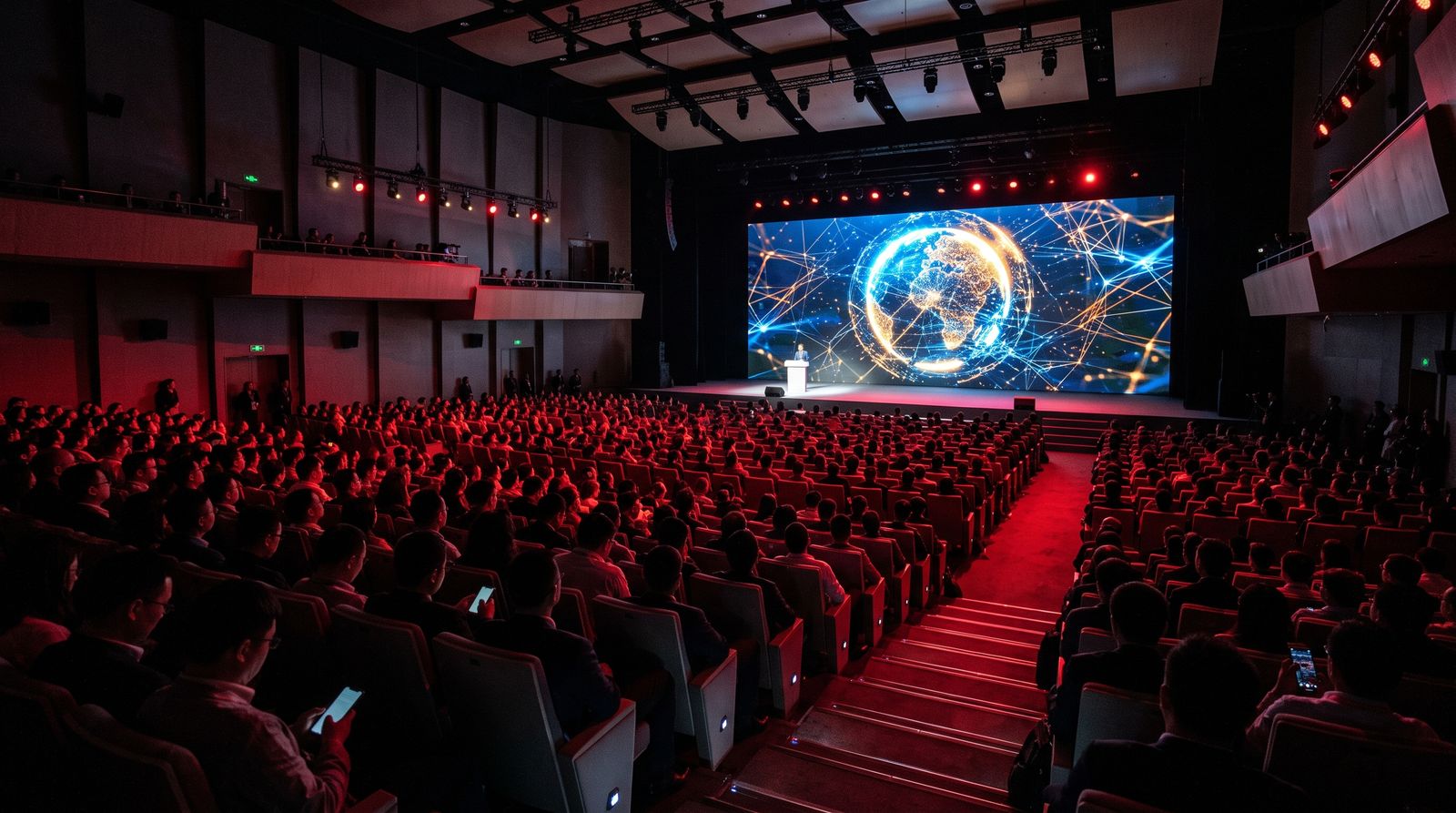
The 2026 World Artificial Intelligence Conference opened in Shanghai on Friday, and for the first time since the event launched in 2018, China’s president walked out and gave the keynote himself. Xi Jinping told the room that AI “should not be a solo performance by a single country, but a symphony of international cooperation” — a line aimed squarely at Washington’s export controls and closed frontier labs.
The conference runs July 17–20 under the theme “AI Partnership for a Brighter Future,” with more than 140 forums and roughly 1,400 invited guests. But the speech wasn’t the real news. The real news was signed the day before.
A rival rulebook, headquartered in Shanghai
On the eve of the conference, 29 countries signed the founding agreement for the World AI Cooperation Organization — a China-backed intergovernmental body that will set AI governance norms for its members and sit permanently in Shanghai, framed around the principles of the UN Charter. Founding signatories reportedly include Russia, Belarus, Cuba, Brazil, Venezuela, Serbia, Kazakhstan, Pakistan, Indonesia and Laos, plus a bloc of countries across Africa and Asia.
Notice who isn’t there: the United States, the United Kingdom, Germany, France, Japan, Australia. The world now has two competing AI governance stacks — the EU AI Act / OECD / G7 track the West has spent three years building, and a new one whose rules don’t have to be compatible with any of it.
The timing is not an accident
This lands the same week Moonshot shipped Kimi K3, the 2.8-trillion-parameter model that benchmarks third in the world and goes open-weight on July 27 — and months after DeepSeek started moving inference onto domestic silicon. The pitch to the Global South is now a full stack: near-frontier models you can download for free, chips that route around US export controls, and a standards body you get a vote in.
Our take: This is distribution strategy dressed as diplomacy. Standards bodies shape procurement defaults, and procurement decides whose models get embedded in the government, banking and telecom systems of 29-plus markets. US labs are selling top-end capability; China is selling an operating system — cheap open weights plus rules built around them. The metric that matters isn’t a benchmark score. It’s which stack a finance ministry in Jakarta installs, because that decision gets made once and renewed for a decade.
What to watch
- The member list. Brazil and Indonesia are G20 economies. If more swing states sign on, this stops being a symbolic bloc and starts being a market.
- The first published standards. Whatever WAICO ships first — safety evals, data rules, model registries — tells you whether it’s a real regulator or a flag.
- Washington’s answer. The US has export controls but no unified domestic AI law, let alone an international offer. That gap is now a stated Chinese talking point.
- July 27. Kimi K3’s open weights drop. First test of whether the “open stack” pitch converts.