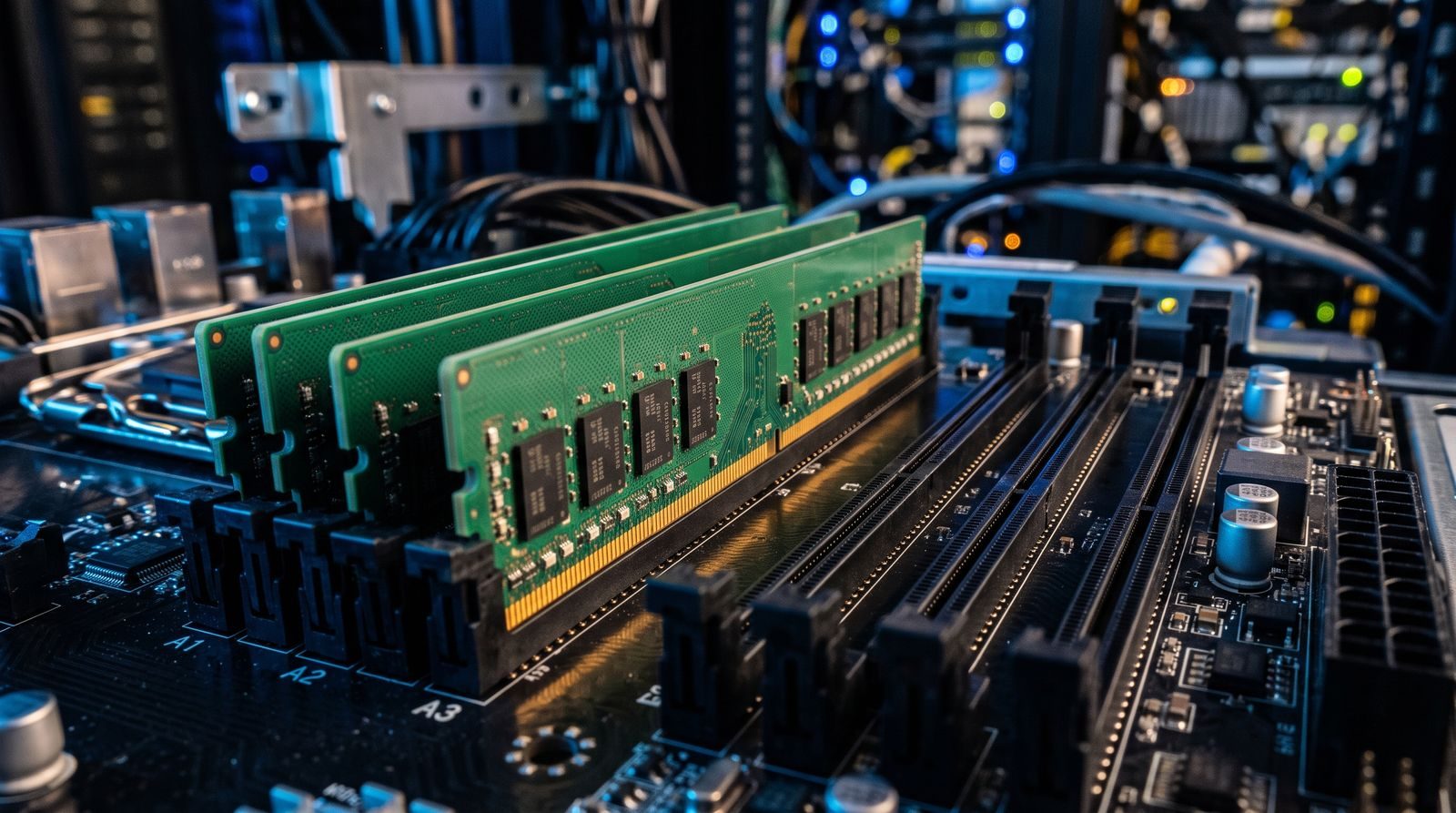
The AI buildout has a bill that nobody put in the capex slide, and it is arriving in the price of memory. DRAM contract prices are estimated to have risen more than 400% between the start of 2024 and the end of 2026, according to J.P. Morgan Global Research. A 64GB DDR5 desktop kit that was a routine purchase two years ago reached roughly $1,118 by August 2026, a 485% increase. A single DDR4 chip — a part that was supposed to be sliding into obsolescence — hit a record $42.45.
The mechanism is not mysterious. High-bandwidth memory, the stacked DRAM that sits next to an AI accelerator, consumed about 23% of global DRAM wafer capacity in 2026, up from 8% in 2024. HBM is wafer-hungry: the same silicon that would have produced consumer modules gets spent on stacks bound for a data centre. Data centres are forecast to absorb roughly 70% of all memory produced worldwide this year, against 20–30% as recently as 2022.
Three companies — Samsung, SK Hynix and Micron — control over 95% of global DRAM production. All three have reallocated capacity toward HBM. That is a rational decision made three times in a row, and it is why your phone, your laptop and your game console are all quietly getting more expensive.
The suppliers have stopped pretending it is temporary
Samsung is seeking up to a 20% average increase in DRAM selling prices in third-quarter contract negotiations, with LPDDR — the mobile part — potentially higher still, according to TrendForce. Broad contract prices are expected to rise 13–18% quarter over quarter in Q3, moderated only by weak consumer demand and a higher comparison base. Server DRAM contract prices had already climbed about 53% quarter over quarter in Q2.
The more telling move is structural. SK Hynix has reportedly scrapped price ceilings in its long-term supply agreements so it can capture spot pricing in full. Micron has kept both floors and ceilings, tied to committed volumes. Those are two different bets on how long this lasts — and one supplier removing its cap is a supplier that does not expect to regret it.
Our take: Everyone modelled the AI capex cycle as a story about GPUs. Memory is the part that leaks. A GPU shortage raises the price of GPUs; a memory shortage raises the price of everything with a memory slot, which is nearly everything. Nvidia’s own filing showed supply commitments swelling to $279 billion, much of it memory for the Vera Rubin generation — a hyperscaler pre-buying years of wafer allocation is not a demand signal, it is a queue. Consumer devices are behind the enterprise in that queue, and the price is how the queue gets enforced.
Where it shows up
The enterprise arithmetic is blunt. A server refresh that budgeted $800–1,200 for 256GB of DDR5 ECC RDIMM in early 2025 now faces $2,000–3,500 for the same specification. That is not a line item you optimise around; it is a re-plan. Companies that assumed hardware costs fall over time have discovered a component where the trend inverted.
The consumer side lags by a quarter or two because devices are built from memory bought earlier. IDC has flagged the shortage as a live risk to 2026 smartphone and PC pricing, and SK Hynix has warned the imbalance may persist past 2030 — a horizon long enough that “wait for prices to normalise” stops being a strategy.
What to watch
- Q4 contract negotiations. If Samsung lands another 20% on top of Q3, the moderating-demand thesis is dead.
- Whether anyone adds non-HBM capacity. New fabs take years; new wafer allocation to conventional DRAM takes a quarter. Nobody has done it, because HBM margins are better.
- PC and phone gross margins. The first OEM to blame memory in an earnings call makes it a sector story.
- Core goods inflation. Electronics have been a disinflationary force in CPI for two decades. If that flips, the Fed inherits a new problem it cannot fix with rates.
The AI trade was sold as software economics on hardware timelines. It turns out to be a commodity squeeze with a very long lead time.