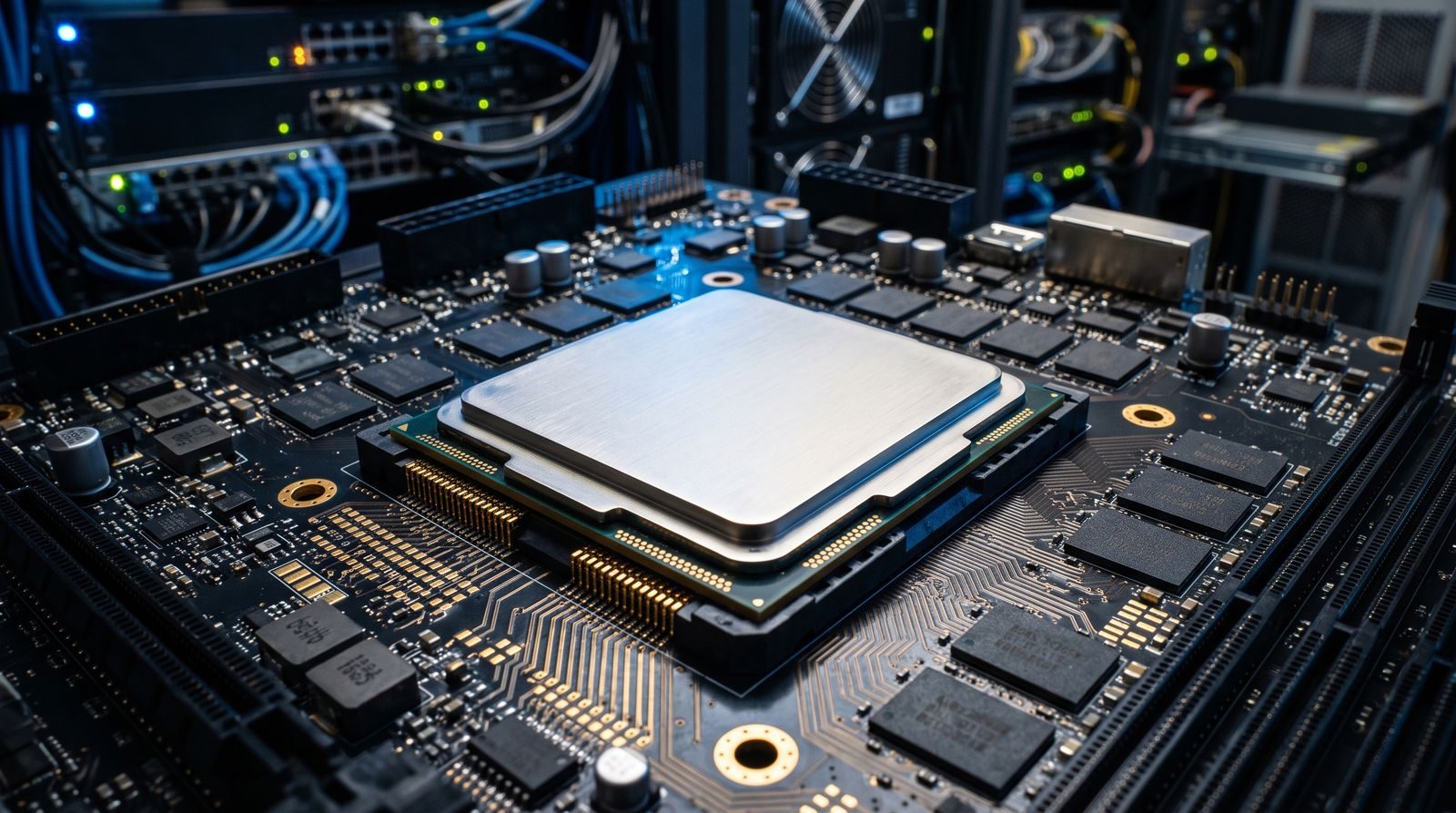
At this week’s Hot Chips conference, Nvidia gave the deepest look yet at Vera, the CPU half of its Vera Rubin platform — and the first Nvidia processor built on a fully custom core. Grace, its predecessor, used off-the-shelf Arm Neoverse designs. Vera’s new Olympus core is Nvidia’s own: Arm-compatible at the instruction level, but designed in-house from branch predictor to decode width.
The specs, as presented to the conference and detailed by Tom’s Hardware and ServeTheHome: 88 cores on a single monolithic compute die, ringed by chiplets split up by function — eight LPDDR5X memory controllers, one I/O die handling PCIe 6.4 and CXL 3.1, and another dedicated to NVLink chip-to-chip. The SOCAMM2 memory system scales to 1.5 TB per socket at 9600 MT/s, good for roughly 1.2 TB/s of bandwidth, backed by 164 MB of L3 cache and 2 MB of L2 per core.
The most unusual choice is what Nvidia calls spatial multithreading: Vera runs 176 threads not by juggling two threads through shared core hardware, the classic hyperthreading approach, but by partitioning each core’s resources into separate lanes. The pitch is predictability — the thing cloud providers complain about most when they sell fractions of a CPU to strangers.
Why show this now
The timing is not subtle. Nvidia reports earnings Wednesday afternoon — Street estimates sit near $92 billion in revenue — and the ramp of the Vera Rubin platform is the question every analyst will ask. With Nvidia at roughly 7.5% of the biggest S&P 500 fund, the report is the market event of the week, and a day-before deep dive on silicon that won’t hit racks for months is a way of saying: the roadmap is real, and it’s wider than GPUs.
ServeTheHome’s read is the one Intel and AMD should worry about: Vera takes aim at the broader AI server market — not just the socket inside Nvidia’s own racks, but the host-CPU market for AI infrastructure generally, a segment x86 has owned by default for two decades.
Our take: The GPU moat gets the headlines; the CPU is the quiet land grab. A custom core is Nvidia’s Apple-silicon moment — every Vera Rubin rack now ships all-Nvidia compute: CPU, GPU, interconnect, memory spec. The threat to Intel and AMD isn’t losing a benchmark bake-off. It’s never being in the RFP at all, because the CPU came bolted to the thing the customer actually wanted. Attach rates, not architecture, are how duopolies end.
What to watch
- Wednesday’s earnings call: Vera Rubin ramp commentary, and whether Vera gets named as its own revenue line.
- Independent SPEC CPU 2026 runs against current Xeon and Epyc parts once hardware reaches testers.
- Whether Nvidia sells Vera standalone to OEMs or keeps it rack-bundled — the answer decides how much share x86 actually loses.
- Memory supply: Vera’s LPDDR5X appetite lands in a market where memory costs already pushed Nvidia to raise server prices 15%.